

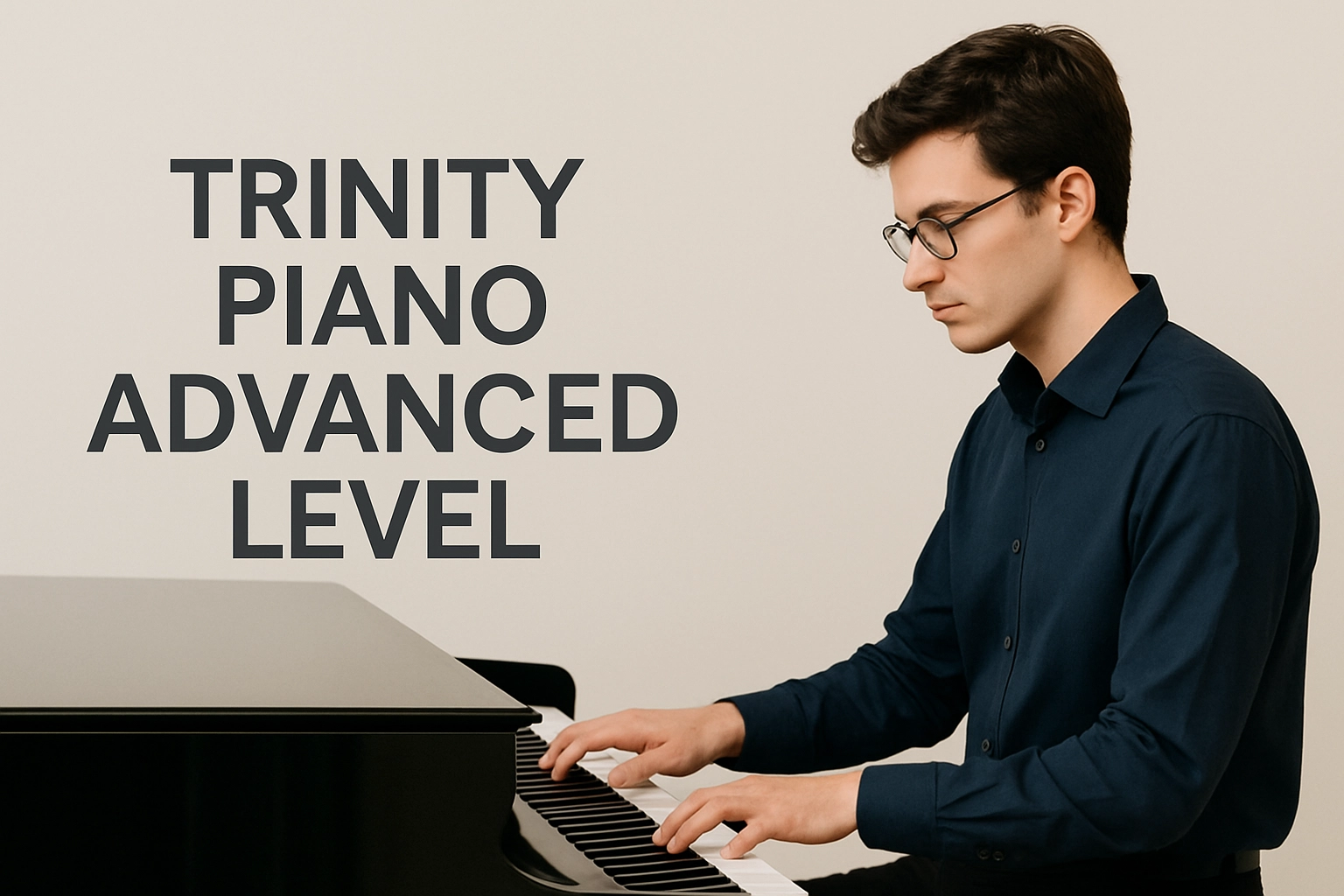
Trinity piano training at the advanced stage, Grades 6 and 7 marks the point where a student no longer thinks like a beginner or even an intermediate player. This is the level where real musical authority begins to show. Technique, discipline, and understanding finally align, allowing a pianist to present music with depth, character, and individuality. At this stage, a student does not merely play pieces; they interpret them, shape them, and communicate something meaningful through every phrase.
Trinity piano students entering Grades 6 and 7 have already built a strong foundation across posture, tone control, rhythmic command, pedal technique, and expressive skills. What happens now is a powerful shift: the journey moves from learning the mechanics of the instrument to mastering its expressive possibilities. This is where a pianist begins to sound polished, confident, and mature, traits that define true musicianship.
The advanced curriculum demands sharper intellect, deeper emotional awareness, and extraordinary precision. Students must be able to understand the stylistic demands of Baroque, Classical, Romantic, and Modern repertoire and deliver each one with authenticity. This requires not only technical agility but also a refined musical sensibility that Trinity’s curriculum deliberately develops.
A defining feature of the Trinity piano advanced syllabus is its emphasis on expressive freedom. While accuracy remains non-negotiable, Grades 6 and 7 encourage personal interpretation. Students are guided to make artistic decisions like, where to breathe, how to shape a line and how to colour a particular motif. These choices are what set advanced pianists apart from those still developing. Trinity’s structured training ensures that these decisions are not random but rooted in musical logic and stylistic understanding.
Trinity piano Grades 6 and 7 ultimately shape students into capable, expressive, and confident musicians. These levels prepare them for the highest levels of piano proficiency, including Grade 8, diploma-level studies, and even performance careers. More importantly, they instil a lifelong sense of artistry, the ability to understand music, feel it deeply, and share it with conviction.
- Where Mastery Begins: The Purpose of the Advanced Stage
- Inside the Trinity Piano Advanced Grades
- 🎼 Grade 7: Professional-Level Interpretation and Projection
- The Significance of Grades 6 and 7
- Why Trinity’s Advanced Levels Stand Out
- Conclusion: The Stage Where Talent Becomes Identity
- FAQs — Trinity Piano Advanced Level (Grades 6 & 7)

Where Mastery Begins: The Purpose of the Advanced Stage
Trinity Piano Grades 6 and 7 shape a pianist into someone who can truly think and sound like a musician. These levels demand more than simple practice, they demand careful listening, thoughtful decision-making, and emotional involvement. Students begin to explore music on a deeper level, understanding how composers use harmony, dynamics, and rhythm to express ideas. This ability to “read between the notes” is what transforms them from capable players into genuine artists.
At this stage, the repertoire becomes broader and more sophisticated. Students encounter intricate counterpoint, rich harmonies, expressive melodies, and complex textures. They must be able to bring out multiple voices in a single piece, maintain clarity while playing fast passages, and switch between gentle and powerful tones with confidence. The music requires sensitivity and strength at the same time.
Technical work also intensifies. Trinity’s advanced syllabus expects students to master not just the speed of exercises but the quality of sound in every scale and arpeggio. They must play with relaxation, control, and consistency. Developing a clean, controlled technique ensures that they can express themselves freely without technical mistakes holding them back.
Another important skill at this level is musical interpretation. Students learn to think about phrasing, breathing points, articulation styles, and emotional direction. They begin making artistic choices like, where to slow down, where to build tension and where to let the music breathe. This interpretative freedom marks a major step toward musical maturity.
Trinity also encourages strong sight-reading, aural awareness, and theoretical understanding. These skills help students recognise patterns quickly, listen critically and understand the musical structure behind what they are playing. Such knowledge supports more confident practice and smarter performance decisions.
Ultimately, Trinity Piano Grades 6 and 7 develop a pianist who is capable, expressive, and independent. Students leave this level prepared for Grade 8, diploma studies, stage performance or even teaching. More importantly, they gain a lifelong appreciation for music and the ability to express themselves through it with clarity and passion. This stage is where a pianist’s true voice begins to shine.
Inside the Trinity Piano Advanced Grades
Trinity Piano Grade 6 introduces students to a new level of refinement. The demands expand sharply, not only in technical ability but in musical maturity, coordination, and interpretative awareness. By this stage, a pianist must show control over the entire instrument, shaping passages with purpose and bringing clarity to expressive details. Grade 6 is where students begin to demonstrate real musical character through thoughtful choices in phrasing, tone, and emotional depth.
Students at this level explore several key areas of advancement:
Full-range technical work
The technical syllabus becomes broader and more challenging. Scales extend across the entire keyboard, arpeggios build speed and fluidity, and broken chords demand accuracy with relaxation. Students also develop smoother transitions, consistent fingering and evenness across difficult patterns.
Tonal balance between melody and accompaniment
This is a defining skill of Grade 6. Learners must make the melody sing cleanly above the accompaniment. They must understand the hierarchy of voices by deciding what should stand out and what should stay subtle. Achieving this balance is essential for shaping expressive lines.
Emotional and stylistic contrast
Students begin learning how to switch emotional colour quickly and convincingly. A Baroque dance, a Classical sonatina, and a Romantic nocturne all demand different kinds of touch and articulation. The ability to honour these stylistic differences marks true progress toward advanced playing.
Artistic storytelling
Grade 6 encourages students to think like musical narrators. Every piece carries a message, and learners must deliver it with clarity. This involves experimenting with tempo shaping, dynamic curves, and expressive pauses. The goal is not just accuracy but emotional connection.
Mature pedaling techniques
Pedal use becomes more refined. Students learn half-pedaling, subtle blending, and how to avoid blurring. They also develop an ear for clean harmony and how pedaling changes tonal colour. Pedal becomes a tool for artistry rather than a simple accessory.
Alongside these skills, learners strengthen aural intelligence, refine sight-reading and handle longer, structurally complex pieces. Performances begin to sound confident, intentional, and expressive. Grade 6 is truly the point where a pianist transitions from competent to convincing.

🎼 Grade 7: Professional-Level Interpretation and Projection
Trinity Piano Grade 7 is where a student steps into near-professional musicianship. This level serves as the final preparation before Grade 8 and diploma-level studies. Everything becomes more intense like the music, the technique, the interpretative demands and the expectations for performance. Grade 7 challenges students to understand music as art, not just skill.
Students engage deeply with:
Complex textures and rapid passages
Grade 7 repertoire contains intricate layers, interwoven voices and technically demanding flourishes. Students must project clarity even in fast passages while keeping the musical shape intact. Independence of hands becomes vital, especially when left and right hands serve different expressive roles.
Layered interpretation
At this level, interpretation goes far beyond simple phrasing. Students learn to highlight secondary melodies, shape hidden motifs, and balance multiple voices simultaneously. They must think vertically (harmonically) and horizontally (melodically), understanding how every line contributes to the overall message.
Advanced pedaling techniques
This includes flutter pedaling for shimmer, sync pedaling for sharp clarity and colour pedaling to shape tones. Students must learn when each technique is appropriate and how to apply it with precision. Pedaling becomes a primary expressive tool, not an afterthought.
Artistic nuance and emotional shaping
Every bar demands intention. A Grade 7 student must choose where to breathe, where to build tension and where to release it. Subtle timing, controlled rubato and refined dynamic shaping all contribute to a polished performance. Emotional depth becomes just as important as technical mastery.
Stage presence and recital readiness
Grade 7 expects professional-level confidence. Students must handle long pieces, recover gracefully from slips, maintain focus and communicate personality on stage. This experience prepares them for formal recitals, competitions and advanced examinations.
At this level, every phrase, articulation, and dynamic contour matters. Students must perform with artistic identity by showing not just technical command but personal interpretation. The aim is to sound purposeful, poised and expressive.
The Significance of Grades 6 and 7
Together, Grades 6 and 7 form the bridge from intermediate playing to artistic maturity. They establish a pianist who can think independently, analyse music deeply and express it confidently. Trinity’s structured approach ensures that students grow not only in skill but also in musical intelligence.
By the time students complete these levels, they are prepared for Grade 8 and ready to enter the world of serious musicianship that is being capable, expressive, disciplined and artistically aware.
Why Trinity’s Advanced Levels Stand Out
Trinity Piano’s advanced framework is respected worldwide because it delivers a rare blend of structured discipline and creative freedom. The Trinity Piano curriculum does not treat music as a mechanical exercise; it develops a player who can think independently, interpret intelligently, and perform with artistic conviction. At this stage, Trinity Piano training transforms technical skill into refined musical understanding, shaping a pianist who can communicate with clarity and depth.
Here is what makes the Trinity Piano approach exceptional:
Trinity Piano technical progression with purpose
Every scale, arpeggio, and exercise in the Trinity Piano syllabus is designed with a clear artistic goal. Technical work is not about speed alone. Trinity Piano techniques help students build tone control, precision, phrasing strength, and expressive fluency. By Grades 6 and 7, students realise that Trinity Piano technical mastery is the foundation that supports complex musical interpretation and polished performance.
Trinity Piano stylistic variety and depth
Trinity Piano offers an impressive range of repertoire from every major musical era. Students learn how to shift between Baroque clarity, Classical symmetry, Romantic expressiveness, and Modern colour with authenticity. This stylistic awareness, built through the Trinity Piano system, creates adaptable performers capable of handling any musical style with authority.
Trinity Piano interpretive freedom
A defining strength of Trinity Piano examinations is the value placed on individuality. Examiners appreciate thoughtful musical decisions, not mechanical accuracy. Students are encouraged to shape phrases, explore tone colours, and use rubato intelligently. Trinity Piano nurtures interpretive courage and helping students perform with their own artistic voice while respecting stylistic norms.
Trinity Piano performance-focused training
Stage confidence is central to the Trinity Piano philosophy. Students prepare through mock exams, recital practice, and psychological readiness training. They learn how to handle pressure, maintain composure, recover gracefully from slips, and present themselves professionally. Trinity Piano ensures that students develop the presence and steadiness needed for real performance environments.
Trinity Piano holistic musicianship
One of the greatest advantages of Trinity Piano education is its commitment to developing the whole musician. Aural training, theory, harmony, sight-reading, and emotional intelligence all advance alongside technical skills. Students learn to analyse music, identify patterns, understand harmonic movement, and listen critically. This holistic growth strengthens every performance.
Trinity Piano preparation for professional study
Completing Trinity Piano Grades 6 and 7 prepares learners for Trinity Piano Grade 8, a globally respected milestone of serious pianistic ability. These levels also position students for diploma-level qualifications such as Trinity Piano ATCL and LTCL. These advanced credentials carry international recognition and open pathways to higher education, teaching careers and performance opportunities.
Conclusion: The Stage Where Talent Becomes Identity
The advanced phase of Trinity Piano study is genuinely transformative. At this level, the journey is no longer about simply mastering notes, memorising passages, or polishing isolated skills. Instead, the focus shifts inward. Trinity Piano students begin mastering themselves, their discipline, their emotional intelligence, their artistic judgment, and their presence as musicians. Trinity Piano Grades 6 and 7 challenge learners to grow not only in technique but also in character. This stage demands resilience, consistency, and a willingness to think deeply about every decision made at the keyboard.
Trinity Piano training at this level pushes students to develop strong internal leadership. They learn to listen critically, to plan thoughtfully, and to take responsibility for their artistic choices. Whether shaping a phrase, choosing the weight of a touch, adjusting pedaling, or controlling timing, every detail must be intentional. Trinity Piano ensures that by the advanced stage, a student’s performance is no longer accidental, it is thoughtful, mature, and self-directed.
One of the defining strengths of the Trinity Piano advanced phase is the way it builds emotional expression. Students learn how to convey storytelling, mood, and character through sound alone. They explore the emotional landscapes of different eras like the clarity of Baroque patterns, the dignity of Classical form, the passion of Romantic melodies, and the bold creativity of Modern harmonic colours. Trinity Piano teaches learners to inhabit these worlds fully, guided by historical understanding and personal intuition.
Discipline becomes a cornerstone. Trinity Piano students must manage longer pieces, practice with structure, and refine minute details that distinguish an advanced pianist. This is the phase where learners understand that true artistry is built on consistency. A refined performance requires weeks of focused work, deliberate repetition, and careful listening. Trinity Piano Grades 6 and 7 demand that students embrace this discipline as part of their musical identity.
Confidence also grows substantially during this period. Trinity Piano advanced students develop the poise required for recitals, competitions, and formal evaluations. They learn how to control stage nerves, maintain steadiness under pressure, and recover gracefully from unexpected slips. These skills prepare them not only for examinations but also for future musical pathways like whether performing, teaching, or pursuing higher studies in music.
The Trinity Piano advanced phase strengthens all the core elements of musicianship:
Technical fluency gained through intentional practice
Interpretive freedom guided by historical insight
Stylistic adaptability across four major musical periods
Emotional range expressed through tone, timing, and dynamic shaping
Professional readiness built through stage preparation and mental discipline
Trinity Piano Grades 6 and 7 combine these skills into a polished, mature musical profile. This stage trains students to think beyond the page, beyond the mechanics, and beyond the familiar. Trinity Piano encourages learners to explore, question, refine, and ultimately express themselves with confidence and clarity.
What makes Trinity Piano truly remarkable at the advanced stage is its internationally respected structure. Students are not simply moving through levels, they are being shaped into musicians capable of stepping onto global platforms. The Trinity Piano approach equips them with the musical literacy, emotional intelligence, and technical authority needed to succeed in demanding environments.
By the time learners complete Trinity Piano Grades 6 and 7, they have undergone a genuine artistic evolution. This is where vision meets execution and where their ideas become real sounds, where their imagination becomes interpretation and where their commitment becomes artistry. Trinity Piano develops the maturity and musicality that define a true pianist.
In the end, this is where dedicated Trinity Piano learners step into their own identity: confident, expressive, disciplined and ready to move toward the highest levels of musical achievement.
FAQs — Trinity Piano Advanced Level (Grades 6 & 7)
1. Who can begin the advanced level?
Students who have successfully completed Trinity Grades 4–5 or demonstrate equivalent skill.
2. How long does the advanced stage typically take?
Usually 8–14 months, depending on practice consistency and repertoire complexity.
3. What makes Grades 6 and 7 challenging?
Complex rhythms, technical demands, tone control, stylistic interpretation, and longer performance pieces.
4. Do students need strong theory knowledge?
Yes. At this level, understanding harmony and form enhances interpretation.
5. Does Trinity value perfection over expression?
No. Trinity prioritizes musicality, expression, and interpretive understanding.
6. What comes after Grade 7?
Students progress to Grade 8, the Expert level, followed by diploma-level certifications.


Comments