
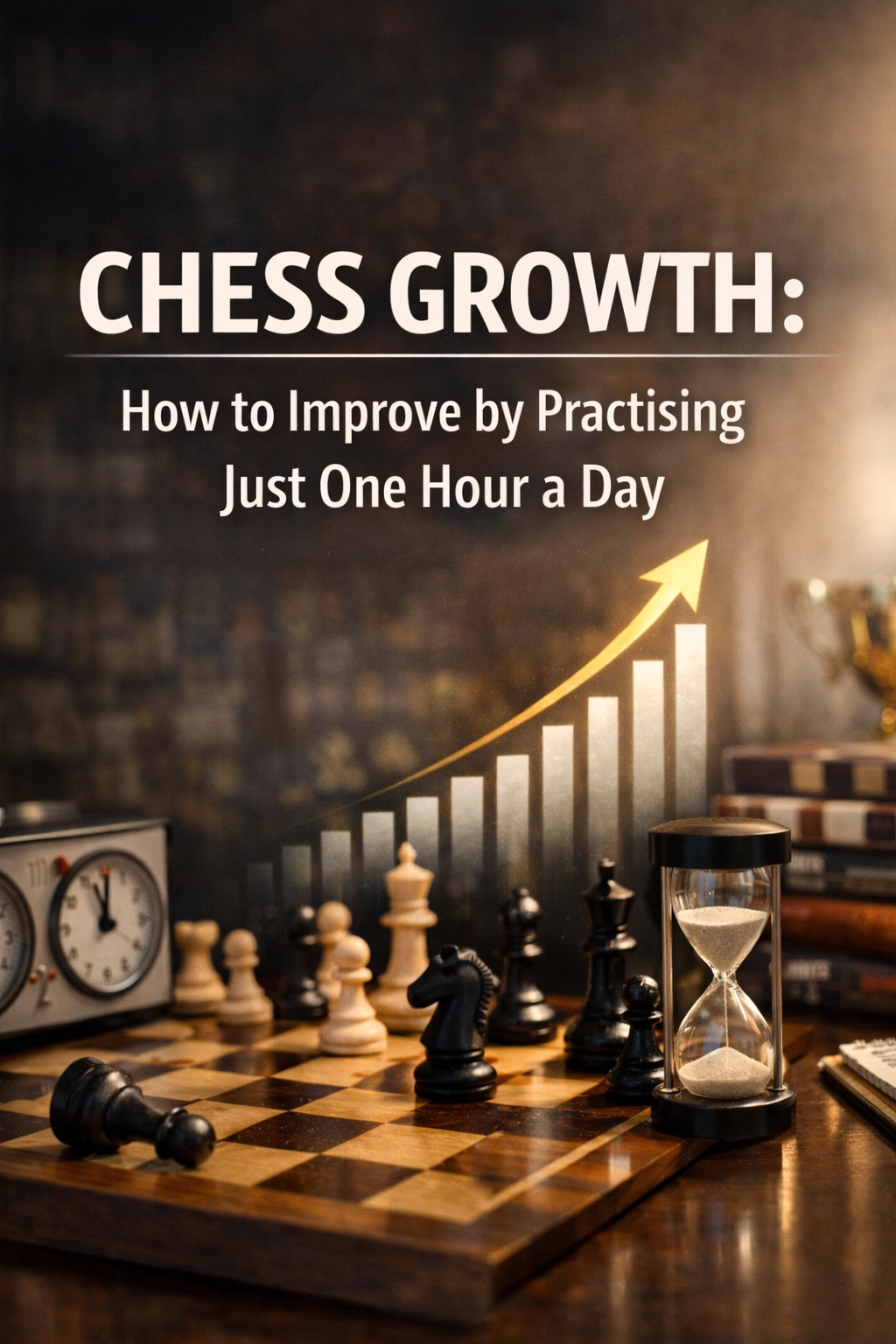
In India, chess is more than just a game; it is a passion that runs deep in our blood. From the legendary Viswanathan Anand to the young prodigies making headlines today, we all dream of playing beautiful moves on the board. But let us be honest, life gets in the way. Whether you are a student preparing for board exams, a professional working a 9-to-5 job in Bengaluru or Mumbai, or a parent managing a household, finding time for chess feels impossible.
You might think, "To become a strong player, I need to study for six or seven hours like the Grandmasters." This thought often discourages us before we even start. We tell ourselves, "I will start training seriously when I have more time." But that "more time" never comes.
Here is the good news: you do not need to quit your job or drop out of college to become a better chess player. You only need one hour one focused, dedicated hour every day.
At Enthuziastic, we believe that consistency beats intensity. In this blog, we will explore how you can transform your chess game with just 60 minutes of daily practice. We will look at simple strategies, practical schedules, and the mindset you need to see real results.
- Why one hour of focused chess training every day can lead to steady improvement
- The key principles of effective training: study, practice, analyse, fix, and repeat
- Choosing the most effective activities and avoiding time-wasting routines
- How to structure your hour for maximum benefit
- How beginners and intermediate players can balance tactics, strategy, openings, and endgame study
- Setting clear goals, understanding your motivation, and maintaining consistency
- Conclusion
- Frequently Asked Questions (FAQs)
Why one hour of focused chess training every day can lead to steady improvement
The Power of Consistency
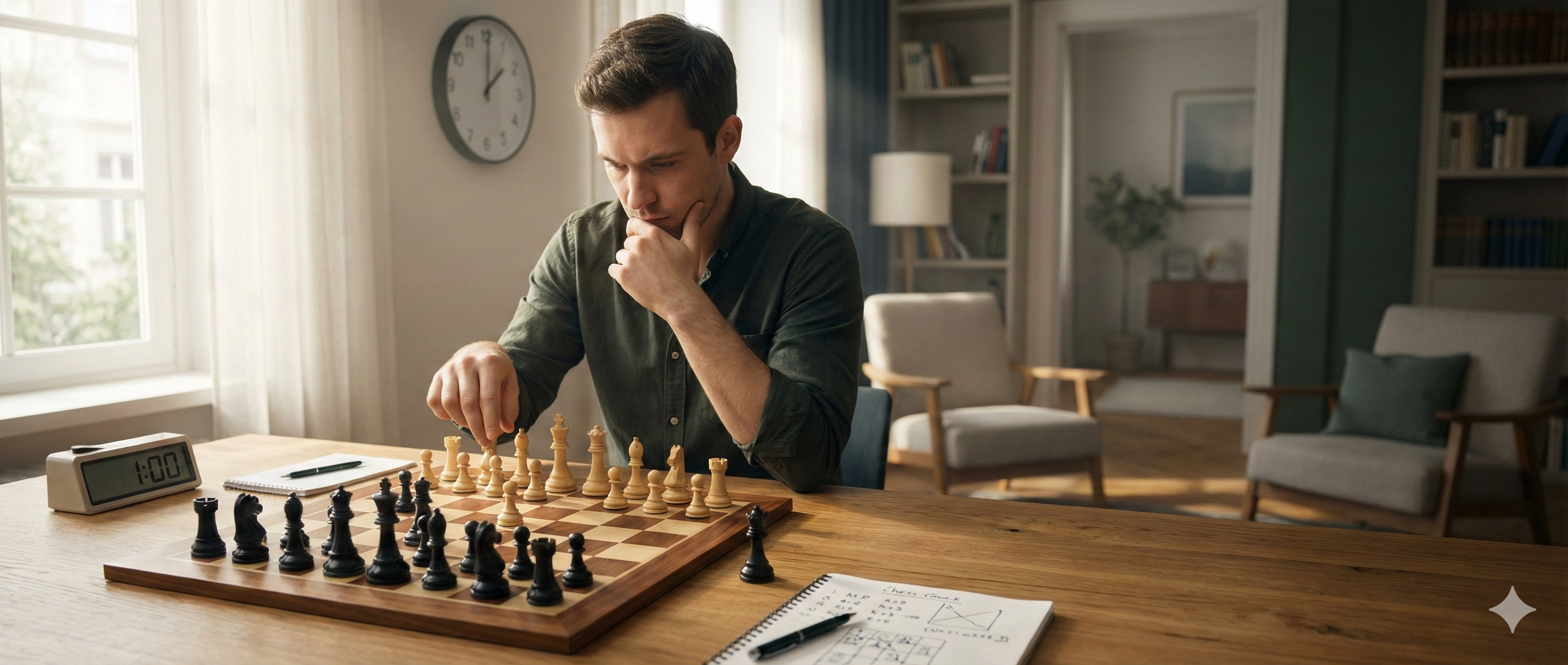
When you study chess for one hour every day, you keep the patterns fresh in your mind. Chess is largely about pattern recognition. If you solve tactical puzzles daily, your brain starts to recognise themes like 'pins', 'forks', and 'skewers' instantly. If you take a week-long break, your calculation speed slows down, and you get "rusty."
Avoiding Mental Burnout
Many enthusiastic players try to study for four hours on a Sunday after doing nothing all week. The result? By the third hour, they are tired, losing focus, and not actually learning anything. With a one-hour limit, your mind stays sharp. You know you have limited time, so you focus better. It is like an examination with a ticking clock you stop wasting time on irrelevant things and focus on the task at hand.
The Compound Effect
Imagine improving your chess understanding by just 1% every day. It might look small today, but over a year, that improvement adds up to a massive transformation. One hour a day is 365 hours a year. That is more training time than most casual players get in a decade!
The key principles of effective training: study, practice, analyse, fix, and repeat
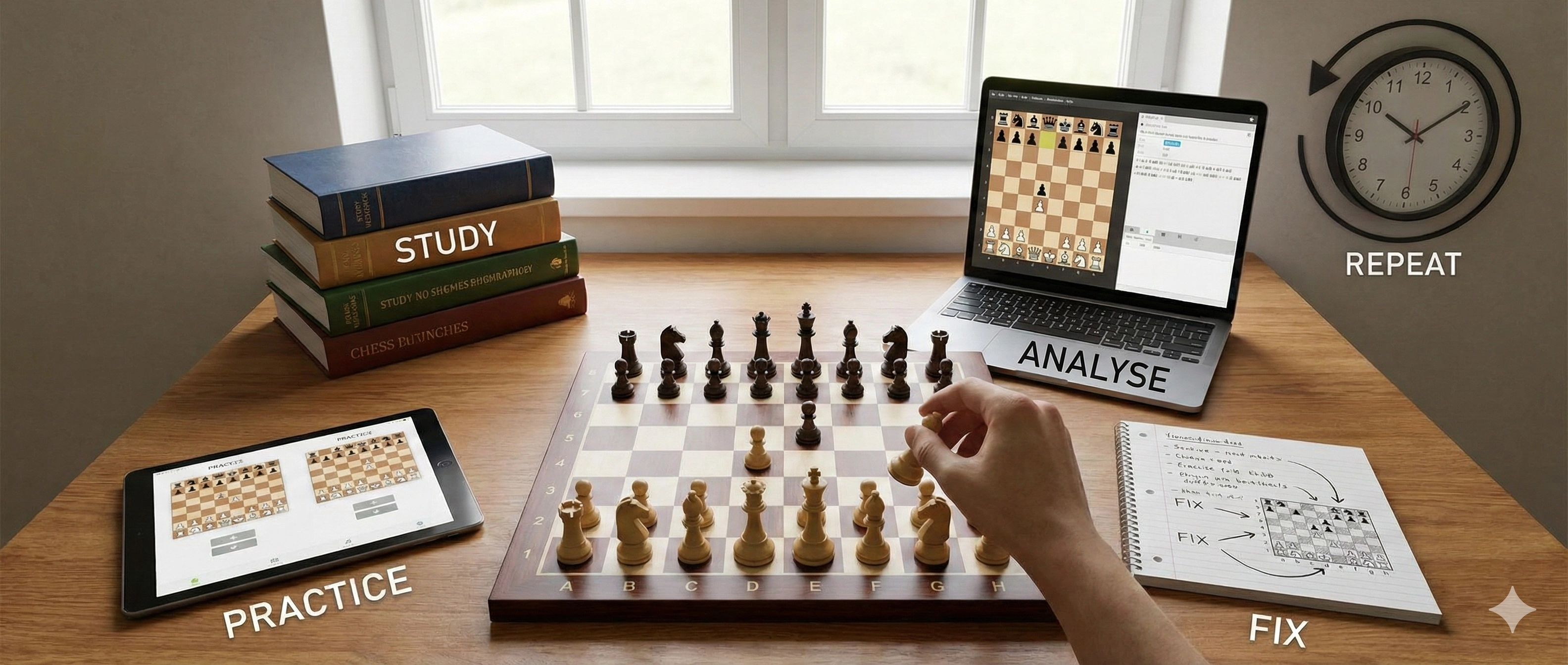
1. Study (Learning New Concepts)
This is where you gain new knowledge. You cannot play what you do not know. This could involve:
Reading a chapter of a classic chess book.
Watching an educational video about a specific opening or endgame concept.
Learning a new tactical motif.
2. Practice (Applying the Knowledge)
Knowledge without application is useless. If you learned about "Weak Squares" today, you must try to find them in your games. Practice can be solving puzzles or playing a serious game with the specific intent of using what you learned.
3. Analyse (Checking Your Work)
This is the most painful but most important step. After you play a game, do not just click "New Game." Stop. Look at the game you just played. Where did you go wrong? Did you miss a tactic? Did you move your knight when you should have developed your bishop?
4. Fix (Correcting the Mistake)
Once you find a mistake, you must fix it. If you lost because you didn't know how to checkmate with a King and Rook, stop everything. Go learn that specific checkmate. "Fixing" means filling the holes in your knowledge so you don't make the same mistake tomorrow.
5. Repeat
Chess improvement is a never-ending cycle. You learn, you play, you mistake, you fix, and then you start again.
Choosing the most effective activities and avoiding time-wasting routines
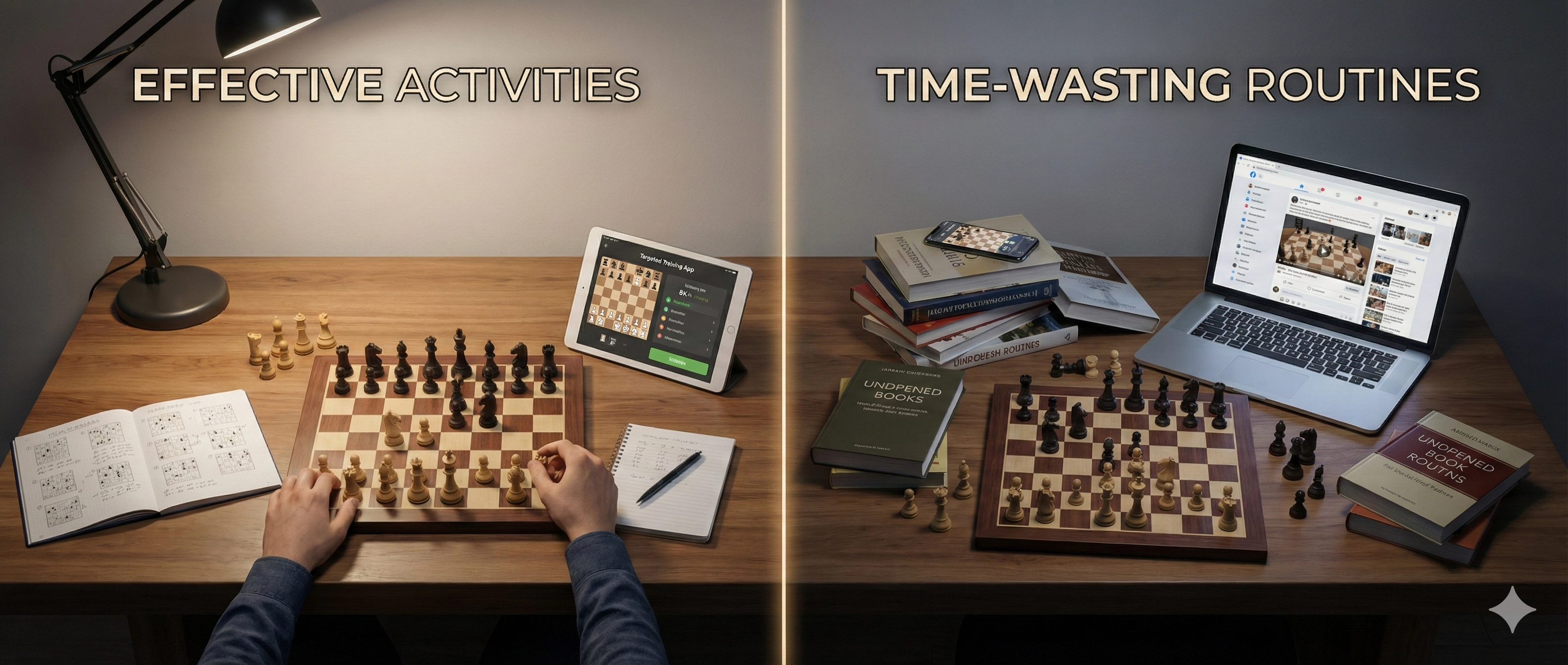
The trap of "Useful" vs. "Effective"
This is a concept many Indian students struggle with. We want to read every book and watch every video. But ask yourself: Is this effective for me right now?
Useful: Watching a Super Grandmaster play a blitz tournament on YouTube. It is entertaining, and you might see some cool moves.
Effective: Solving 10 difficult tactical puzzles that force you to calculate three moves ahead.
The first activity is passive; the second is active. For improvement, Active Training is always superior to Passive Training.
Common time-wasters to avoid
Mindless Blitz Marathons: Playing 20 blitz games in a row without analysing a single one. This reinforces bad habits.
Opening Obsession: Spending weeks memorising the "Najdorf Sicilian" variation 20 moves deep when you are dropping pieces in the middlegame.
Passive Video Watching: Lying on the sofa watching a lecture without a board. If you aren't pausing the video and guessing the move, you aren't really training.
High-value activities
Tactics Solving: This gives the highest return on investment for players under 2000 rating.
Endgame Drills: practicing theoretical endgames (like Lucena or Philidor positions) until you can do them in your sleep.
Guess the Move: Going through a Grandmaster game, covering the notation, and trying to guess the next move.
How to structure your hour for maximum benefit
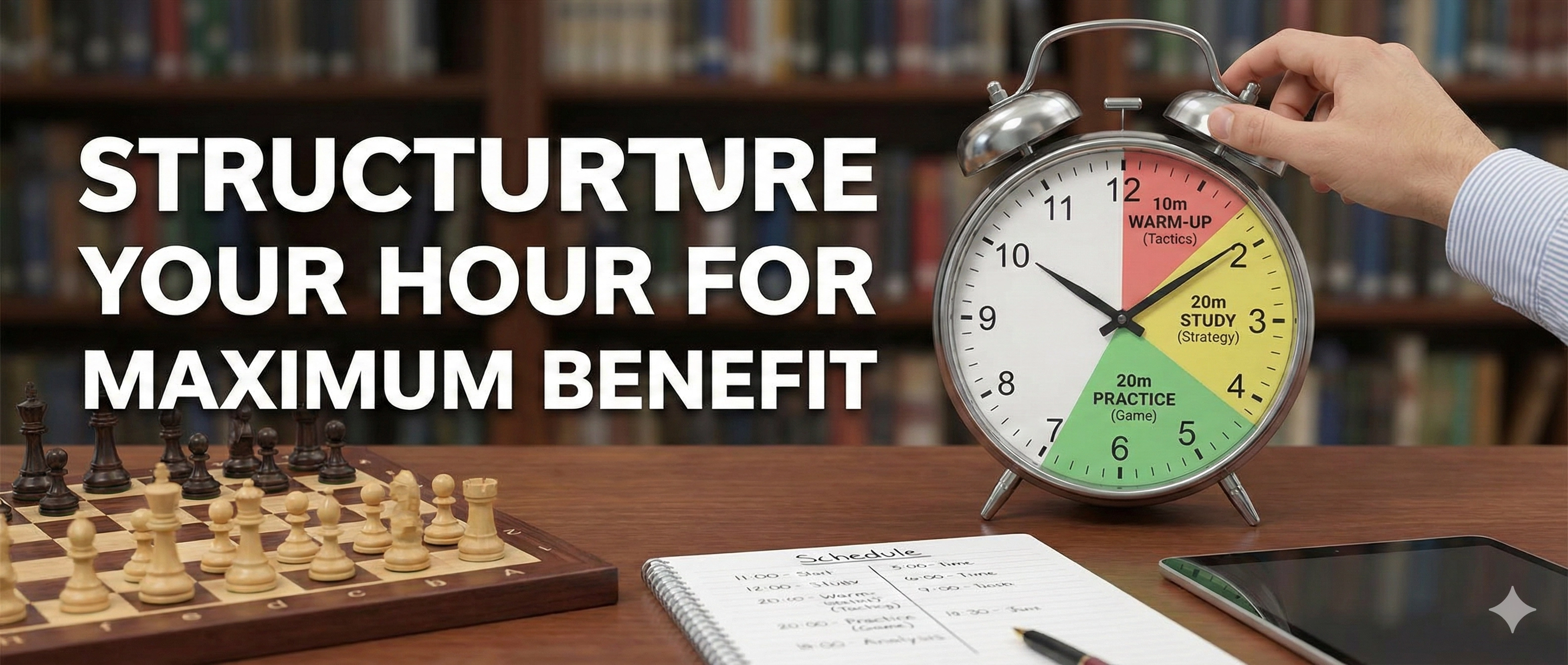
Plan A: The "All-Rounder" Session (Great for weekdays)
0-15 Minutes: Warm-up Tactics. Solve simple puzzles to wake up your brain.
15-45 Minutes: Play one Rapid Game (15+10 time control). A longer game allows you to think. Do not play Bullet or 3-minute Blitz.
45-60 Minutes: Analysis. Review the game you just played without an engine first, then check with the engine to see what you missed.
Plan B: The "Study & Drill" Session (Great for learning new topics)
0-30 Minutes: Focused Study. Read a book or watch a course lesson on a specific topic (e.g., "Isolated Queen's Pawn").
30-60 Minutes: Practice Drills. Set up positions related to that topic and play them out against a computer or a friend.
Plan C: The "Tactical Gym" (For days when you are tired)
0-60 Minutes: Puzzle Rush or Tactics. Spend the whole hour solving puzzles. Start with easy ones to build confidence, then move to hard ones that require 10-15 minutes of calculation each.
Pro Tip: Do not try to do everything every day. Maybe Monday is for Openings (Study), Tuesday is for Playing (Practice), and Wednesday is for Endgames (Fixing).
How beginners and intermediate players can balance tactics, strategy, openings, and endgame study
Balancing your diet is important for health; balancing your chess study is important for your rating. However, the "diet" changes depending on your level.
For Beginners (Rating 0 - 1200)
If you are just starting, or if you often lose games because you didn't see a bishop attacking your queen, your focus should be 80% Tactics.
Tactics: You need to stop hanging pieces. Solve simple puzzles every single day.
Endgames: Learn the basics King and Pawn, Checkmate with Queen/Rook.
Openings: Do not memorise lines. Just learn the principles: Control the centre, develop pieces, castle early.
Strategy: Ignore for now. Tactics decide your games.
For intermediate players (Rating 1200 - 1800)
Now you stop hanging pieces in one move. The game becomes deeper.
Tactics: Still crucial, but focus on calculation (seeing 3-4 moves ahead).
Strategy: Start learning positional concepts like "Good vs Bad Bishop," "Outposts," and "Pawn Structures."
Endgames: This is where you can beat beginners. Learn Rook endgames deeply.
Openings: Build a simple, reliable repertoire. You don't need to know everything, but you should know the first 10 moves of the systems you play.
The Golden Rule: Never spend more time on Openings than on Endgames. Grandmaster Capablanca said, "In order to improve your game, you must study the endgame before everything else."
Setting clear goals, understanding your motivation, and maintaining consistency
Why do you want to get better at chess?
This seems like a simple question, but the answer determines your success. If your answer is vague, like "I just want to be good," you will likely quit when things get tough.
Find your "Why"
Do you want to beat your office colleague who always acts arrogant?
Do you want to cross the 1500 rating barrier on an online platform?
Do you simply enjoy the beauty of the game and want to understand it deeper?
When you know your "Why," you will find the time. Suddenly, waking up 30 minutes earlier or skipping that evening TV serial doesn't feel like a sacrifice. It feels like a choice you are making for your goal.
Setting SMART Goals
Instead of saying "I want to be a Grandmaster," set smaller, achievable goals.
Bad Goal: "I want to increase my rating fast."
SMART Goal: "I will solve 10 puzzles every day for the next 30 days." or "I will analyse every rapid game I lose this month."
Focus on the process, not the result. If you stick to the process (the one hour of training), the results (rating increase) will happen automatically.
The "No-Excuses" Mindset
In India, we are masters of "Jugaad" (finding a way). Apply that to your time management.
Traveling in the Metro or local train? Solve puzzles on your phone.
Waiting for a meeting to start? Read one page of a chess PDF.
Lunch break? Watch one 10-minute instructive video.
If you really want to improve, you will make the time appear from nowhere.
Conclusion
Improving at chess does not require you to be a genius or to have unlimited free time. It requires discipline, a smart plan, and the willingness to learn from your mistakes.
By dedicating just one focused hour a day, you are investing in yourself. You are training your brain to focus, calculate, and plan skills that help you not just on the 64 squares, but in life as well.
Remember the principles:
Consistency is King: Show up every day.
Active Learning: Solve and think; don't just watch.
Analyse Everything: Your mistakes are your best teachers.
At Enthuziastic, we believe in the power of learning and growing together. So, set your alarm clock, clear your schedule for just one hour, and get ready to checkmate your old self. The Grandmaster journey starts with a single pawn move.
Best of luck with your training!
Frequently Asked Questions (FAQs)
Q1: Is one hour really enough to become a rated player?
A: Yes, absolutely. Most club-level players and even many strong rated players do not study more than an hour a day on average. The key is that the hour must be focused study, not just casual playing. Consistency over a year yields better results than sporadic intense study.
Q2: I work a full-time job. When is the best time to train?
A: The best time is whenever you have the most mental energy. For many working professionals, early morning (before the day's stress begins) is ideal. However, if you are a night owl, doing your hour after dinner works too. Just ensure you are not too exhausted to calculate.
Q3: Should I play Blitz or Rapid games during my training hour?
A: Avoid Bullet (1 minute) and fast Blitz (3 minutes) during training. They rely mostly on intuition and hand speed. For improvement, play Rapid games (10 minutes or 15 minutes + increment). This gives you time to think, calculate, and apply what you have learned.
Q4: I get bored solving puzzles. Is there an alternative?
A: If generic puzzles feel boring, try analyzing your own games. It is a form of puzzle solving where the stakes are personal. Alternatively, try "Guess the Move" with games of your favourite player (like Vishy Anand or Magnus Carlsen). It makes the training feel like a game.
Q5: Can I split the one hour into two 30-minute sessions?
A: Yes, you can. For example, you can do 30 minutes of tactics in the morning and 30 minutes of playing/analysis in the evening. However, try not to break it down into very small chunks (like 10 minutes), as deep chess thought requires some time to get into the "zone."
Q6: What if I miss a day? Should I do two hours the next day?
A: If you miss a day, do not stress. Just get back to your one hour the next day. trying to "compensate" by doing double often leads to burnout. Just accept the break and restart your routine.
Q7: Do I need to buy expensive software or books?
A: Not necessarily. There are excellent free resources available online, including Lichess for puzzles and analysis, and YouTube channels for lessons. However, one or two good classic books can be a great investment for structured learning.
Q8: How long will it take to see results?
A: Chess improvement is often like a staircase, not a straight line. You might study for two months and see no rating change, and then suddenly jump up 100 points in a week. Trust the process. Usually, with diligent one-hour daily practice, you should see noticeable improvement within 3 to 6 months.

Comments