
Introduction: the battlefield of the mind
Hello friends, and welcome to another deep dive by Enthuziastic – Global People to People Live Learning Network. Today, we are going to talk about something that many of us play, watch, or teach our children, but rarely stop to think about deeply. We are talking about the game of chess.
Now, you might ask, "What is so special about chess captures? You just take the piece off the board, right?" Well, wait a minute. Have you ever wondered why we use the word "captured" and not "killed"? In almost every other war game or video game, enemies are "killed," "destroyed," or "eliminated." But in chess, we say the piece is captured. It is removed from the board, yes, but the terminology is very specific.
This choice of words is not accidental. It changes the entire spirit of the game. It turns a war simulation into a lesson in management, strategy, and even mercy. At Enthuziastic, we believe that learning happens not just in the classroom but in understanding the "why" behind things. Whether you are a parent looking to introduce chess to your child, a student trying to improve your logic, or just a curious soul, this topic has something for you.
In this blog, we will explore the fascinating world of chess captures. We will look at the rules (some of which might surprise you!), the psychology behind trading pieces, and most importantly, the life lessons we can learn from this beautiful game. So, grab a cup of chai or coffee, sit back, and let us unravel the mystery of the chess board together.
- Introduction: the battlefield of the mind
- Part 1: The philosophy of 'captured' vs. 'killed'
- Part 2: How captures work – the rules and mechanics
- Part 3: The strategy and tactics of capturing
- Part 4: The chess psychology of the capture
- Part 5: Educational value – why we teach 'capturing' to kids
- Conclusion: the game goes on
- Frequently asked questions (FAQs)
Part 1: The philosophy of 'captured' vs. 'killed'
Why words matter
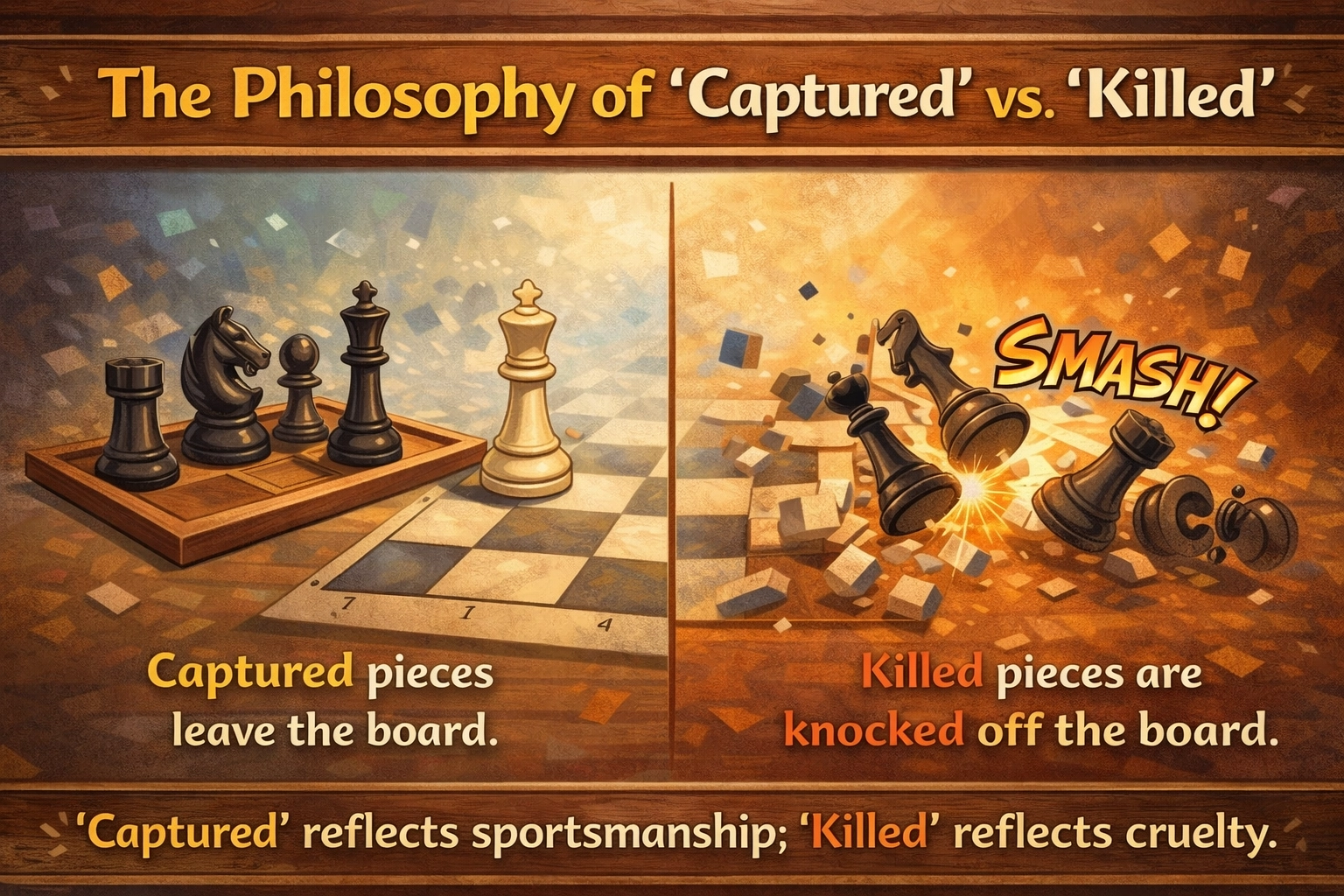
In Indian culture, we often say that words carry energy. The way we describe an action changes how we feel about it. If we said a chess piece was "killed," the game would become about violence, destruction, and finality. But when we say "captured," the narrative changes.
When a soldier is captured in battle, they are neutralized. They are no longer a threat, but they are still respected as an entity. In chess, this is exactly what happens. When you take an opponent’s Knight or Bishop, you are essentially saying, "Your piece was in my territory, it was dangerous, so I have removed it from the field." You have solved a problem; you haven't committed a crime.
This distinction is very important for young learners. We want children to learn strategy and competition without learning aggression. Chess allows this perfectly. It teaches that you can win by outsmarting someone, by restricting their options, rather than by destroying them. It is a subtle difference, but a powerful one.
The king never dies
The biggest proof that chess is about capture and not killing lies in the fate of the King. Have you noticed? The King is the only piece on the board that is never actually removed. You can capture a Queen, you can capture Rooks, Bishops, Knights, and all the Pawns. But the King? The King remains.
The game ends with "checkmate." Checkmate comes from the Persian phrase "Shah Mat," which roughly translates to "the King is helpless" or "the King is ambushed." It does not mean the King is dead. It simply means the King has no moves left. He is trapped. He must surrender.
This teaches us a profound lesson about leadership and dignity. The ultimate goal is not to annihilate the leader but to corner them to a point where they must admit defeat. It frames the game as a contest of intellects where the ending is a resignation, a handshake (symbolically), rather than a slaughter. For a child learning the game, this reinforces that winning is about achieving a specific goal (trapping the King), not about wiping out every single enemy piece.
A civilized war
Think of chess as a debate rather than a fistfight. In a debate, you "capture" your opponent’s points by countering them with better logic. You neutralize their arguments. You don't silence the person; you silence their argument. Similarly, on the chess board, every capture is a transaction. You give up something (maybe time, or position) to gain material.
This philosophical grounding is why chess has been played by kings, scholars, and thinkers for centuries. It appeals to the part of us that wants to solve puzzles, not the part of us that wants to break things.
Part 2: How captures work – the rules and mechanics
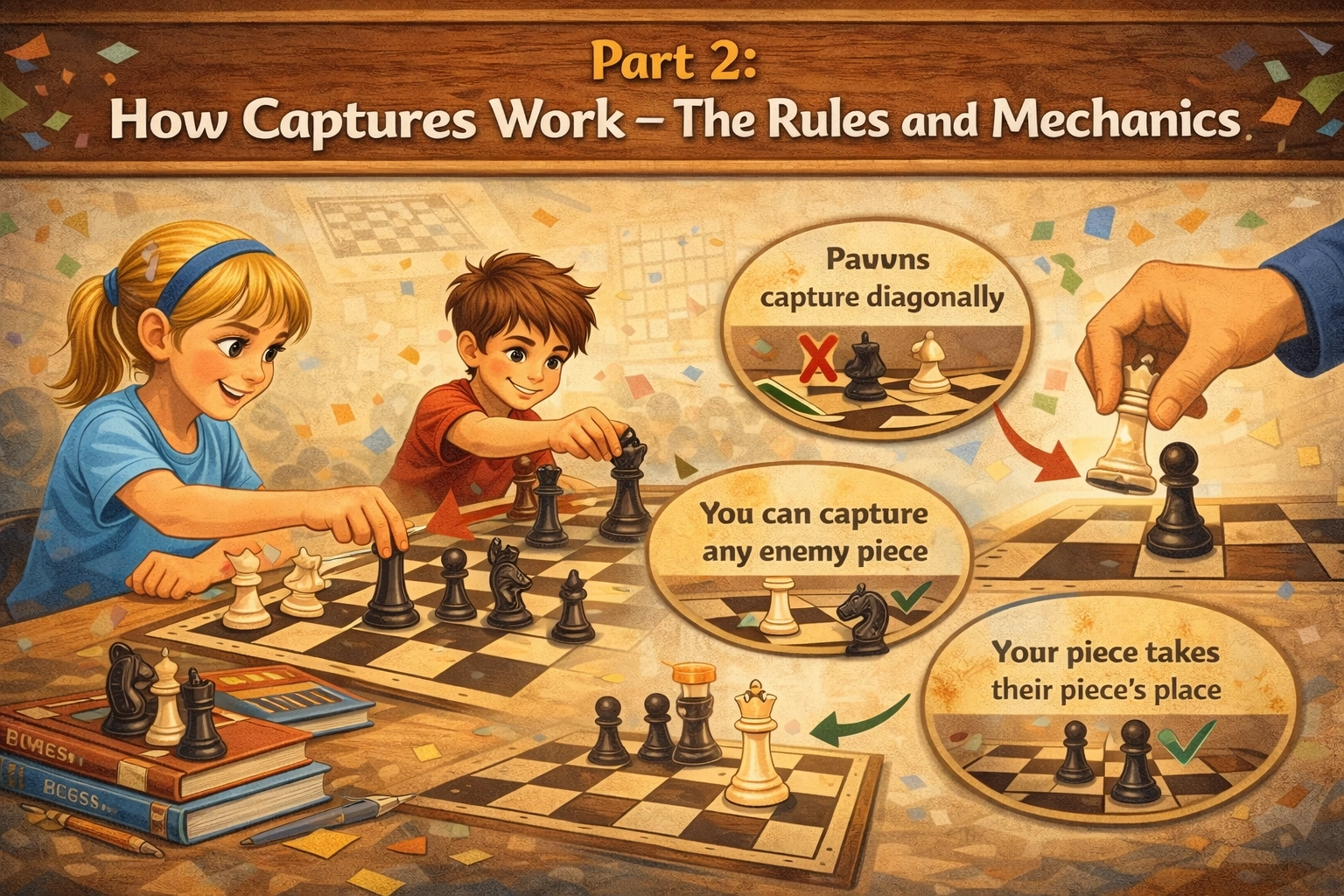
Now that we understand the "spirit" of the game, let us get into the mechanics. For beginners or parents teaching their kids, this section is vital. Capturing in chess is not just "bumping" a piece. Different pieces have different ways of claiming territory.
The basics of capturing
In many board games, like Ludo or Checkers, you often jump over a piece to capture it. Chess is different (mostly). In chess, you capture by moving your piece onto the square occupied by the opponent’s piece. You pick up their piece, remove it from the board, and place your piece on that square. It is a replacement.
The sliding pieces (Rook, Bishop, Queen)
These pieces are straightforward.
The Rook: Moves in straight lines (up, down, left, right). If an enemy piece is in its path, the Rook can stop on that square and capture it. It cannot jump over it to capture something behind.
The Bishop: Moves diagonally. It stays on its color complex (white squares or black squares). It captures whatever is first in its diagonal path.
The Queen: The powerhouse. She combines the powers of the Rook and Bishop. She can capture in any direction straight or diagonal.
The Knight: the jumper
The Knight is unique. It moves in an "L" shape (two squares in one direction, then one square perpendicular). The Knight is the only piece that can jump over others. However, it only captures the piece on the square where it lands.
Scenario: If there are pawns blocking the Knight's path, it jumps over them. It does not capture them. It only captures the piece sitting on the final destination square. This makes the Knight a dangerous "sniper" that can attack from behind enemy lines.
The King: the defender
The King can also capture! Many beginners forget this. If an enemy piece is standing next to the King (and that piece is not defended by another enemy), the King can simply step over and capture it. However, the King can never capture a piece if doing so puts him in "check." The King has a strong survival instinct!
The complex world of pawn captures
Pawns are the most confusing pieces for beginners because they move in one way but capture in another.
Movement: Pawns move straight forward.
Capturing: Pawns capture diagonally forward one square.
Important note: A pawn cannot capture a piece that is directly in front of it. If a pawn meets an enemy piece nose-to-nose, they are both stuck. They block each other.
En passant: the ghost capture
This is the rule that causes the most arguments among casual players! "En passant" is French for "in passing."
The rule: If your opponent moves a pawn two squares forward from its starting position, and it lands right next to your pawn, you can capture it as if it had only moved one square.
How it looks: You move your pawn diagonally behind their pawn, and you lift their pawn off the board.
The catch: You must do this immediately on the very next move. If you wait, the chance is gone.
Why this exists: It prevents players from using the two-square initial move to simply bypass enemy pawns without any risk. It keeps the game fair.
Promotion: the ultimate transformation
When a pawn reaches the other end of the board (the 8th rank), it is not captured. Instead, it is promoted. You can swap that pawn for a Queen, Rook, Bishop, or Knight. Usually, players choose a Queen. This acts like a "rescue mission" where the humble foot soldier brings in heavy reinforcements. It changes the material balance of the game instantly.
Part 3: The strategy and tactics of capturing
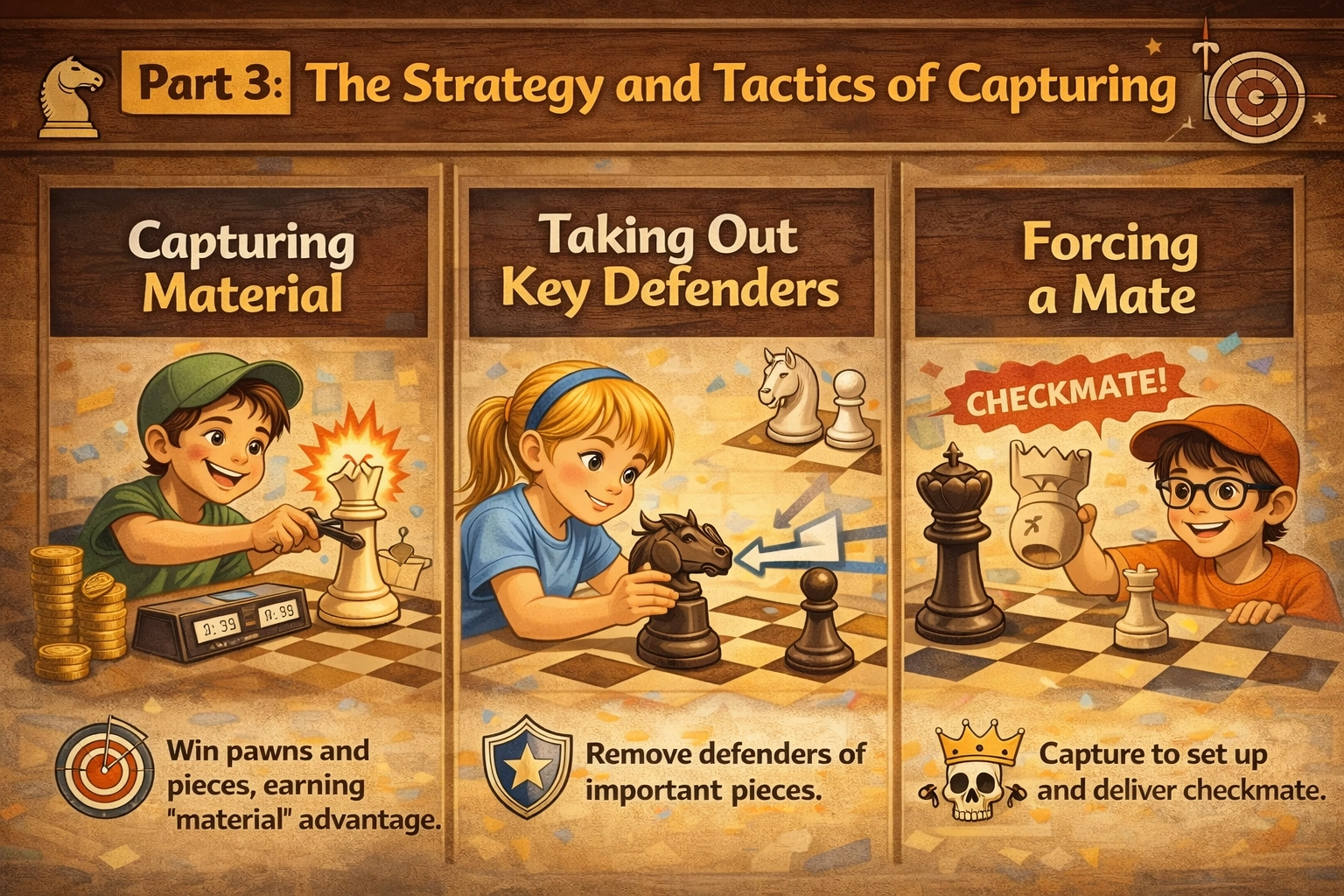
So, we know how to capture. But when should you capture? This is where chess transitions from a game of rules to a game of art and intellect.
Material advantage: the simple math
In chess, we assign points to pieces to help us make decisions:
Pawn = 1 point
Knight = 3 points
Bishop = 3 points
Rook = 5 points
Queen = 9 points
A basic strategy is to capture pieces of higher value than the ones you lose. This is called "winning material." If you trade your Knight (3 points) for their Rook (5 points), you have made a "profitable exchange." You are up by 2 points.
However, at Enthuziastic, we always tell our students: Material is not everything. Sometimes, capturing a pawn can open up lines for an attack on your King. This leads us to the concept of "poisoned pawns" pieces that look free to capture but actually lead to a trap.
Tactical themes involving captures
Capturing is the ending of a tactical sequence. Let us look at three common tactics:
1. The fork
Imagine a Knight jumps to a square where it attacks both the King and the Queen at the same time. The opponent must save the King (rules of the game). This leaves the Queen effectively "captured" on the next turn. This double-attack is called a fork. It forces the opponent to lose material.
2. The pin
A pin happens when you attack a piece that cannot move because a more valuable piece is behind it.
Example: Your Bishop attacks an enemy Knight. Behind that Knight is the enemy King. The Knight cannot move because it is illegal to expose the King to check. The Knight is "pinned." On the next turn, you can simply capture the helpless Knight.
3. The skewer
This is the reverse of a pin. You attack a valuable piece (like the King or Queen). It is forced to move away. Once it moves, you capture the piece that was hiding behind it. It is like an X-ray attack.
To trade or not to trade?
One of the hardest decisions in chess is knowing when to trade pieces (capture their piece and let them capture yours back).
When winning: If you have more material (e.g., you are up a Knight), you should generally try to trade off pieces. Why? Because the fewer pieces on the board, the easier it is for your extra Knight to dominate. It simplifies the game.
When losing: If you are down material, you should avoid trading. You want to keep the game "messy" and complicated, hoping your opponent makes a mistake.
Part 4: The chess psychology of the capture
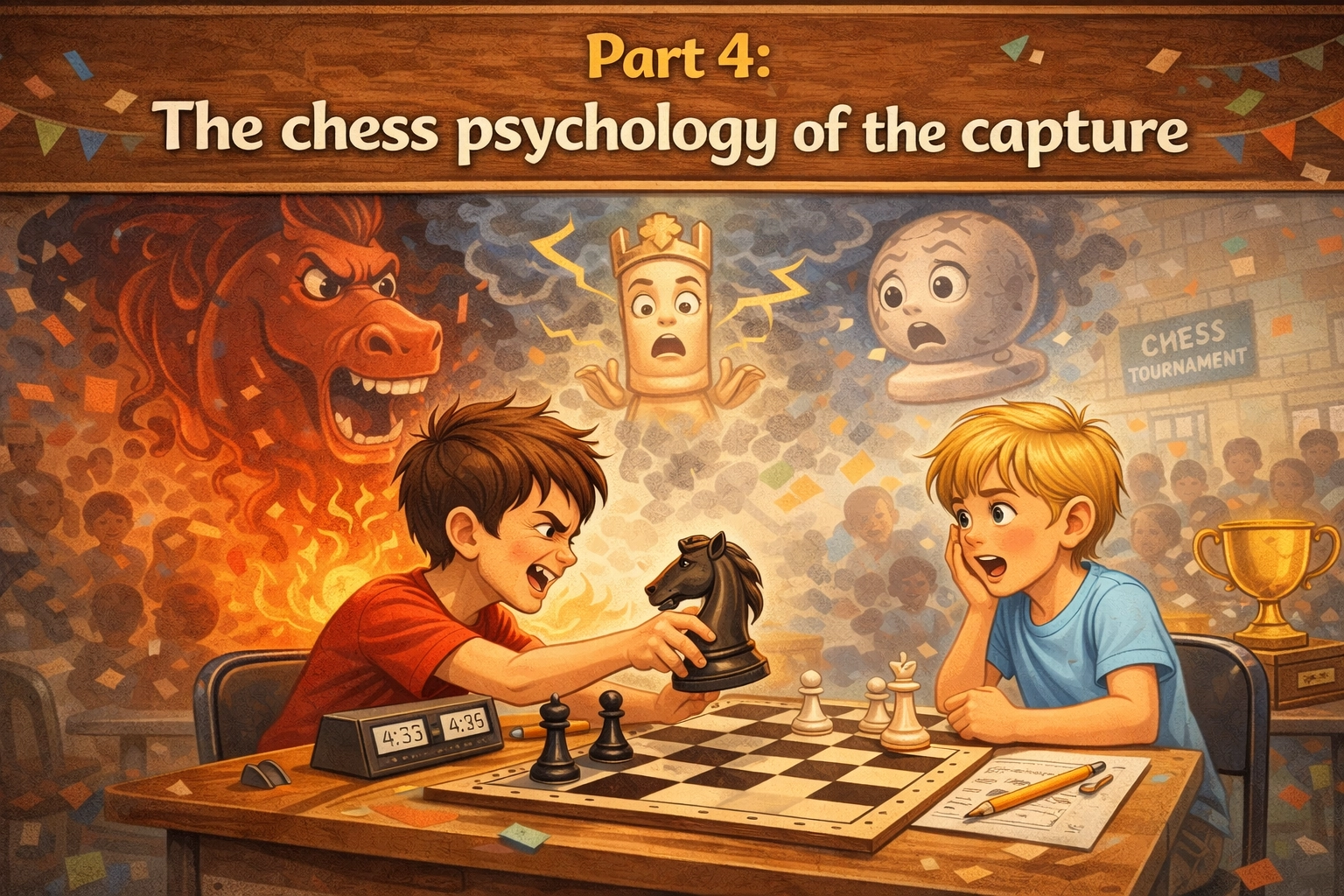
Now, let us talk about the human element. This is something we focus on deeply at Enthuziastic because chess is not played by computers (well, not usually); it is played by people with emotions.
The thrill of the hunt
There is a distinct dopamine hit when you capture a major piece. Taking an opponent’s Queen feels like scoring a century in cricket or hitting a winning goal. It gives a surge of confidence. However, this confidence can be dangerous.
We often see players get "capture happy." They see a piece they can take, and they take it immediately without thinking. They forget to ask, "What happens after I capture?" This greed is often punished. A player might capture a pawn only to find their Queen trapped. Learning to control this impulse is a huge part of emotional maturity.
The pain of loss
On the flip side, losing a piece can be devastating. When a player blunders (makes a mistake) and loses a Bishop for nothing, their immediate reaction is often panic or anger. They might feel stupid.
The tilt: In gaming psychology, this is called "tilting." Because you are upset about losing the Bishop, you play the next few moves aggressively and recklessly to "get it back." Usually, this leads to losing even more pieces.
Resilience: We teach students that losing a piece is not losing the game. We have seen grandmasters win games even when they are down a Queen. It requires a shift in mindset: "Okay, I have less army now. I must be more careful, more creative, and fight harder." This builds incredible resilience.
Time pressure and decision making
Captures become critical when the clock is ticking. In Blitz chess, players often capture just to change the board state and force the opponent to react. It forces a "recapture" reflex. It is a psychological weapon to disturb the opponent's thinking flow.
Part 5: Educational value – why we teach 'capturing' to kids
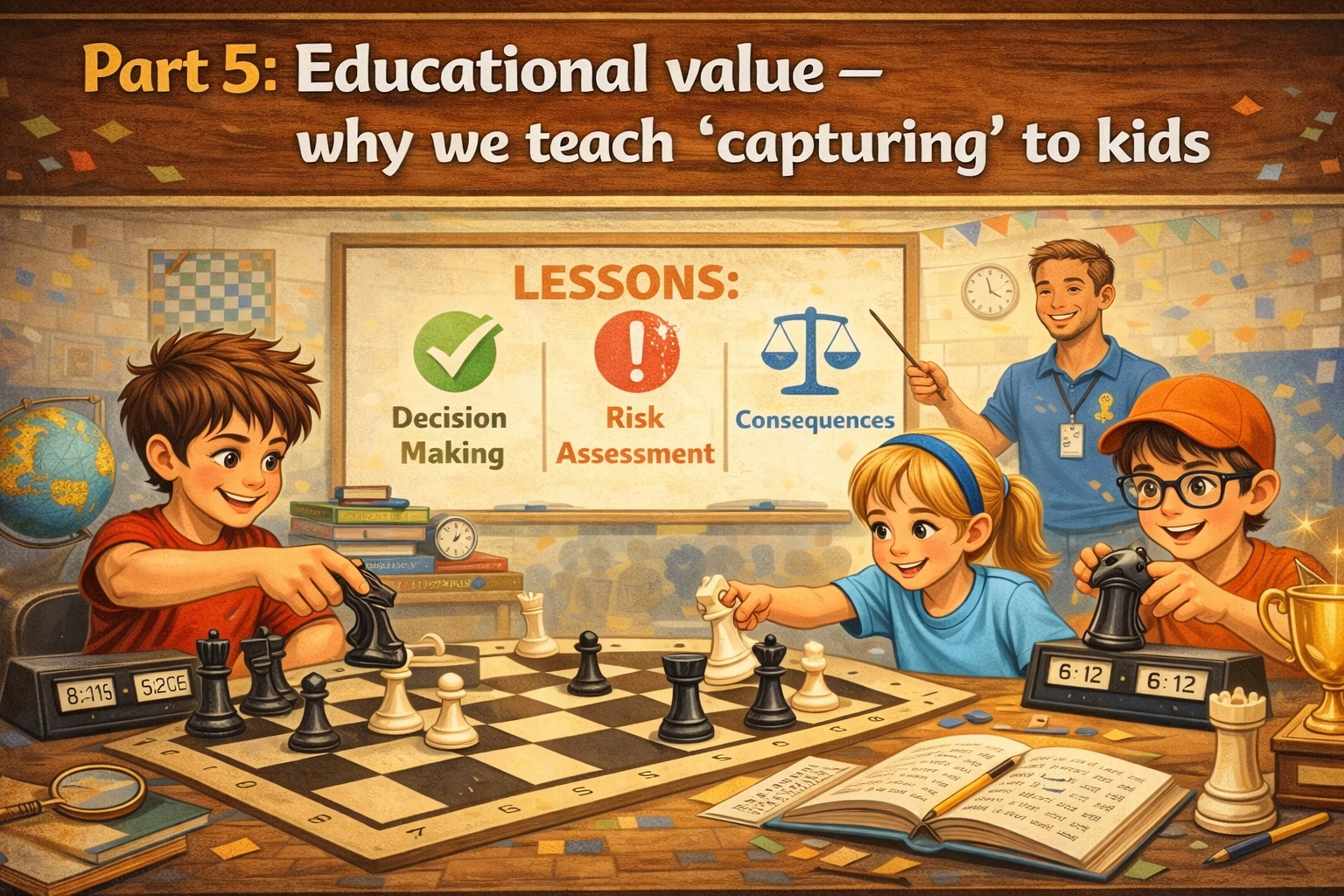
At Enthuziastic, our motto revolves around live learning and growth. Chess is one of the best tools for this. The concept of "capturing" serves as a brilliant metaphor for education.
Consequences of action
Every time a child captures a piece, the board changes. A file opens up, a diagonal closes, a defender is removed. They learn that every action has a reaction. If I take this pawn, will his Bishop take me? This develops "if-then" logical thinking, which is the foundation of coding and mathematics.
Empathy and fair play
Because we use the term "capture" and not "kill," we maintain a level of sportsmanship. We teach kids to shake hands before and after the game. We teach them that the opponent is not an enemy to be hated, but a partner in creating a beautiful game. Without the opponent, there is no game.
Resource management
Kids learn the value of things. They learn that they cannot just throw away their pieces. A Rook is valuable; you don't trade it for a Pawn just for fun. This is a basic lesson in economics and resource management. They learn to value what they have and protect it.
Pattern recognition
Capturing reinforces patterns. Kids start to see geometries diagonals, L-shapes, straight lines. This spatial reasoning helps significantly in subjects like geometry and physics later in school.
A curriculum for life
We believe chess shouldn't just be an extra-curricular activity; it should be a way of thinking. When we design our learning modules, we use chess scenarios to discuss real-life problems:
Scenario: You are in a tough position (bad grades/lost a piece). Do you give up, or do you look for the best possible move?
Scenario: You have a great opportunity (capture a Queen), but it looks too good to be true. Do you rush in, or do you double-check? (Critical thinking).
Conclusion: the game goes on
So, the next time you sit down at the board, or the next time you see two people hunched over those 64 black and white squares, remember: it is not a slaughter. It is a conversation. It is a negotiation.
The pieces are captured, set aside, and when the game is over, they are all put back in the box together. The White King and the Black King rest side by side. This is perhaps the greatest lesson of all. The conflict is temporary; the shared humanity (or piece-hood!) is permanent.
At Enthuziastic, we encourage you to look deeper into the games you play. Whether you are a grandmaster in the making or someone who just knows how the Knight moves, remember that every capture is a lesson in strategy, psychology, and life.
Keep playing, keep learning, and keep growing.
Frequently asked questions (FAQs)
Q1: If I capture a piece, can I use it as my own later in the game?
A: No, unlike some variants of chess (like Crazyhouse), in standard chess, once a piece is captured, it is removed from the board permanently for that game. You cannot bring it back or use it for your side.
Q2: Is it mandatory to capture a piece if I can?
A: In standard chess, no. You are never forced to capture (unless it is the only legal move to get out of check). However, in the game of Checkers, capturing is often mandatory. In chess, it is your strategic choice.
Q3: Can a King capture a Queen?
A: Yes, absolutely! If the enemy Queen is adjacent to your King and is not protected by another enemy piece, your King can capture her. It is a glorious moment for the King!
Q4: What happens if I capture a piece but forget to press my clock?
A: In tournament chess, your move is not considered "complete" until you press the clock. If you capture and forget to press, your opponent’s time does not start running, and you lose valuable seconds on your own clock.
Q5: Why is the 'en passant' rule so confusing?
A: It is confusing because it is the only time in chess where a piece captures on a square where the enemy piece is not sitting. It feels like magic or cheating to beginners! But it was invented to ensure pawns couldn't just run past enemy defenses using their double-step move.
Q6: Does capturing more pieces guarantee a win?
A: Not always. You can capture almost all your opponent’s pieces but still get checkmated if your King is trapped. Strategy and King safety are often more important than just the number of pieces captured.
Q7: How can I teach my child not to be upset when their pieces are captured?
A: Remind them that the pieces are just "helpers." Even if a helper leaves the board, the General (the player) is still in charge. Focus on the remaining pieces. Praise them for making a good fight with what they have left, rather than focusing on what they lost.
Q8: What is a 'sacrifice' in chess?
A: A sacrifice is when you intentionally let your opponent capture one of your valuable pieces to gain a better strategic position or to deliver a checkmate. It is considered the most beautiful and creative part of chess.

Comments