
Namaste chess lovers! Welcome to another comprehensive guide brought to you by Enthuziastic.
Whether you are a parent looking to help your child improve, a weekend hobbyist, or a serious tournament player, you have likely heard the famous saying by Richard Teichmann: "Chess is 99% tactics."
While modern chess engines and grandmasters might argue that strategy holds equal weight, the truth remains simple for most of us. You can play a brilliant strategic game, outmanoeuvre your opponent for forty moves, and then lose it all to a simple, unforeseen tactical blunder. That is exactly why mastering chess tactics is non-negotiable if you want to climb up the rating ladder and enjoy the game to its fullest.
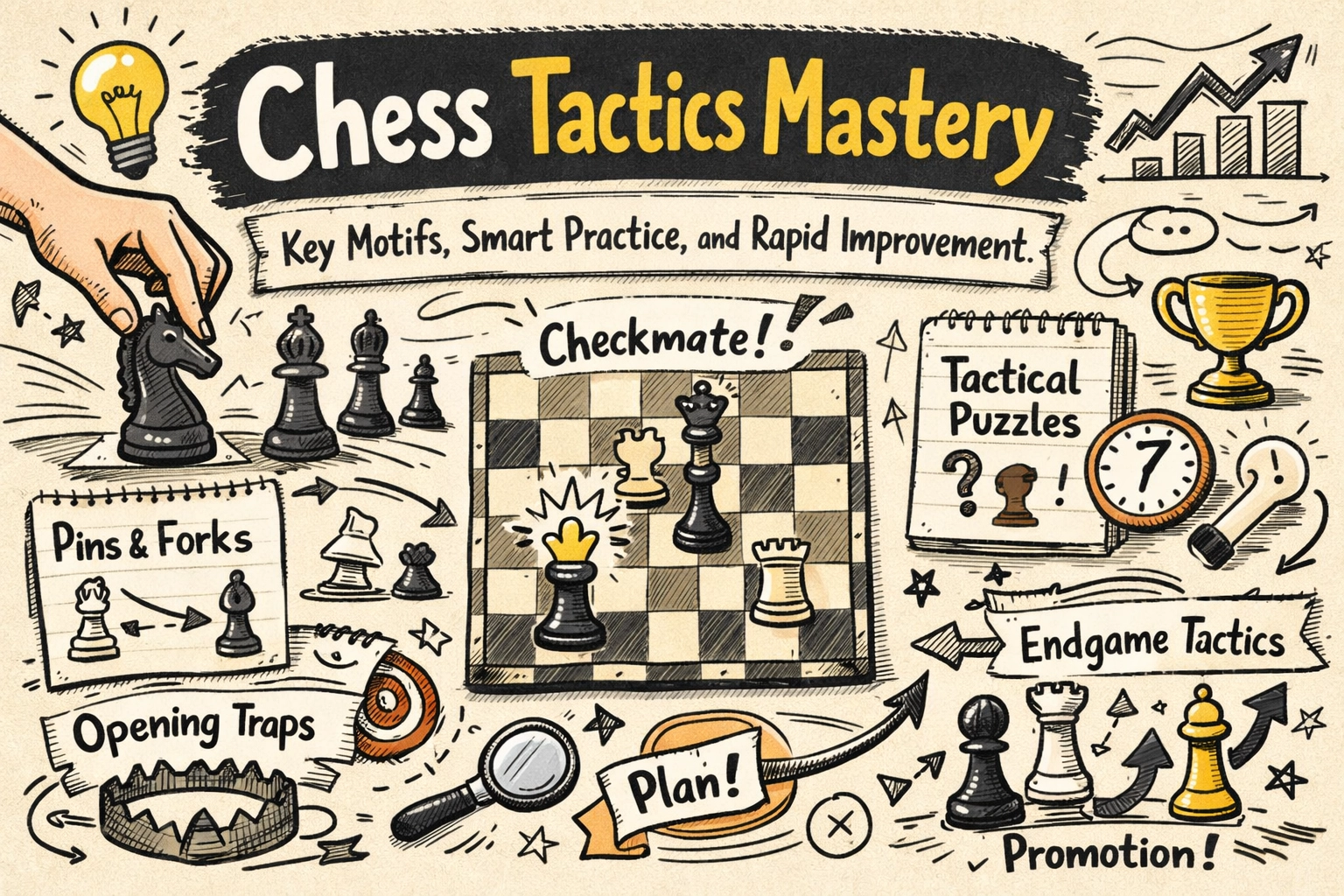
In this blog, we are going to explore everything you need to know about chess tactics. We will cover the most essential tactical motifs in chess, discuss solid tactics training methods, and show you exactly how to improve at chess tactics. By the end of this read, you will have a clear, actionable roadmap to sharpen your tactical vision.
- Introduction to chess tactics
- Fundamental tactical motifs in chess
- Developing tactical vision: how to recognise tactical patterns
- Practice techniques for tactical improvement
- Using puzzles and drills effectively
- Mistakes players make in tactical training
- Applying tactics in real games
- Long-term tactics strategy
- Conclusion
- Frequently Asked Questions (FAQs)
Introduction to chess tactics
Before we dive into the deep end of the pool, let us first understand what chess tactics really are. In simple terms, a tactic is a short sequence of moves that results in an immediate, tangible advantage. This advantage could be winning a piece, gaining a significant positional edge, or even delivering a checkmate.
Strategy, on the other hand, is your long-term plan. It is the roadmap you build to slowly improve your position. If strategy is the war, tactics are the individual battles.
Why chess tactics matter for players of all levels
For beginners, chess tactics are the bread and butter of the game. When you first start playing, most games are decided by who drops fewer pieces. A simple missed fork or a hanging queen dictates the result of the match. Therefore, a solid grasp of basic tactics is the fastest way to jump from a beginner to an intermediate level.
For intermediate players, tactical motifs in chess become slightly more hidden. Opponents stop blundering pieces outright, but they might leave their pieces vulnerable to a two-move or three-move combination. Here, your tactical vision helps you spot opportunities that are not immediately obvious on the board.
Even for grandmasters, tactics are the sharp tools used to execute their profound strategic plans. A beautiful positional squeeze often culminates in a decisive tactical blow. Without tactics, strategy is just a dream without execution.
How tactical awareness influences decision-making in games
When your tactical vision is sharp, your confidence at the board skyrockets. You stop second-guessing your moves because you can clearly calculate the consequences. Tactical awareness acts as an alarm bell in your head. When your opponent makes a move, your brain automatically scans the board for threats.
This awareness heavily influences your decision-making. Instead of passively defending, you start looking for active counter-play. You learn to differentiate between a safe square and a dangerous one, and your overall board vision improves drastically. In the Indian chess circuit, where competition is fierce right from the under-7 categories, having this sharp tactical radar is what separates the champions from the rest.
Fundamental tactical motifs in chess
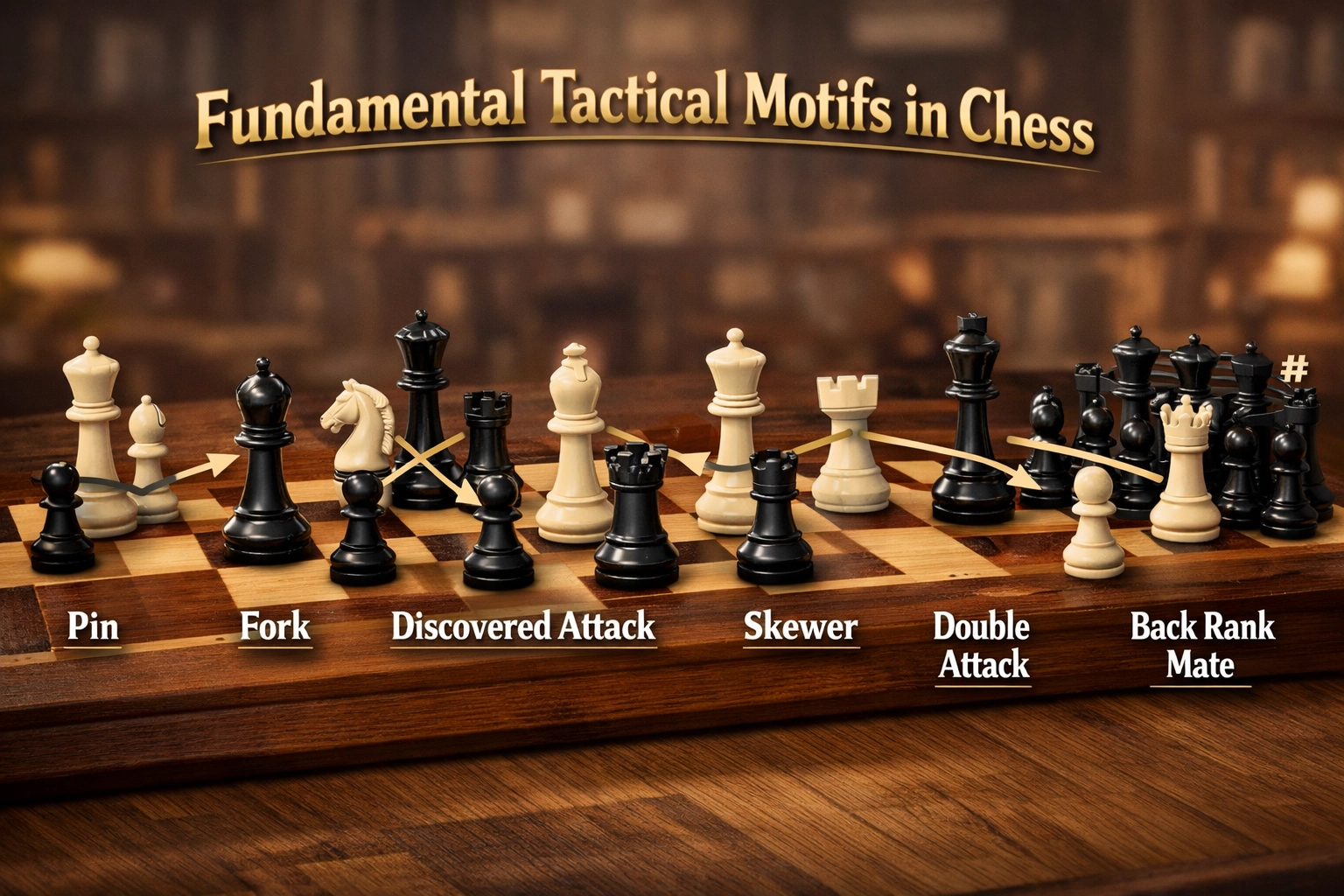
To build a house, you need bricks. To build your tactical vision, you need to understand the basic tactical motifs in chess. These are the recurring patterns that happen time and time again in chess games. Let us break down the most fundamental ones.
The pin: freezing your opponent's pieces
A pin occurs when an attacking piece threatens a defending piece, and that defending piece cannot move without exposing a more valuable piece behind it. You can think of it as freezing your opponent's army in place.
There are two main types of pins: absolute and relative.
An absolute pin happens when the piece behind the pinned piece is the King. In this case, it is illegally impossible to move the pinned piece. For example, if your Bishop is pinning an enemy Knight to the enemy King, that Knight simply cannot move.
A relative pin happens when the piece behind is not the King, but another valuable piece, like a Queen or a Rook. The pinned piece can legally move, but doing so would mean losing the more valuable piece behind it.
Pins arise naturally in almost every chess game, especially in the opening and middle game. The best way to exploit a pin is to "put pressure on the pinned piece." If a Knight is pinned, attack it with a pawn. Since it cannot move, you are guaranteed to win it!
The fork: the ultimate double threat
A fork is a beautiful tactic where a single piece attacks two or more enemy pieces at the same time. While any piece on the board (even a King or a pawn) can deliver a fork, the Knight fork is the most feared and famous.
Because of its unique "L-shaped" movement, a Knight can jump into the heart of the enemy position and simultaneously attack the King, the Queen, or the Rooks, all while staying safely out of their direct line of sight. Pawn forks are also incredibly common and highly effective. Pushing a pawn to attack two minor pieces at once is a classic motif that beginners must learn to spot.
Forks are devastating because it is usually impossible to defend two pieces at the same time with a single move. The opponent is forced to save the more valuable piece, allowing you to capture the other.
The skewer: the reverse pin
If the pin is about attacking a lesser piece to trap a more valuable one behind it, the skewer is exactly the opposite. In a skewer, you attack a highly valuable piece (like a King or a Queen). Because it is so valuable, it is forced to move away, leaving a less valuable, but still important piece behind it undefended.
For instance, imagine your Rook attacks the enemy King, and directly behind the King on the same file is the enemy Queen. The King must step aside to escape the check, and in doing so, it allows your Rook to capture the Queen. Skewers often happen in the endgame, especially when Rooks and Queens are roaming across open files and diagonals.
Discovered attacks: the hidden sniper
A discovered attack is like a hidden trap waiting to be sprung. It happens when you move a piece out of the way, thereby opening up the line of attack for another piece behind it.
Imagine you have a Bishop aiming directly at the enemy Queen, but your own Knight is sitting between them, blocking the view. When you move that Knight, you suddenly unleash the Bishop's attack on the Queen.
What makes the discovered attack so lethal is that the piece you move (the Knight, in our example) can also create a threat of its own. If the moving Knight delivers a check, the opponent is forced to deal with the check, leaving the Queen completely at the mercy of your Bishop. This specific variation is called a discovered check, and it is one of the most powerful weapons in Chess Tactics.
Double attacks: creating chaos
A double attack is a broader term that encompasses any move that creates two separate, independent threats at the same time. A fork is a type of double attack, but double attacks can also involve different pieces.
For example, your Queen might move to a square where it simultaneously threatens checkmate on one side of the board and attacks an unprotected Rook on the other side. The opponent is forced to stop the checkmate, allowing you to happily capture the Rook. Double attacks are the essence of why aggressive, active piece play is so important. By creating multiple problems for your opponent at once, you drastically increase the chances of them making a mistake.
Removing the defender: destroying the guard
Sometimes, you spot a juicy target, maybe a hanging piece or a potential checkmate square but there is an annoying enemy piece defending it. The tactic of removing the defender (also known as removing the guard) involves eliminating that defensive piece so you can execute your primary threat.
You can remove the defender in several ways: by capturing it, by chasing it away with a lesser piece, or by distracting it with a sacrifice. Once the guard is gone, the target is yours for the taking. This motif requires a bit of forward calculation, as you need to see the position not just as it is, but as it will be once the defender is out of the picture.
Developing tactical vision: how to recognise tactical patterns
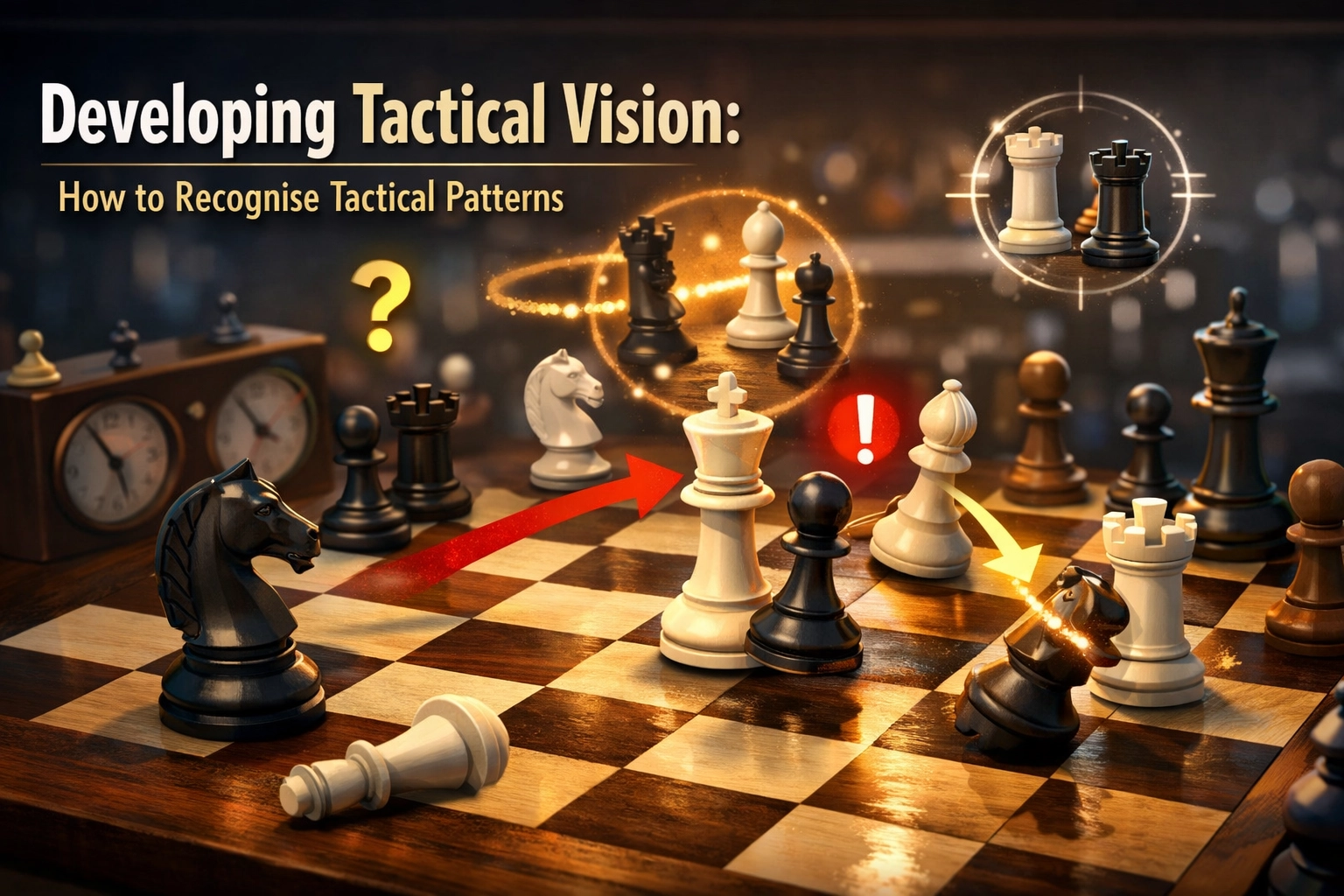
Knowing the definitions of tactical motifs in chess is one thing, but spotting them in the heat of a blitz game or a tense tournament match is completely different. This is where tactical vision comes into play. Tactical vision is the ability to look at a board and instantly see the tactical possibilities.
The magic of pattern recognition
Human brains are incredibly good at recognising patterns. When you learn to read, you don't look at every single letter; your brain recognises the shape of the word as a whole. Chess tactics work exactly the same way.
Grandmasters do not calculate every single possible move on the board. Instead, they look at the position and their brain instantly recognises familiar patterns. They see an uncastled King and an open file, and their brain immediately flashes "danger!" or "opportunity!" depending on whose turn it is.
To improve at chess tactics, you must build this visual library of patterns in your brain. When you solve a puzzle that features a classic back-rank checkmate, you are storing that pattern. The more patterns you store, the better your tactical vision becomes.
How repetition builds strong tactical vision
If you want to get physically fit, doing one push-up a month won't help. You need consistent repetition. Similarly, tactical vision is built through repetitive tactics training.
By exposing yourself to thousands of tactical puzzles over time, these motifs become second nature. You will start noticing that a specific formation of pawns and pieces always leads to a Greek Gift sacrifice, or that a Queen and Knight working together near the King often leads to a smothered mate. Repetition moves tactical spotting from the conscious, calculating part of your brain to the subconscious, intuitive part.
The role of spatial awareness and calculation
While pattern recognition gives you the intuition that a tactic exists, calculation is the hard work required to verify it. Spatial awareness is your ability to visualise how the board will look two, three, or four moves down the line.
When you suspect a tactic, you must calculate: "If I go here, he goes there. Then I check, he blocks, and I capture." You must see this sequence clearly in your mind's eye before touching a piece. Improving your spatial awareness takes time and deliberate practice, which brings us to our next crucial section.
Practice techniques for tactical improvement
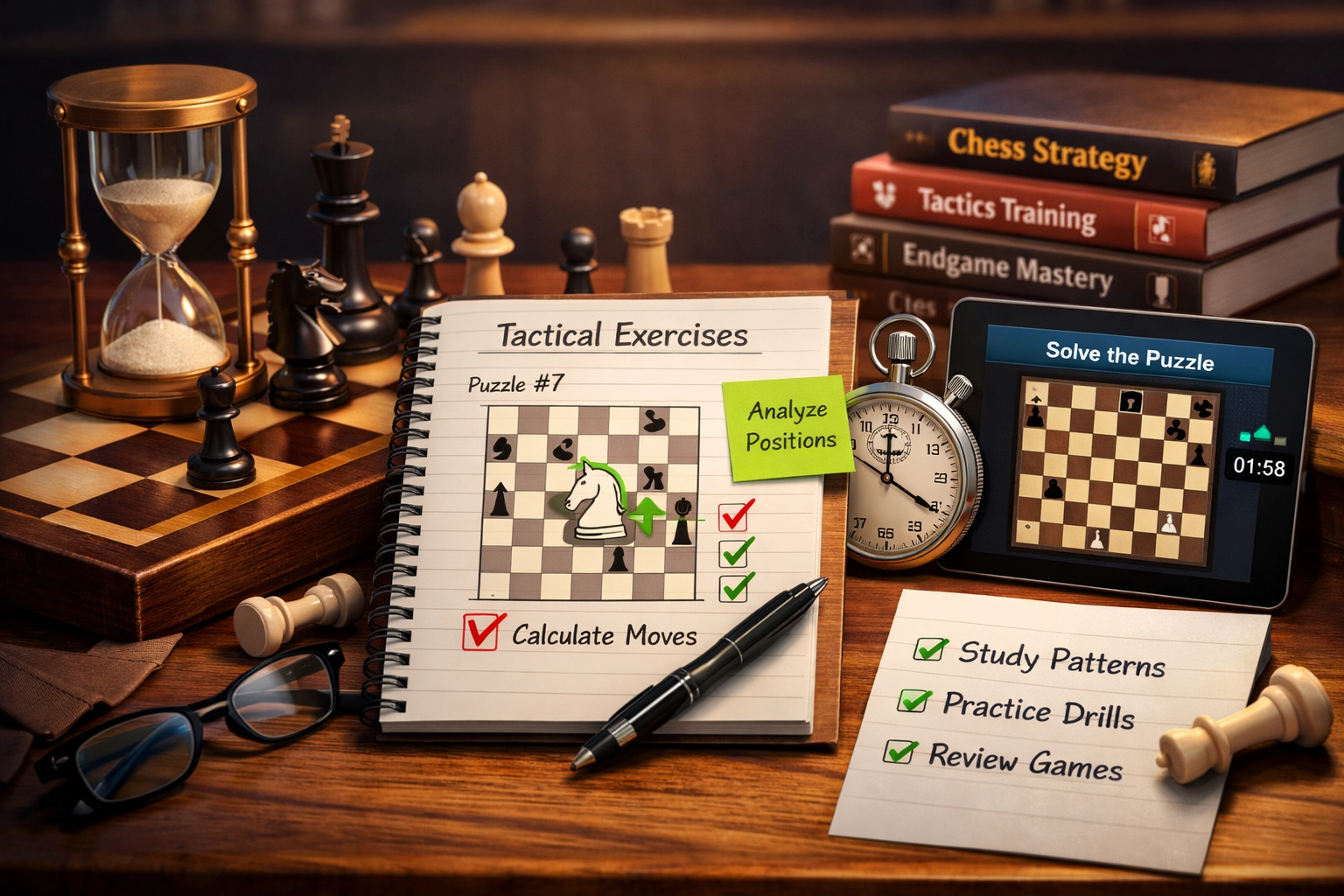
Many players ask, "How to improve at chess tactics?" The answer is not a secret potion; it is structured, consistent practice. Just mindlessly solving random puzzles on your phone while commuting might keep you entertained, but it won't lead to massive improvement. You need a structured approach.
Daily routines and exercises
Consistency beats intensity every single time. It is far better to solve chess puzzles for 20 minutes every day than to binge for three hours on a Sunday and do nothing the rest of the week.
Create a daily tactics training routine. For example, you can start your day with a session of 15-20 puzzles. Make it a habit, just like brushing your teeth or doing your morning yoga. When you train daily, your brain stays sharp, and the tactical patterns remain fresh in your memory.
Balancing tactics training with broader study
While tactics are incredibly important, chess is a vast game. You cannot ignore openings, positional strategy, and endgame principles. A good rule of thumb for beginner and intermediate players is to dedicate about 60% of your study time to tactics and the remaining 40% to strategy, endgames, and game analysis.
Remember, positional play and strategy are what create the favourable positions where tactics can emerge. If you play terrible openings and get cramped, passive positions, you will never get the chance to use your brilliant tactical skills. Balance is key. Study grandmaster games to see how they build up a position strategically before unleashing a tactical combination.
Using puzzles and drills effectively
The internet is flooded with chess puzzle trainers. Platforms like Chess.com, Lichess, and various mobile apps offer endless supplies of tactics. But how you use these tools matters more than which tool you use.
Choosing puzzles of the right difficulty
One of the biggest mistakes players make in tactics training is solving puzzles that are way too hard for them. If you stare at a puzzle for 20 minutes, get frustrated, and then click "show solution," you haven't really learned much.
Your sweet spot for practice should be puzzles that make you think, but which you can ultimately solve correctly about 70-80% of the time within a few minutes. This builds confidence and reinforces pattern recognition.
For speed and pure pattern recognition, it is also highly beneficial to solve very easy puzzles very quickly (like Puzzle Rush or Puzzle Storm). This drills the fundamental tactical motifs in chess deep into your subconscious.
Solving for deep understanding, not surface calculation
When you do an un-timed puzzle session, do not just guess the first move that looks good. This is a very bad habit!
Sit on your hands. Look at the board. Identify the opponent's threats first. Then, look for forcing moves: Checks, Captures, and Threats. Calculate the entire line to the very end before you make your first move on the screen.
If you make a move just to see what the computer plays in response, you are cheating yourself out of the calculation practice. In a real game, the board won't give you hints. Train yourself to see the full sequence of the tactic with deep understanding.
Mistakes players make in tactical training
Even with the best intentions, players often fall into traps during their tactics training that stunt their growth. Let us look at some common pitfalls and how to avoid them.
Relying on brute force calculation
Some players try to calculate every single legal move on the board. This is exhausting and highly inefficient. The human brain cannot work like a chess engine.
Instead of brute force, use targeted calculation based on pattern recognition. Let your intuition guide you to the most critical sectors of the board. Look for unprotected pieces, poorly placed Kings, and aligned pieces that could be vulnerable to skewers or pins. Focus your energy on calculating forcing moves rather than random pawn pushes.
The guessing game
We mentioned this earlier, but it is worth repeating. Guessing the first move in a puzzle because "it looks attacking" is the enemy of progress. If you guess and get it right, you have learned nothing. If you guess and get it wrong, you just get frustrated.
Discipline yourself to find the complete solution before moving. If you find a good move, look for a better one. This disciplined approach is exactly what you need when you sit down for a serious over-the-board tournament.
Approaching mistakes as learning opportunities
When you fail a puzzle, do not just sigh and click 'Next'. Stop! This is your golden opportunity to improve.
Ask yourself: Why did I miss this? Was there a tactical motif I didn't recognise? Did I calculate the first two moves but miss the opponent's defensive resource on move three? Did I miss a quiet, in-between move (zwischenzug)?
Take the failed puzzle, analyse it, understand the exact mechanism of the tactic, and try to remember the pattern. Some dedicated players even save their failed puzzles into a separate folder and review them at the end of the week.
Applying tactics in real games
You have done the hard work. You have solved thousands of puzzles, your rating on tactics trainers is skyrocketing, and you feel sharp. But when you play a real game, you still miss simple forks. Why does this happen?
Bridging the gap between puzzles and live play
The main difference between a puzzle and a real game is a flashing neon sign. When you open a puzzle, you are explicitly told, "There is a tactic here! Find it!"
In a real game, nobody taps you on the shoulder to tell you there is a winning combination on the board. You have to maintain a state of constant vigilance. To bridge this gap, you need to incorporate a "blunder check" routine into your thought process.
Before you finalize your move, quickly scan the board. Ask yourself: Are any of my pieces undefended? Can my opponent deliver a nasty check? What is my opponent's last move threatening? By making this a habit, you switch on your tactical radar during real games.
Staying calm and finding tactics under time pressure
Time trouble is the breeding ground for tactical blunders. When the clock is ticking down to the final seconds, panic sets in, calculation goes out the window, and players resort to playing purely on hope.
To handle time pressure, rely on the pattern recognition you built through repetitive practice. When there is no time to calculate deep lines, trust your intuition. Look for solid, forcing moves. Furthermore, do not let your opponent's time pressure make you play recklessly. Stay calm, breathe, and keep looking for the tactical motifs in chess that you know so well.
Long-term tactics strategy
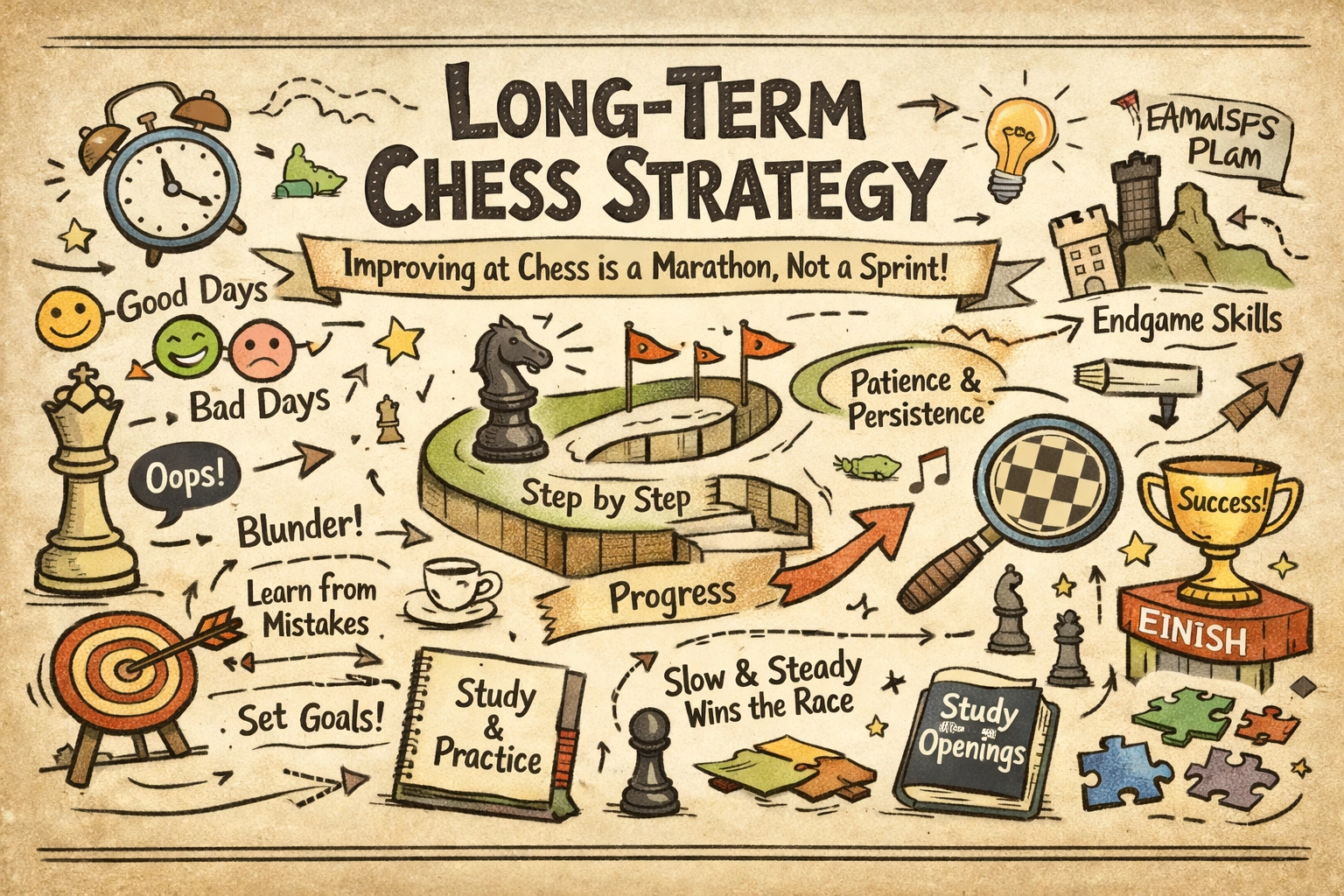
Improving at chess is a marathon, not a sprint. You will have days where you feel like a genius, and days where you blunder your Queen in one move. Building a sustainable plan is vital.
Building a sustainable tactics improvement plan
Your long-term strategy should evolve as you improve. When you are a beginner, focus purely on basic motifs like pins, forks, and one-move checkmates. As you reach the intermediate stage, introduce harder puzzles that require three to five moves of calculation, and start studying famous tactical games played by legends like Mikhail Tal or Garry Kasparov.
Keep a chess journal. Document the types of tactics you frequently miss. If you notice you are always missing Knight forks, dedicate a week to solving exclusively Knight fork puzzles. Customise your training to patch up your specific weaknesses.
Keeping engaged and avoiding training burnout
Solving puzzles can sometimes feel like a chore. If you ever feel burned out, change your routine.
Try solving tactics from physical chess books on a real, wooden board instead of a glaring computer screen. Play tactical variants like "Crazyhouse" or "Bughouse" with friends, which are incredibly fun and naturally train your brain to look for crazy tactical sacrifices. Join a local chess club or an Enthuziastic community session to discuss interesting positions with fellow chess lovers. Keep the joy of the game alive!
Conclusion
Chess tactics are the heartbeats of a chess game. They bring the board to life, turning a quiet, strategic standoff into a beautiful, dynamic battle of minds. From the humble pin to the glorious discovered double attack, these motifs are the tools you need to outsmart your opponents.
Remember, there are no shortcuts to how to improve at chess tactics. It takes dedicated tactics training, an understanding of fundamental tactical motifs in chess, and the patience to develop true tactical vision. So, set up your board, start your daily puzzle routine, and embrace the tactical side of this beautiful game. Happy playing, and may your forks always be sharp!
Frequently Asked Questions (FAQs)
1. What is the difference between strategy and tactics in chess?
Strategy is your long-term plan, such as controlling the centre, improving piece activity, or weakening the opponent's pawn structure. Tactics are short, forcing sequences of moves like a fork or a pin used to gain an immediate advantage or win material. Strategy guides you to a good position; tactics win you the game.
2. How much time should a beginner spend on tactics training daily?
For beginners, consistency is more important than volume. Spending 15 to 30 minutes a day on basic tactics training is highly effective. It helps build foundational pattern recognition without causing mental fatigue.
3. What are the most common tactical motifs in chess that I should learn first?
The most essential motifs to master first are pins, forks, skewers, and discovered attacks. Once you are comfortable with these, you can move on to slightly more complex ideas like double attacks, removing the defender, and interference.
4. Why do I easily solve puzzles but miss tactics in real games?
In puzzles, you already know a winning tactic exists, which puts your brain in "search mode." In a real game, nobody warns you. To fix this, develop a habit of doing a quick "blunder check" on every single move to see if any pieces are undefended or vulnerable to basic tactical motifs in chess.
5. Are blitz and bullet games good for improving tactical vision?
While fast time controls can help test your raw intuition, they are generally not good for learning or improving tactical vision. They often encourage superficial thinking and guessing. To truly improve at chess tactics, slower games where you have time to calculate deeply are much more beneficial.
6. Can older players still improve their chess tactics?
Absolutely! While young children may absorb patterns quickly, adult brains are excellent at structured learning and logical calculation. With consistent daily practice and a disciplined approach to solving puzzles without guessing, players of any age can significantly sharpen their tactical vision.

Comments