

By Enthuziastic Team
Namaste and welcome to the world of chess mastery! If the opening is the "Powerplay" where you get your pieces out, and the endgame is the "Slog Overs" where you finish the job, then the middlegame is the heart of the match the middle overs where the real battle is fought.
Many players in India, from eager school kids in Mumbai to club regulars in Chennai, often tell us: "Sir, I know my opening theory, I know how to checkmate with a King and Rook, but in the middle, I just get stuck. I don't know what plan to make."
Does this sound like you? You are not alone. The transition from opening to middlegame is where most players lose their way. They make moves just because it "looks safe," not because they have a concrete plan. But don’t worry, mastering the middlegame is not rocket science. It is about understanding simple logic, patterns, and strategies that have been played by legends like Vishy Anand and young tigers like Gukesh and Pragg.
In this comprehensive guide, we will deep dive into the middlegame strategies that can turn you from a confused mover into a confident planner. We will cover everything from basic principles to advanced pawn structures. So, grab your chai or coffee, set up your chessboard, and let’s improve your game!
- Why Middlegame Strategy is Essential for Overall Chess Improvement
- The Three Pillars of Middlegame strategies
- Key Middlegame Plans and Ideas
- Strategic Nuances: How to Win Positionally
- Common Middlegame Tactics and Their Role
- Pawn Structures: The Skeleton of the Position
- Practical Tips for Indian Club Players and Learners
- Examples of Typical Plans Emerging from Structure
- Conclusion: Your Journey to Chess Mastery
- Frequently Asked Questions (FAQs)
Why Middlegame Strategy is Essential for Overall Chess Improvement

You might wonder, "Why spend so much time on strategy? Can’t I just calculate tactics?"
Here is the truth: Tactics are important, but strategy is the soil from which tactics grow. You cannot simply "find" a tactic if your pieces are passive and uncoordinated. A strong middlegame strategy creates the conditions where tactical errors from your opponent become inevitable.

The "Soul" of the Game
The middlegame is where the unique character of the position emerges. In the opening, you are often following "book moves" (theory). In the endgame, you are following technical rules. But the middlegame? That is pure creativity and logic. It is where you show your true understanding of chess.
The Difference Between 1200 and 1600
If you are stuck at a rating of 1200-1300, it is likely because you are playing "move-by-move" chess. You see a threat, you react. You see a check, you give it. A 1600+ player thinks differently. They think in plans.
“I want to place my knight on that weak square.”
“I want to open the f-file for my rook.”
“I want to trade off his strong bishop.”
This shift in thinking from reacting to planning is what we will focus on today.
The Three Pillars of Middlegame strategies
Before we look at specific moves, you must understand the thought process. Every time you finish your development (usually around move 10-15), you need to stop and perform a positional assessment. Think of it like a doctor’s checkup for your position.
1. King Safety
This is priority number one. Is your King safe? Is your opponent’s King exposed?
If your opponent’s King is stuck in the center, your strategy should be aggressive: open lines and attack immediately.
If your King is weak, your strategy must be defensive or prophylactic (preventing threats).
2. Material Balance
Count the pieces. It sounds simple, but it dictates your plan.
Up material? Your strategy should be to simplify. Trade pieces (not necessarily pawns) to reach a winning endgame.
Down material? You must complicate the game. Avoid trades, create chaos, and try to trick your opponent.
3. Piece Activity and Structure
Look at the board without calculating. Who has more space? Who controls the center?
Better structure? Play patiently. Squeeze the opponent.
Worse structure? You often need to play dynamically to compensate for your long-term weaknesses.
Key Middlegame Plans and Ideas
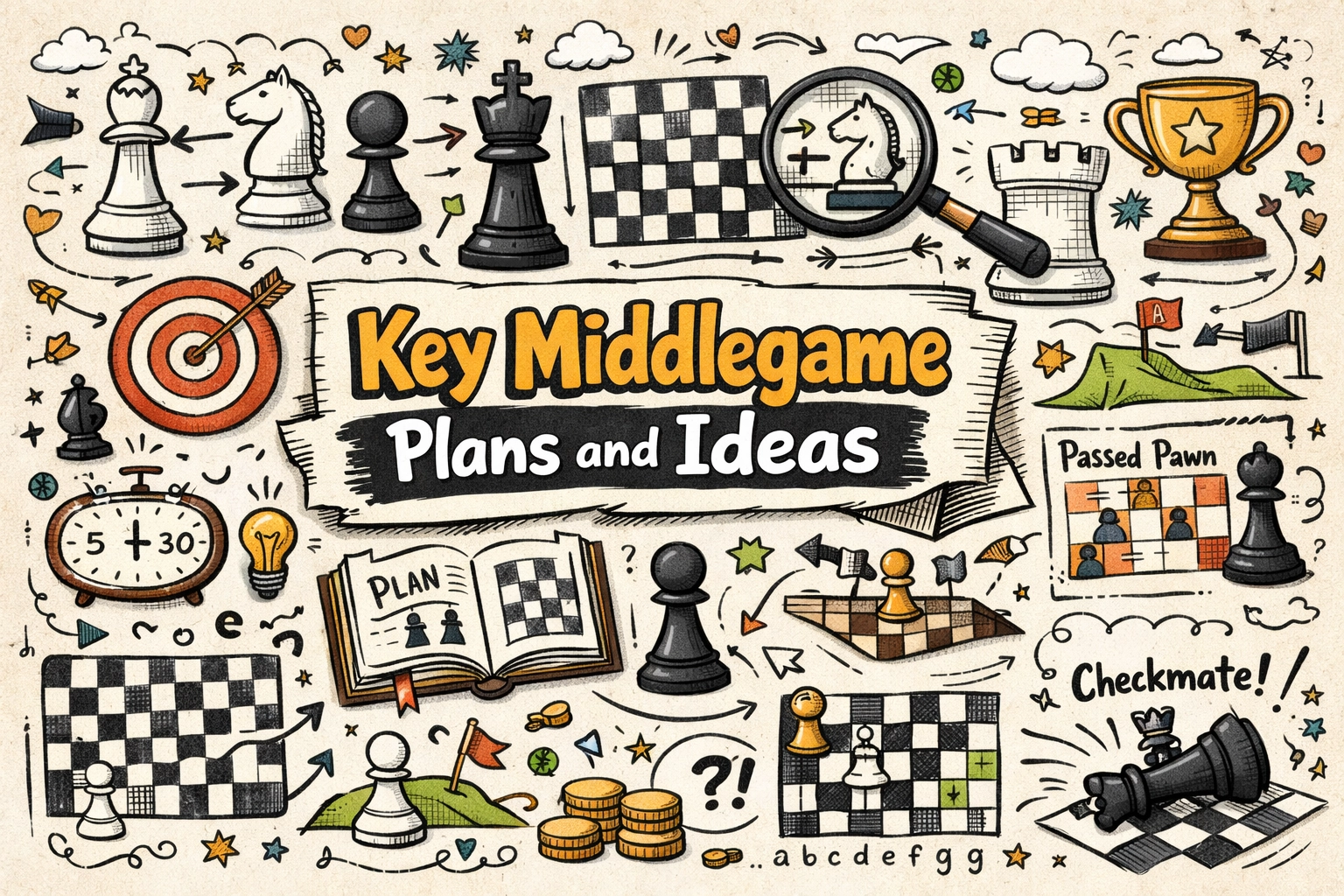
Now, let’s get into the meat of the matter. What are the actual plans you can use? You cannot just say "I will checkmate him." That is a wish, not a plan. A plan is a series of small goals.
Restricting Enemy Pieces (Prophylaxis)
One of the strongest strategies used by Grandmasters is restriction. It is not always about what you want to do; sometimes, it is about stopping what they want to do.
Imagine your opponent has a Knight that wants to jump to a dangerous square like d5. A simple pawn move (like c4 or e4) can take that square away. This is called controlling key squares.
Practical Tip: constantly ask yourself, "If it were my opponent's move, what would they play?" If the answer is a dangerous move, stop it first! This is called Prophylaxis.
Controlling Files and Squares
Chess is a game of territory. The board has 64 squares, but they are not all equal.
The Center (e4, d4, e5, d5): These are the "VIP seats" of the board. Control them, and your pieces can go anywhere.
Open Files: Rooks love open roads. If there is a file with no pawns (or only your opponent's pawn), put your Rook there! A Rook on an open file is like a fast bowler on a bouncy pitch very dangerous.
The 7th Rank: If you can get your Rook to the 7th rank (the rank where your opponent’s pawns start), it is usually a winning advantage. It attacks pawns from behind and cuts off the enemy King.
Piece Activity: The "Golden Rule"
If you remember only one thing from this blog, let it be this: Active pieces win games. An active piece is one that controls many squares and creates threats. A passive piece is stuck behind its own pawns.
The Bad Bishop vs. Good Bishop: If your pawns are on dark squares, your dark-squared bishop is "bad" because it is blocked by its own team. Your plan should be to trade this bad bishop or get it outside the pawn chain.
The "Octopus" Knight: A Knight on a protected central square (an outpost) is a monster. It reaches out in all directions like an octopus. If you can plant a Knight on e5 or d5 where no enemy pawn can kick it away, you are strategically winning.
Strategic Nuances: How to Win Positionally
Moving beyond the basics, let's talk about the sophisticated ideas that separate the experts from the amateurs.
1. The Power of Pawn Breaks
Beginners are often scared to move pawns in the middlegame because they don't want to weaken their King. But Pawn Breaks are essential. A pawn break is a move where you clash your pawn with an opponent's pawn to open lines.
Why do we need them? If you never trade pawns, the position stays closed. Your Rooks and Bishops will have no room to move. You need to "break" the wall.
Example: In the French Defense or Queen's Gambit, playing moves like c5 or e5 is critical to challenge the center.
Timing: You must time your break when your pieces are ready to use the open lines. If you open the position when your King is unsafe, you are just inviting trouble.
2. Seizing the Initiative
In India, we often play cricket aggressively, right? We want to set the tone. In chess, this is called the Initiative. Having the initiative means you make the threats, and your opponent has to react. When you have the initiative, the game flows your way. Even if the computer says the position is "equal," the human player defending has a much harder job than the one attacking.
How to get it? Sacrifice a pawn (a gambit), make a surprise move, or attack a weakness relentlessly.
How to keep it? Do not give your opponent a "breather." Keep making forcing moves (checks, captures, threats).
3. Piece Coordination
Have you ever seen a cricket team where the fielders collide with each other? That is bad coordination. In chess, your pieces must work together.
Battery: Lining up a Queen and Bishop on the same diagonal, or two Rooks on the same file.
Overloading: Forcing an enemy piece to defend two things at once, so it fails at both.
Don't leave pieces alone: A loose piece (unguarded) is a target for tactics. As the saying goes, "Loose pieces drop off (LPDO)."
Common Middlegame Tactics and Their Role
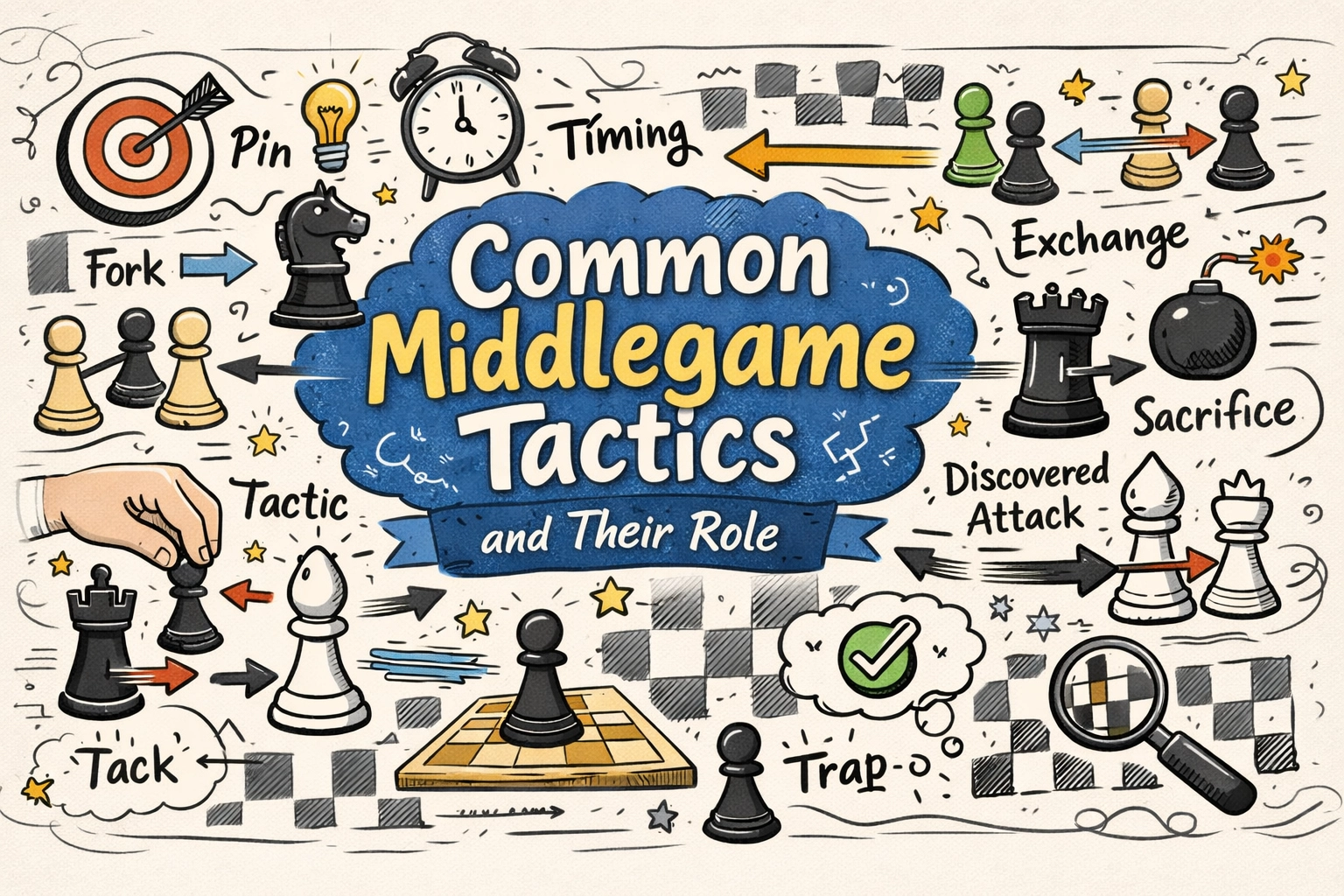
We said strategy comes first, but tactics are the "execution" of your strategy. You plan to control the center (Strategy), and suddenly you spot a Fork (Tactic). They go hand in hand.
1. The Fork and The Pin
These are the bread and butter of the middlegame.
Knights love Forks: Because Knights move weirdly, they are perfect for attacking two pieces at once. Always look at squares where a Knight can jump.
Bishops love Pins: If you can pin an opponent's Knight to their Queen or King, you effectively paralyze them. A pinned piece is a useless piece.
2. Discovered Attack
This is very sneaky. You move one piece, and suddenly a piece behind it attacks something. It is like a hidden fast bowler running in from behind the umpire!
Example: Moving a Knight to unleash a Bishop's attack on the Queen. These often lead to winning material immediately.
3. Removing the Defender
This is a tactical motif that relies on strategic understanding. If a specific Knight is the only thing guarding the Checkmate square, your plan shouldn't be "how do I checkmate?" but rather "how do I kill that Knight?" Once the defender is gone, the game is over.
Pawn Structures: The Skeleton of the Position
Strategies change completely based on where the pawns are. You cannot play the same way in every game. Here are three common structures and the plans that go with them.
1. The Open Center
What is it? Both e and d pawns are traded off. The center is empty.
The Plan: Speed! This is a tactical shootout. Piece activity is everything. Kings are unsafe. Do not waste time pushing flank pawns; bring your Rooks to the middle and attack.
2. The Locked Center (Closed Game)
What is it? The pawns are interlocked (e.g., White pawns on d4/e5 vs Black pawns on d5/e6).
The Plan: Flank Attack. Since the center is blocked, you cannot attack there. You must attack on the side where you have more space (Kingside or Queenside).
Indian Wisdom: Think of this like a traffic jam in Bangalore. You cannot go through the middle; you have to take the side roads! Use your "Pawn Storms" to break open the enemy King's fortress.
3. The Isolated Queen's Pawn (IQP)
What is it? You have a pawn on d4, but no pawns on the c or e files to protect it.
The Plan (For the side with IQP): You have space and open lines. You must attack in the middlegame. If you reach the endgame, that lone pawn becomes a weakness.
The Plan (Playing against IQP): Blockade it! Put a Knight right in front of that pawn so it cannot move. Then, trade pieces to reach an endgame where you can simply eat that weak pawn.
Practical Tips for Indian Club Players and Learners
At Enthuziastic, we see thousands of learners making the same mistakes. Here are some practical tips to help you apply these strategies in your next game.
1. Don't Just Memorize, Understand
Many students memorize the first 10 moves of the Sicilian Defense but have no clue what to do on move 11.
Tip: When you learn an opening, learn the middlegame plans associated with it. Ask your coach, "Sir, what is the 'dream' position for White here?" or "What is my bad piece in this opening?"
2. The "Worst Piece" Method
If you don't know what to play, look at your board. Which piece is doing nothing? Which piece is sleeping? Improve your worst piece. It is simple but powerful logic. If your Rook is stuck in the corner, bring it to the center. If your Knight is on the rim, bring it in. If you make every piece 10% better, your whole position becomes 100% stronger.
3. Talk to Your Pieces
This sounds funny, but try it. mentally ask your pieces:
"Mr. Bishop, are you happy on c1?" -> "No, I am blocked."
"Okay, I will move the pawn so you can come out." This internal dialogue helps you formulate plans based on the needs of your army.
4. Watch Your Opponent’s Threats
We often get so lost in our own "master plan" that we forget there is another person playing! Before every move, ask: "Why did they make that move?" Did they just attack my Queen? Are they threatening mate in 1?
Golden Rule: Safety first, then strategy.
5. Analyze Your Games
After the game is over, don't just close the board. Whether you won or lost, look at the game again.
Where did I lose the initiative?
Did I miss a pawn break?
Did I trade my good bishop for his bad knight? Use engines sparingly; try to find the logic with your own brain or a coach first.
Examples of Typical Plans Emerging from Structure
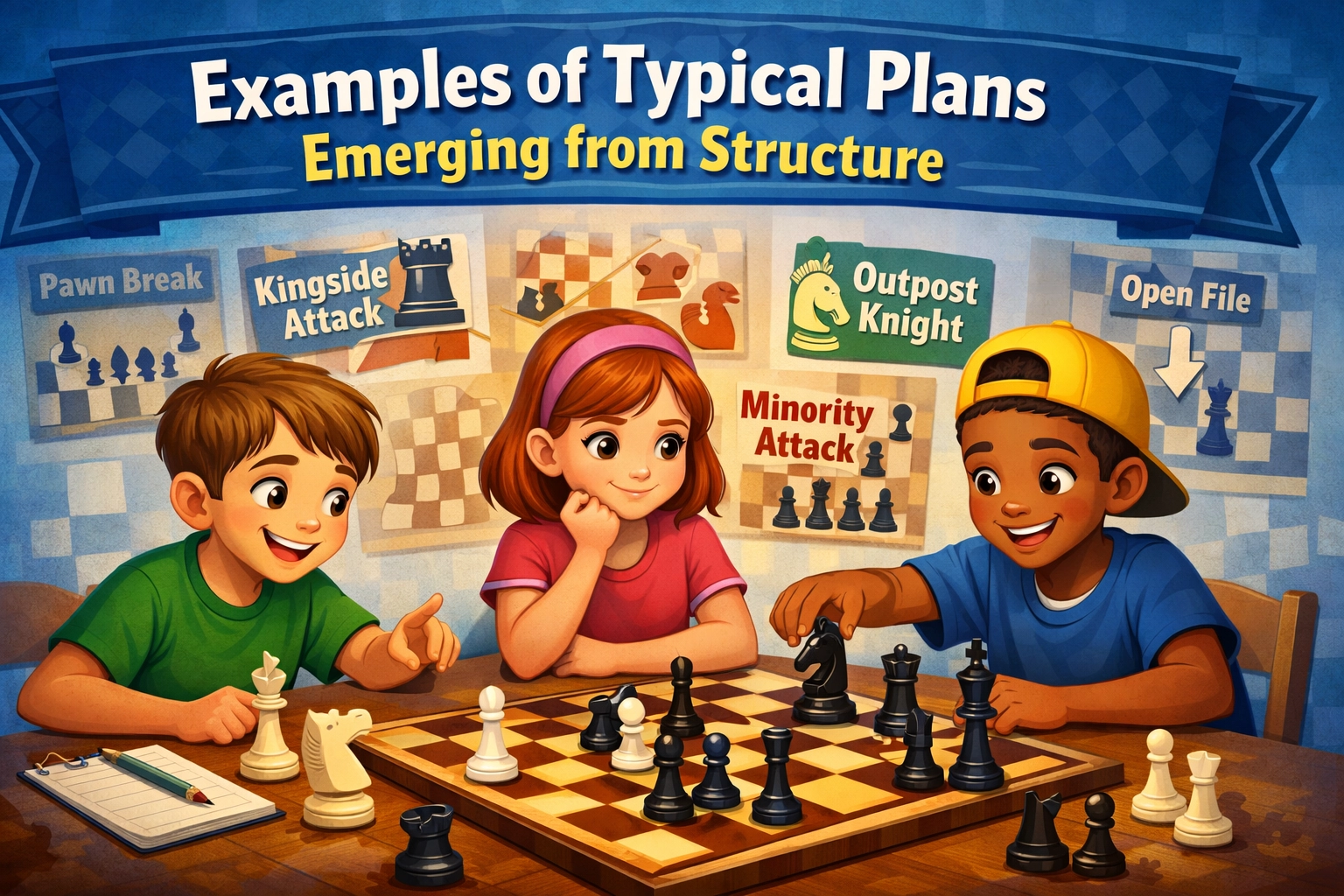
Let’s visualize a classic scenario to bring this all together.
Scenario: The Minority Attack Imagine a position (often from the Queen's Gambit) where White has pawns on a2, b2, d4. Black has pawns on a7, b7, c6, d5. White has fewer pawns on the Queenside (2 vs 3).
The Strategy: White pushes the pawns! b4, a4, b5.
The Goal: White wants to crash into Black’s structure. When the pawns trade on c6, Black will be left with a "backward" pawn that is weak.
The Outcome: White wins not by checkmate, but by creating a weakness that eventually falls. This is a pure strategic plan.
Scenario: The Opposite Side Castling White castles Queenside (Long), Black castles Kingside (Short).
The Strategy: It is a race!
The Plan: Throw your pawns at the enemy King. White pushes h4, g4, h5. Black pushes b5, a5, b4.
The Logic: Since your King is on the other side, moving pawns in front of your King doesn't weaken your King as much. Speed is the only thing that matters here.
Conclusion: Your Journey to Chess Mastery
Mastering the middlegame is a journey, not a destination. It requires patience, study, and a lot of practice. But the satisfaction of executing a perfect strategic plan where you squeeze your opponent until they have no good moves left is unlike anything else.
Remember, every Grandmaster was once a beginner who lost games in the middlegame. The difference is they learned from it. They learned to value activity, to respect king safety, and to think in plans rather than moves.
At Enthuziastic, we believe in learning together. Whether you are looking to refine your strategy, learn a new instrument, or master public speaking, our global community is here to support you. Chess is just one of the many ways we connect people and grow minds.
So, go ahead. Play that pawn break. Centralize that Knight. And most importantly, enjoy the beautiful complexity of the chess middlegame.
Keep playing, keep learning, and keep being Enthuziastic!
Frequently Asked Questions (FAQs)
Here are some common questions we get from our community regarding chess middlegames.
1. When does the opening end and the middlegame begin?
There is no fixed move number, but typically, the middlegame begins when:
Both players have developed their minor pieces (Knights and Bishops).
Kings have been castled (usually).
The Rooks are connected (the Queen has moved). This usually happens around move 10 to 15.
2. How do I know which side of the board to attack on?
Follow your Pawn Structure.
If your pawns "point" to the Kingside (e.g., pawns on c3, d4, e5), you generally attack the Kingside.
If your pawns point to the Queenside, attack there.
If the center is open, play in the middle!
Simple Rule: Play where you have more space.
3. Is it better to keep Bishops or Knights in the middlegame?
It depends on the position!
Open positions (few pawns): Bishops are better because they can zip across the board from long range.
Closed positions (lots of blocked pawns): Knights are better because they can jump over obstacles.
Generally, the "Bishop Pair" (having both bishops) is considered a slight advantage in most middlegames.
4. What should I do if I don't see any good plan?
If you are stuck, fall back on the basics:
Improve your worst-placed piece.
Prevent your opponent's next idea (Prophylaxis).
Make a safe "waiting move" that doesn't create weaknesses, and see if your opponent makes a mistake. Never make a pawn move just because you are bored; that usually creates a permanent weakness!
5. How can I improve my calculation for middlegame tactics?
Practice solving tactical puzzles every day. Look for specific motifs like Forks, Pins, and Skewers. Also, when playing, force yourself to calculate "Candidate Moves." Don't just play the first move you see. Look at:
Checks.
Captures.
Threats. Calculate these lines first before looking at quiet moves.
6. What is the "Initiative" and why is everyone talking about it?
The Initiative is essentially "control of the flow." If you have the initiative, you are dictating the action. You are attacking, and your opponent is defending. In the middlegame, having the initiative is often worth more than a pawn because it forces your opponent into difficult decisions where they are likely to make mistakes.
7. Should I memorize middlegame positions?
You cannot memorize specific positions because there are too many possibilities! Instead, memorize patterns and plans. For example, learn the typical plan for an "Isolated Queen's Pawn" or a "King's Indian Defense" structure. Recognizing the type of position is more useful than memorizing the exact placement of every piece.

Comments