

Chess is often described not just as a game, but as a vast ocean where a gnat may drink and an elephant may bathe. Whether you are playing a friendly match in your local club, competing in a district tournament, or just enjoying a quick game online after work, the way you start the game sets the tone for everything that follows.
At Enthuziastic, we believe that learning is a journey best shared with others. We see chess not just as a battle of wits, but as a beautiful language that connects people across the globe. Today, we are going to dive deep into one of the most fascinating and often intimidating parts of the game: the opening.
Many players, especially here in India where the legacy of Viswanathan Anand has inspired millions, feel a lot of pressure about openings. You might see Grandmasters rattling off the first 15 moves in seconds and think, "How will I ever remember all that?" But here is the good news: you do not need a computer brain to master openings. You need understanding, logic, and the right approach.
In this comprehensive guide, we will explore why chess openings matter, the golden rules that govern them, how to classify them, and most importantly, how you can build a repertoire that suits your unique personality. So, grab a cup of chai, sit back, and let us master the art of the chess opening together.
- Why chess openings matter in the game and how they influence the middle game and overall strategy
- Fundamental opening principles like controlling the centre, efficient piece development, king safety, and tempo
- Different categories of openings (open, closed, semi-open, and flank openings) and their strategic ideas
- Methods for learning and remembering openings, such as visualisation, chunking moves, spaced repetition, and quizzes
- How to choose a suitable opening repertoire based on playing style, goals, and flexibility
- Practical advice on practising openings through games, analysis, and studying master games
- Common pitfalls in opening study and how to avoid them
- Conclusion: your journey begins now
- Frequently Asked Questions (FAQs)
Why chess openings matter in the game and how they influence the middle game and overall strategy
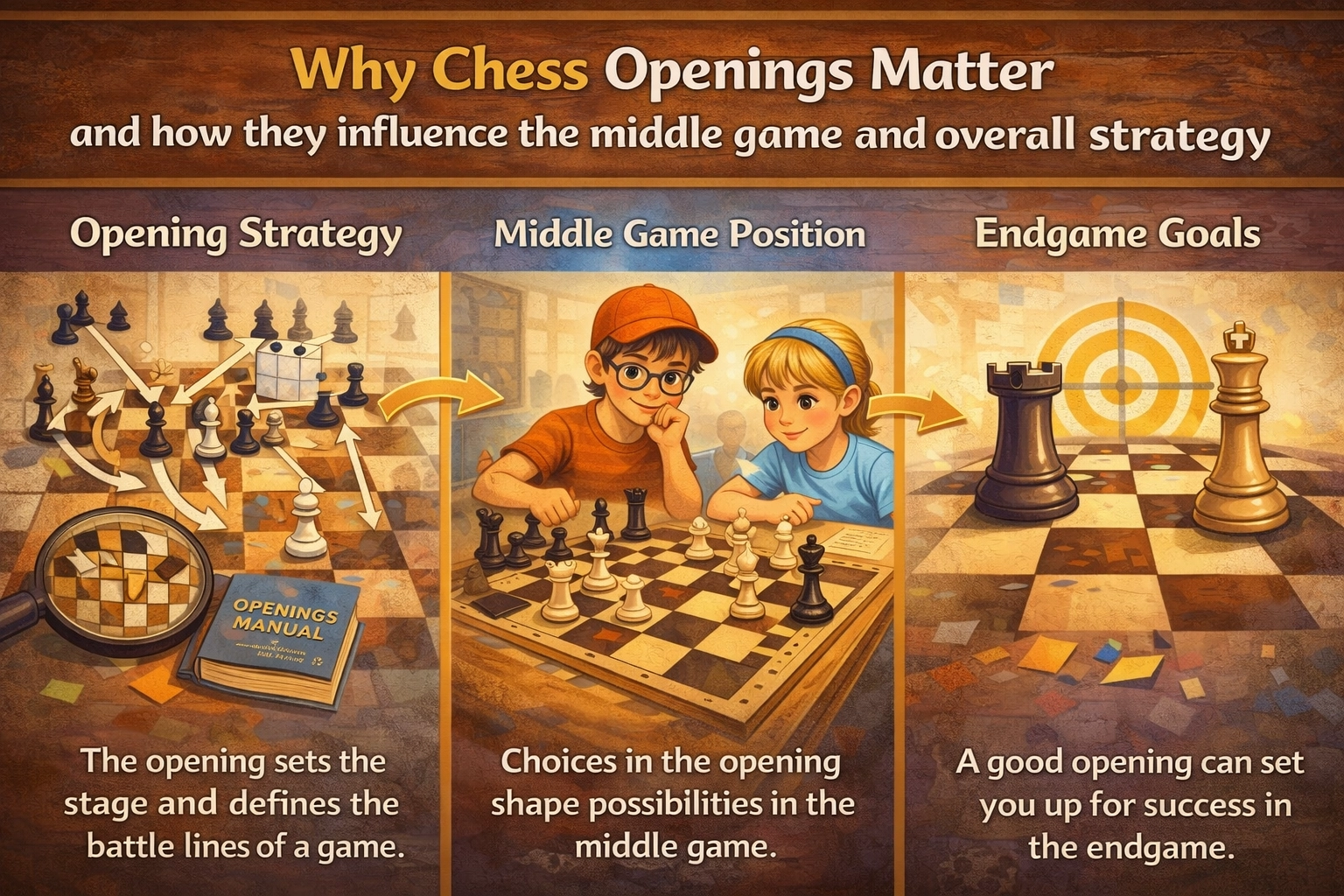
Imagine you are building a house. The opening is your foundation. If you build a weak foundation, it does not matter how beautiful your furniture is or how expensive the paint is; the house will eventually develop cracks. Similarly, in chess, if your opening play is shaky, your brilliant tactical ideas in the middle game will never get a chance to shine because you will be too busy fixing your early mistakes.
Setting the trajectory of the game
The opening is not just about getting your pieces out; it is about defining the terms of the battle. When you choose a specific opening, you are essentially telling your opponent what kind of game you want to play. Do you want a quiet, strategic game where you slowly squeeze the opponent? Or do you want a chaotic, tactical firestorm where pieces are flying off the board?
For example, if you play 1. e4 and your opponent responds with 1... c5 (the Sicilian Defence), the game immediately becomes sharp and unbalanced. If you play 1. d4 and they respond with d5, things might proceed more quietly. By mastering openings, you get to steer the ship rather than just floating along with the current.
The link to the middle game
A common misconception among beginners is that the opening and the middle game are two separate phases. In reality, the opening creates the middle game. The pawn structure you establish in the first 10 moves will dictate your plans for the next 30 moves.
If you block the centre with pawns, you are setting up a closed game where knights will be more valuable than bishops. If you open up the centre, your bishops will become long-range snipers. Understanding openings means you know what your "job" is once the theory ends. You won't be sitting there thinking, "Okay, my pieces are out, now what?" You will already know the plan.
Saving time on the clock
In modern chess, time management is crucial. If you know your opening well, you can play the first 10 to 15 moves quickly and confidently. This saves your precious thinking time for the complex calculations required in the middle game and endgame. There is nothing worse than falling into time pressure because you spent 20 minutes figuring out move number 4.
Fundamental opening principles like controlling the centre, efficient piece development, king safety, and tempo
Before you start memorising lines like a parrot (or doing "ratta" as we say in school), you must understand the logic behind the moves. Even Grandmasters sometimes forget specific lines, but they rarely play bad moves because they follow these core principles.
Controlling the centre: the hill strategy
Think of the chess board as a battlefield. The four squares in the absolute middle e4, d4, e5, and d5 are the "hill." Whoever controls the hill controls the battle.
If you have pawns or pieces controlling these squares, your troops have space to manoeuvre. You can easily shift your attack from the kingside to the queenside. If you let your opponent control the centre, your pieces will get pushed back, and you will feel suffocated. This is why almost every good opening starts with a pawn moving to e4 or d4. You are staking your claim on the hill.
Efficient piece development: bring out the cavalry
A common mistake beginners make is moving the same piece multiple times while others are still sleeping on the back rank. This is bad strategy. In the opening, your goal is to get your minor pieces (Knights and Bishops) into the game as fast as possible.
Imagine a cricket team where only two players go out to field while the other nine sit in the pavilion. You will lose the match! In chess, you need your whole team fighting.
Knights before Bishops: usually, it is better to develop knights first because they control the centre immediately, whereas bishops often need to wait to see which diagonal is best.
Don’t bring the Queen out too early: The Queen is powerful, but she is valuable. If you bring her out too soon, the opponent will attack her with their minor pieces. You will have to run away with your Queen, wasting time, while they develop their army for free.
King safety: tucking the king away
In the starting position, the King is sitting in the middle of the board, wide open to attacks. The centre is where the most violence happens in chess. Therefore, one of your top priorities is to get the King to safety.
This is usually done by castling. Castling does two wonderful things at once: it moves the King behind a wall of pawns, and it brings the Rook towards the centre where the action is. A good rule of thumb is to try and castle within the first 10 moves. A King stuck in the centre when the game opens up is usually a dead King.
Tempo: the value of time
In chess, "tempo" refers to a turn or a move. Time is a resource just like material. If you make a move that forces your opponent to react defensively, you are gaining a tempo. If you make a useless move that allows your opponent to improve their position, you are losing a tempo.
For example, if you move a Bishop to a square, and the opponent attacks it with a pawn, and you have to move the Bishop again, you have effectively wasted a turn. Always ask yourself: "Is this move improving my position, or am I just shuffling pieces?"
Different categories of openings (open, closed, semi-open, and flank openings) and their strategic ideas
Chess openings are broadly categorised based on the first move. Understanding these categories helps you navigate the vast sea of theory.
Open games (1. e4 e5)
This is the classic way to start a game, often taught to beginners first. White plays the King's pawn to e4, and Black mimics it with e5.
The Vibe: These games tend to be tactical and open. Lines are cleared quickly for piece activity.
Examples:
The Ruy Lopez (Spanish Game): One of the oldest and most respected openings. It is all about long-term pressure on Black’s center.
The Italian Game: Focuses on rapid development and controlling the centre. It is very intuitive and great for learning tactics.
The King’s Gambit: A romantic, high-risk opening where White sacrifices a pawn early to attack the Black King.
Semi-open games (1. e4, followed by anything other than e5)
Here, White plays e4, but Black refuses to mirror the move. Black breaks the symmetry immediately, leading to unbalanced positions.
The Vibe: These games are often asymmetrical. Both sides have different advantages, and the battle is fierce.
Examples:
The Sicilian Defence (1... c5): The most popular response to e4 at the master level. Black fights for the centre from the flank (c-file). It is sharp, aggressive, and full of theory.
The French Defence (1... e6): solid and resilient. Black accepts a slightly cramped position in exchange for a solid structure and counter-attacking chances later.
The Caro-Kann (1... c6): Known for being incredibly solid. It is hard for White to break down the Caro-Kann wall.
Closed games (1. d4 d5)
When the game starts with the Queen's pawns, the positions tend to remain "closed" for longer. The pawns block the lines, meaning pieces cannot fly across the board easily.
The Vibe: Strategic, slow-burning, and positional. It is more about maneuvering and long-term planning than immediate checkmating attacks.
Examples:
The Queen’s Gambit: White offers a pawn (the c-pawn) to fight for better central control. It is a very classical and principled way to play.
The London System: A very popular "system" opening where White puts pieces on the same squares almost regardless of what Black plays. It is easy to learn and very solid.
Flank openings
These are openings where White does not move a central pawn on move 1. Instead, they might move a knight or a side pawn.
The Vibe: Hypermodern. The idea is to control the centre from a distance with pieces rather than occupying it immediately with pawns.
Examples:
Reti Opening (1. Nf3): flexible and tricky.
English Opening (1. c4): controlling the d5 square from the side.
Methods for learning and remembering openings, such as visualisation, chunking moves, spaced repetition, and quizzes
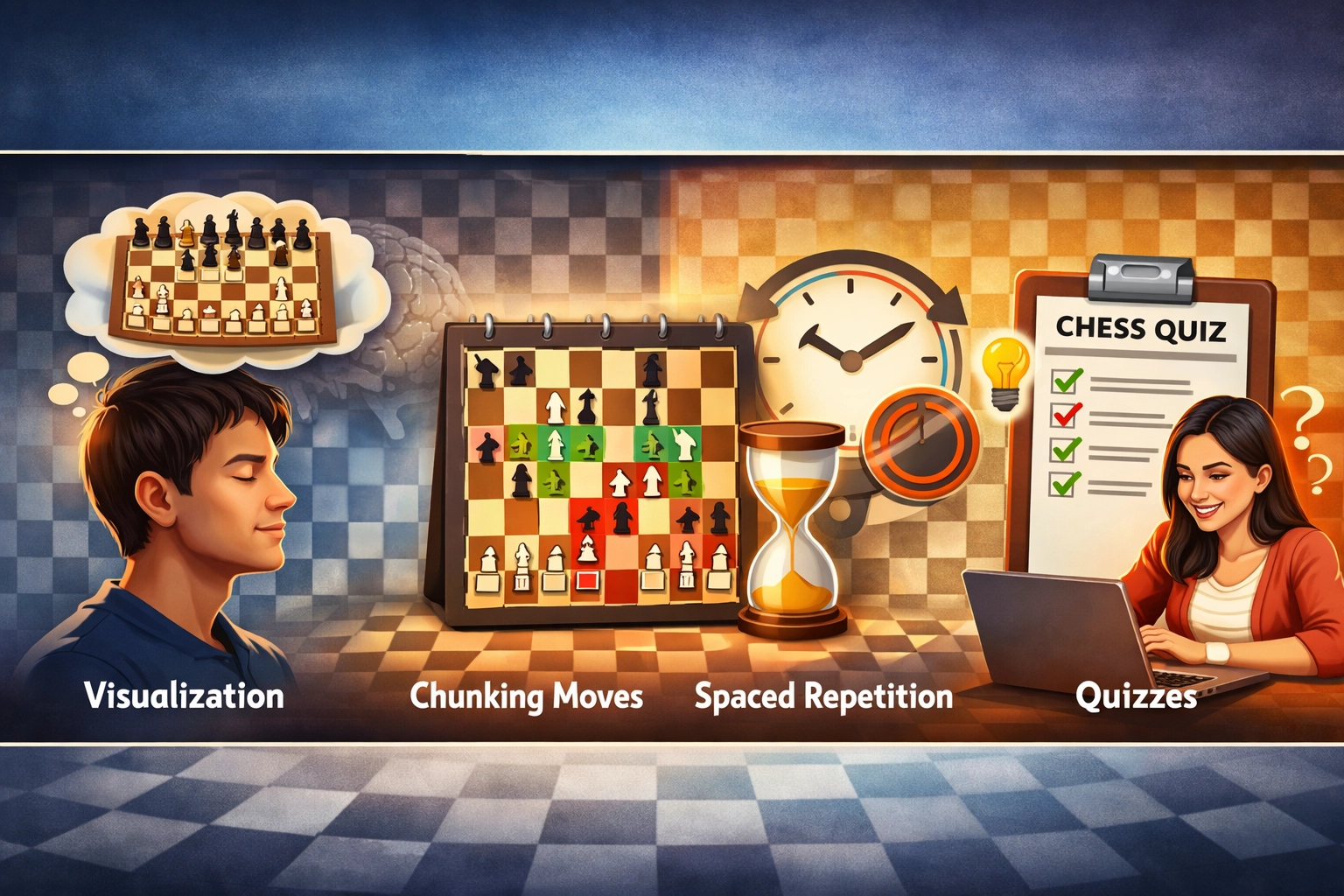
This is the part where many students get stuck. They try to rote learn moves from a book without understanding. At Enthuziastic, we encourage "smart learning." Here is how you can make openings stick in your brain.
Visualisation: seeing the board in your mind
When you are studying an opening, don't just move the pieces on the board blindly. Stop and look. Try to close your eyes and visualize the position. Where are the weak squares? Which diagonal is open?
By visualizing, you are training your brain to recognize patterns rather than just coordinates. If you can "see" that the f7 square is weak in a specific opening, you won't need to memorize the exact move order to attack it; your intuition will guide you there.
Chunking moves: eating the elephant bite by bite
You cannot memorize a 20-move variation in one go. That is like trying to swallow a whole chapati without chewing. Instead, use "chunking."
Break the opening down into small logical groups (chunks) of 3-4 moves.
Chunk 1: The Setup (getting the pawns and knights out).
Chunk 2: The Development (getting bishops out and castling).
Chunk 3: The Conflict (where the pawns clash).
By remembering the purpose of the chunk (e.g., "In this phase, I am just trying to castle"), the individual moves become easier to recall.
Spaced repetition: the science of memory
Have you ever studied for an exam, memorized everything, and forgotten it two days later? That is because you crammed. The brain needs "spaced repetition" to move information from short-term to long-term memory.
Day 1: Learn a new opening line.
Day 2: Review it.
Day 4: Review it again.
Day 8: Review it again.
There are many online tools and apps that use this algorithm. They will show you the moves you are likely to forget just before you forget them. This is the most efficient way to build a repertoire.
Quizzes and active recall
Reading a book is passive. Your brain can trick you into thinking you know it. To really learn, you must test yourself.
Cover the notation side of your book. Look at the position and ask, "What is the move here?" If you get it right, great. If not, don't just look at the answer immediately. Try to figure out why your move was wrong and the book move was right. This active struggle is where the real learning happens.
How to choose a suitable opening repertoire based on playing style, goals, and flexibility
One of the most common questions we get at Enthuziastic is, "Sir, which opening is the best?" The answer is: the one that fits you.
Know yourself: style assessment
Are you an aggressive player? Do you like taking risks, sacrificing material, and attacking the King? Or are you a quiet, positional player who likes to grind the opponent down slowly?
For the Attacker: Try the King’s Gambit, the Scotch Game, or the Sicilian Defence.
For the Strategist: Try the Queen’s Gambit, the Caro-Kann, or the Ruy Lopez.
For the "Safety First" Player: Try the London System or the Petroff Defence.
Do not play the Sicilian Defence just because your favourite Grandmaster plays it. If you hate chaotic positions, playing the Sicilian will only make you miserable.
Define your goals
The Casual Player: If you play for fun, pick "system" openings (like the London System or King’s Indian Attack). These require less memorization because the setup is almost always the same. You can learn one system and play it for years.
The Tournament Player: If you want to compete, you need a broader repertoire. You need a main weapon, but also a backup option to surprise opponents who might have prepared for you.
Flexibility and transpositions
A good repertoire should have some flexibility. As you get better, you will learn about "transpositions" where you start with one opening but switch into another.
For example, you might start with 1. d4, but depending on what Black does, you might end up in a position that usually comes from the English Opening. Choosing openings that share similar pawn structures makes your life easier because the plans remain similar.
Practical advice on practising openings through games, analysis, and studying master games
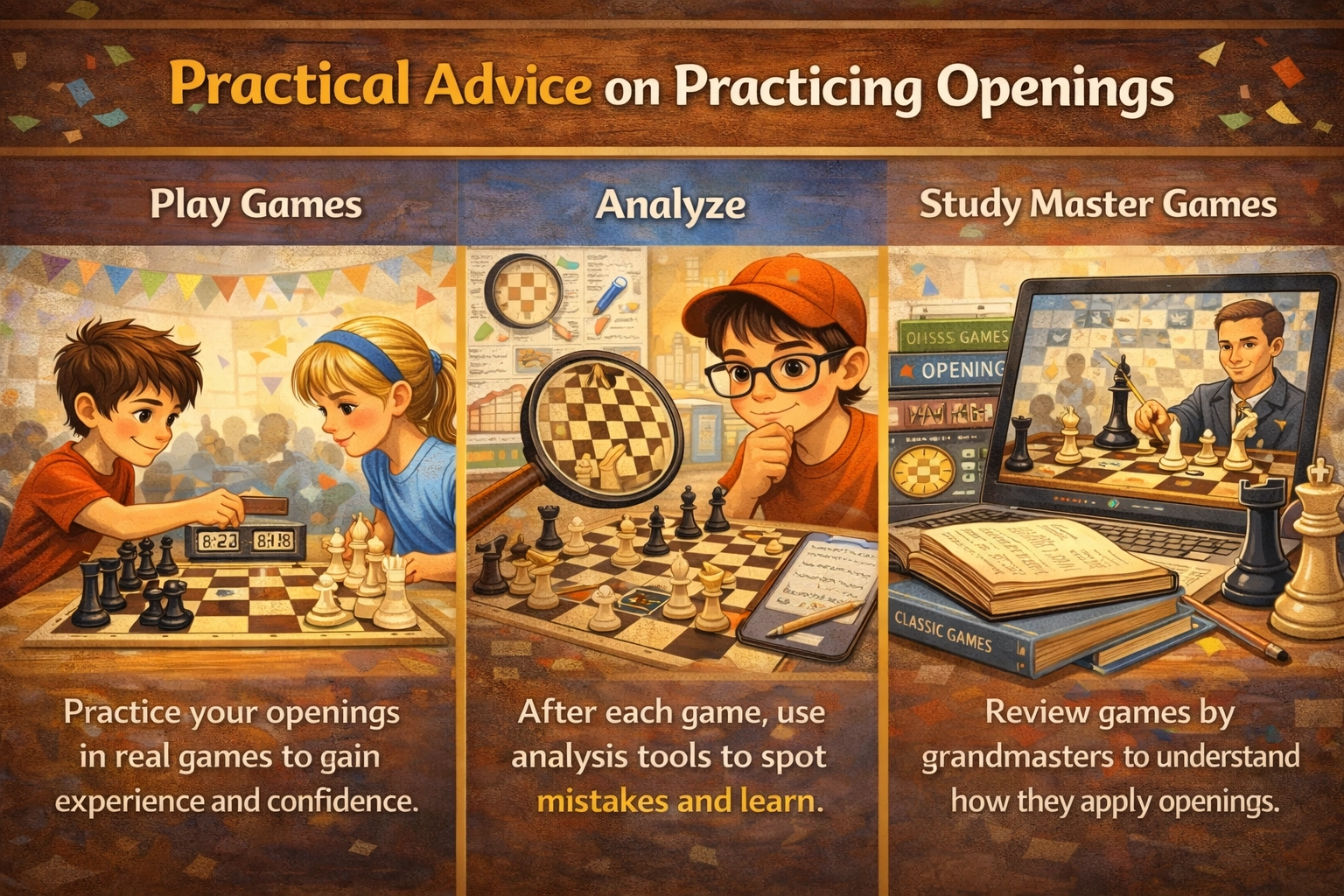
You have chosen your openings. You have memorized the first few moves. Now, how do you actually get good at them?
Study master games: find your hero
The best way to learn an opening is to see how the masters play it.
If you want to play the King’s Indian Defence, look at games by Garry Kasparov or Bobby Fischer. Don't just look at the opening moves. Look at the whole game.
How did they attack?
Where did they place their pieces in the middle game?
What were the common endgames?
By watching the "history" of the opening in the hands of legends, you gain a conceptual understanding that raw memorization can never give you.
Analyze your own games
This is non-negotiable. After every game you play (especially online), you must analyze it.
Did you follow your opening prep? At what move did you go "out of book"? Did you play a move that the computer says is a mistake?
If you lost a game because you forgot the theory, go back and look it up immediately. That pain of losing makes the lesson stick. "Ah, I remember, last time I moved the Knight there I got checkmated. I won't do that again."
Practice games: blitz vs. rapid
Blitz (3-5 minutes): Good for testing your memory and reflexes. You can play many games quickly to see different variations of your opening.
Rapid (10-15 minutes+): Much better for deep learning. In rapid games, you have time to think about the plans and structures.
We recommend a mix. Use blitz to test your knowledge, but use rapid games to deepen your understanding.
Use engines wisely
Computers are great tools, but they can be dangerous for beginners. A computer might tell you that a move is "+0.5" (slightly better), but if the position is incredibly complicated and impossible for a human to understand, it is not a practical choice.
Look for moves that are "human" moves that have a clear plan and logic. Don't just blindly follow the top engine line if you don't understand why it is good.
Common pitfalls in opening study and how to avoid them
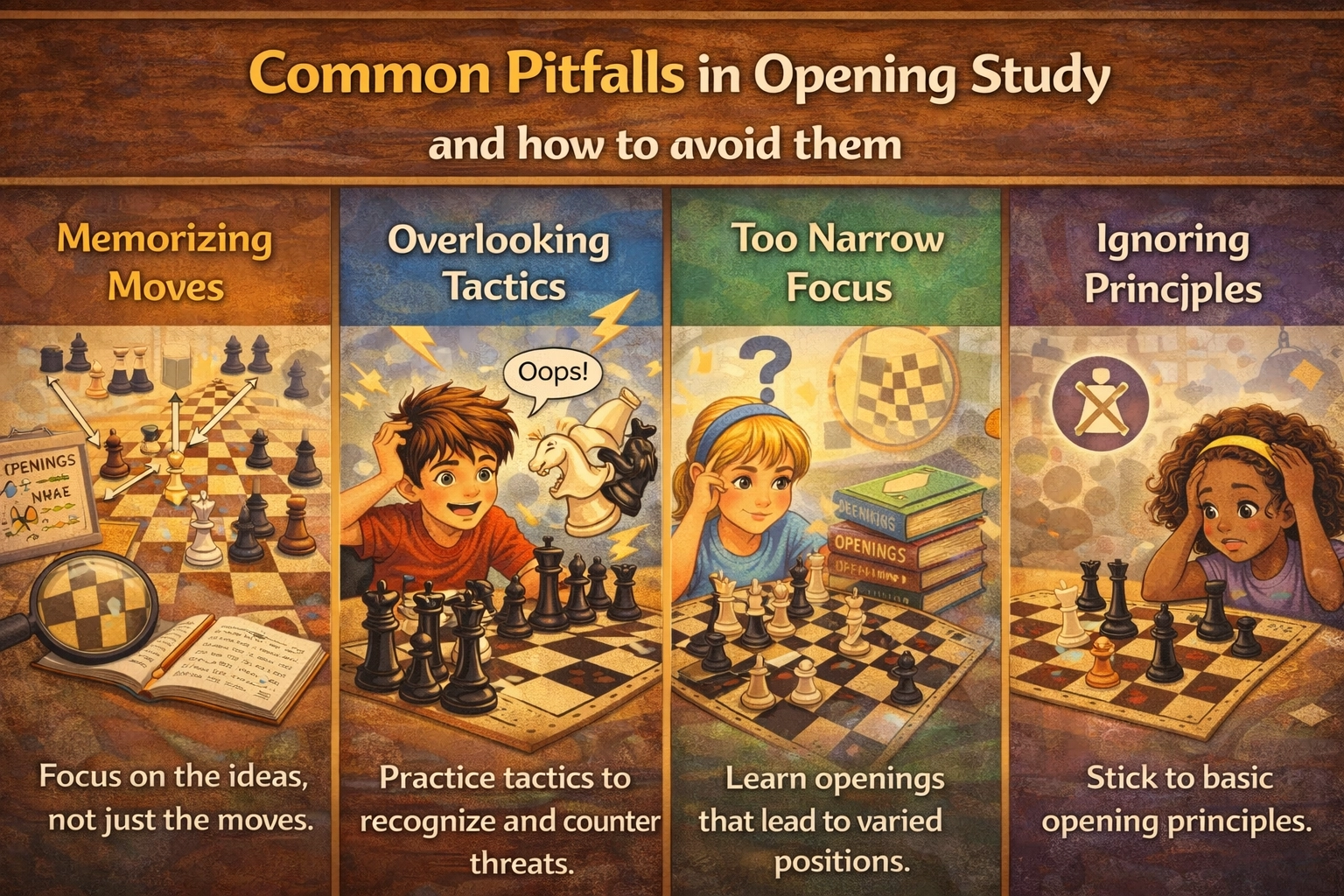
The path to mastery is full of traps. Here are the most common ones we see students falling into.
The "Ratta" Trap (Rote Memorization)
We cannot stress this enough: memorizing moves without understanding ideas is a recipe for disaster.
If you memorise 15 moves deep, and your opponent plays a weird move on move 6 that isn't in your book, you will panic. You won't know what to do because you don't know why you were playing those moves. Always prioritize ideas over move orders.
The "Opening Collector" Syndrome
Some players spend all their time watching videos on "The Best Opening to CRUSH White" or "The Unbeatable Trap." They switch openings every week.
Result? They know the first 5 moves of 20 different openings, but they don't know any opening deeply. It is much better to be a master of one opening than a jack of all trades. Stick to your choice for at least a few months before switching.
Ignoring the opponent
Chess is a two-player game. You cannot just play your moves in a vacuum. You have to react to what your opponent is doing.
Sometimes players are so focused on their "system" that they miss a blunder by their opponent, or worse, they miss a threat. Always ask, "What is my opponent trying to do?" before you play your pre-planned move.
Neglecting the rest of the game
Openings are fun and easy to study, so players often spend 90% of their time on them. But remember, the opening is just the start. If you come out of the opening with a great advantage but drop your Queen in the middle game, the opening didn't matter.
Keep a balanced diet. Study tactics, study endgames, and study strategy. The opening is just the appetizer; the middle game is the main course.
Conclusion: your journey begins now
Mastering chess openings is not about becoming a walking encyclopaedia. It is about building confidence. It is about sitting down at the board, looking your opponent in the eye, and knowing that you are ready for whatever battle lies ahead.
Remember, every Grandmaster was once a beginner who didn't know where to put their Knight. It takes time, patience, and practice. But the satisfaction of playing a perfect opening, where every piece flows naturally into a winning attack, is one of the greatest feelings in the world.
At Enthuziastic, we are here to support you on this journey. Whether you are learning to beat your neighbour or aiming for a FIDE rating, the principles remain the same. Control the centre, develop your pieces, keep your King safe, and have fun.
So, go ahead. Pick an opening that excites you. explore its secrets, learn from your losses, and enjoy the beautiful game of chess. Your move!
Frequently Asked Questions (FAQs)
1. How many openings should a beginner learn?
As a beginner, you don't need to overwhelm yourself. We recommend learning just one opening for White (like the Italian Game or London System) and two defences for Black (one against 1. e4 and one against 1. d4). Focus on understanding the main ideas of these three setups rather than memorising endless variations.
2. Is it better to study openings with books or videos?
Both have their pros and cons. Videos are great for getting a general overview and understanding the "vibe" of an opening quickly. However, books (and interactive courses) are often better for deep study because they force you to go slow and visualize the moves. For Indian students, we often find that a combination works best watch a video to get interested, then use a book or database to study the details.
3. What if my opponent plays a move I have never seen before?
Don't panic! This happens to everyone, even World Champions. If you are "out of book," revert to the fundamental principles:
Control the centre.
Develop your pieces to active squares.
Keep your King safe.
Ask yourself: "What is the threat behind their strange move?"
If you follow the basics, you will usually find a decent move.
4. Should I learn "trap" openings to win quickly?
Opening traps (like the Scholar's Mate or the Fried Liver Attack) can be fun and get you some quick wins against other beginners. However, relying on them is a bad habit. As you play against stronger opponents, they will know how to defend against these traps, and you will end up in a bad position. It is much better to learn sound, solid openings that give you a good game even if your opponent plays perfectly.
5. How much time should I spend studying openings compared to tactics?
For beginners and intermediate players, tactics are more important. A rough guideline is:
Beginner (Rating < 1000): 20% Openings, 80% Tactics & Endgames.
Intermediate (Rating 1000-1600): 30% Openings, 70% Tactics & Strategy.
Advanced (Rating 1600+): 40-50% Openings.
Don't become an "opening scholar" who loses because of a simple tactical oversight.
6. What is the most flexible opening system?
If you want an opening you can play against almost anything, the London System (for White) and the King’s Indian Defence (for Black) are very popular choices. In these systems, you focus on your own setup rather than reacting to every single move the opponent makes. This makes them easier to learn and very flexible.
7. Why is controlling the centre so important?
Think of the chess board like a football field. If you control the midfield, you can pass the ball to the strikers (attack) or back to the defenders (defence) easily. If your pieces are stuck on the edges (the sidelines), they take a long time to get into the game. Central control gives your pieces mobility and restricts your opponent's options.
8. How do I stop forgetting my opening moves?
The key is consistency and understanding.
Don't try to learn too much at once.
Review your openings regularly (spaced repetition).
Most importantly, understand the reason for the move. If you know that "this pawn moves here to stop the Knight," you won't forget it. If you just remember "h3", you will forget it. Connect the move to a plan.

Comments