


- What is the Digital SAT?
- Why is SAT Prep important?
- Understanding the Digital SAT format
- When should you start SAT Prep?
- The four pillars of effective SAT Prep
- How to prepare for SAT Reading & Writing
- How to prepare for SAT Math
- Make the most of the Bluebook App
- The importance of an adaptive testing strategy
- Weekly SAT Prep study plan
- Common SAT Prep mistakes to avoid
- Resources for SAT Prep
- Should you self-study or take a SAT Prep Course?
- Final tips for SAT success
- Conclusion
- Frequently Asked Questions (FAQs)
Whether you're aiming for a competitive university in the United States or simply want to strengthen your college application, effective SAT prep can significantly improve both your score and your confidence.
In this comprehensive guide, we'll cover everything you need to know about SAT preparation, including the latest Digital SAT format, study techniques, timelines, resources, and expert tips to maximize your performance.
What is the Digital SAT?
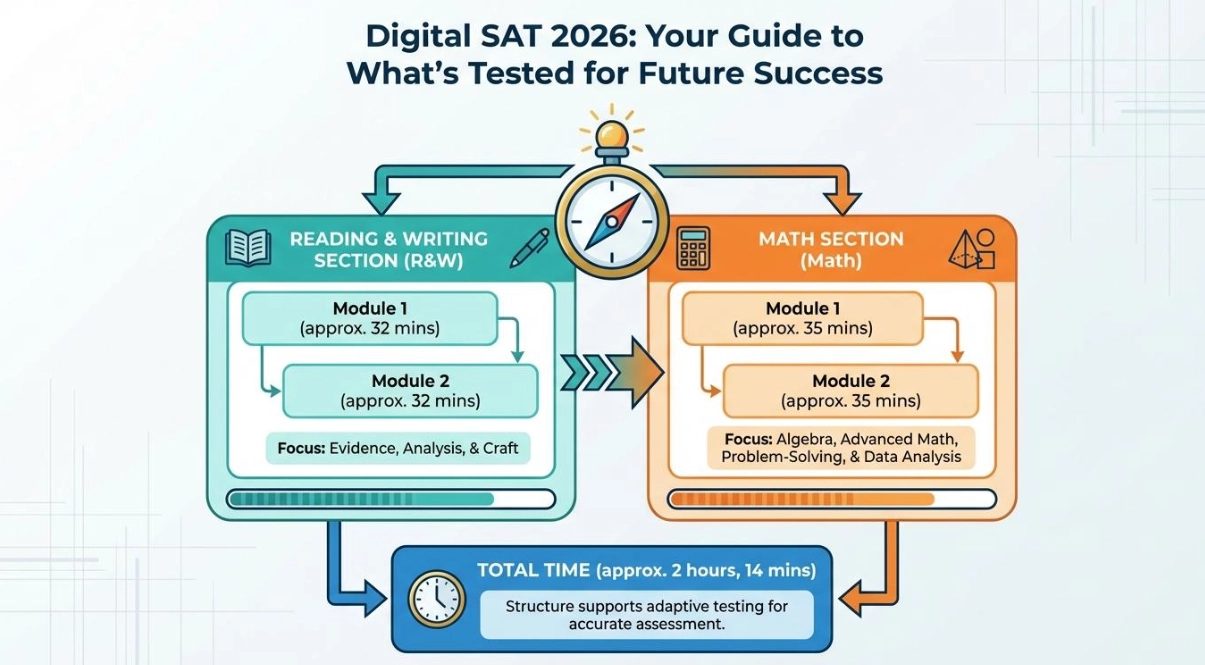
The Scholastic Assessment Test (SAT) is a standardized exam administered by the College Board and accepted by thousands of colleges and universities worldwide. It evaluates the academic skills students have developed throughout high school and helps colleges assess college readiness.
The current Digital SAT is shorter, more streamlined, and delivered entirely on a computer through the Bluebook™ testing application.
The exam consists of two sections:
Reading & Writing
Mathematics
Unlike the previous paper-based format, the Digital SAT uses adaptive testing, meaning the difficulty of the second module in each section depends on a student's performance in the first module.
Why is SAT Prep important?
Many students underestimate the importance of structured SAT prep, assuming that strong classroom performance alone will guarantee a high score. While school knowledge provides the foundation, the SAT measures much more than subject knowledge.
Effective SAT prep helps students:
Understand the exam format.
Recognize recurring question patterns.
Improve time management.
Build test-taking confidence.
Reduce careless mistakes.
Learn strategic guessing techniques.
Increase speed without sacrificing accuracy.
Students who follow a structured preparation plan often see substantial improvements compared to those who rely solely on self-study.
Understanding the Digital SAT format
Before beginning your SAT prep, it's essential to understand what you'll encounter on test day.
Reading & Writing
The Reading & Writing section contains:
Two adaptive modules
54 multiple-choice questions
64 minutes total
Instead of long passages, students answer one question per short passage, making reading more focused and manageable.
Questions assess four key skill areas:
Information and Ideas
Craft and Structure
Expression of Ideas
Standard English Conventions

Mathematics
The Mathematics section includes:
Two adaptive modules
44 questions
70 minutes
Students answer both multiple-choice and student-produced response questions.
The four official math domains include:
Algebra
Advanced Math
Problem-Solving and Data Analysis
Geometry and Trigonometry
A built-in Desmos graphing calculator is available throughout the entire Math section.
When should you start SAT Prep?
One of the most common questions students ask is:
"When should I start preparing for the SAT?"
The answer depends on your target score and current academic level.
A general guideline is:
Preparation Time | Ideal For |
|---|---|
2–3 Months | Students already scoring near their target |
4–6 Months | Most students |
6–9 Months | Students aiming for top universities or significant score improvement |
Starting early allows students to master concepts gradually without feeling overwhelmed.
The four pillars of effective SAT Prep
A successful SAT prep strategy combines four essential components.
1. Concept mastery
Students should first build strong foundations in reading comprehension, grammar, algebra, advanced math, geometry, and data analysis before focusing on speed.
Without conceptual understanding, practice questions become guesswork.
2. Guided practice
Simply solving hundreds of questions isn't enough.
Students benefit from:
Teacher explanations
Step-by-step problem solving
Guided corrections
Strategy demonstrations
Concept reinforcement
Learning why an answer is correct is just as important as finding the correct answer.
3. Timed practice
Once concepts are mastered, students should gradually introduce timed exercises.
Timed practice helps students:
Improve pacing
Build stamina
Handle pressure
Develop quick decision-making skills
Practicing under exam conditions prepares students for the real testing environment.
4. Error analysis
One of the most overlooked aspects of SAT prep is reviewing mistakes.
Top-performing students don't simply move on after answering questions—they analyze:
Why the answer was incorrect
Which concept was misunderstood
Whether the mistake resulted from rushing
How to avoid repeating it
Maintaining an error log is one of the most effective ways to improve scores consistently.
How to prepare for SAT Reading & Writing

Reading & Writing requires more than simply reading quickly.
Students should learn how to:
Identify central ideas.
Interpret evidence.
Analyze author purpose.
Understand tone.
Improve vocabulary through context.
Master grammar and punctuation.
Revise sentences for clarity and organization.
Daily reading practice using science articles, editorials, historical passages, and literary texts can strengthen comprehension skills naturally.
How to prepare for SAT Math
The Digital SAT emphasizes reasoning over memorization.
Students should focus on:
Algebra
Linear equations
Inequalities
Ratios
Proportions
Advanced Math
Functions
Quadratic equations
Exponents
Polynomials
Problem-Solving & Data Analysis
Percentages
Graphs
Tables
Statistics
Probability
Geometry & Trigonometry
Triangles
Circles
Coordinate Geometry
Angles
Right Triangle Trigonometry
Instead of memorizing formulas alone, students should understand how and when to apply them.
Make the most of the Bluebook App

The Digital SAT is administered through the Bluebook™ application.
During your SAT prep, spend time becoming familiar with:
Navigation tools
Question review features
Built-in timer
Calculator functions
Highlighting tools
Answer elimination features
Practicing within the same environment you'll use on test day helps reduce anxiety and improves efficiency.
The importance of an adaptive testing strategy
Unlike traditional exams, the Digital SAT uses adaptive testing.
This means your performance in the first module influences the difficulty of the second module.
Rather than worrying about question difficulty, students should focus on:
Accuracy first
Avoiding careless mistakes
Managing time wisely
Staying calm if questions become more challenging
A consistent approach throughout the exam is more effective than rushing through easier questions.

Weekly SAT Prep study plan
Here's a balanced weekly study schedule.
Monday
Reading comprehension and grammar
Tuesday
Algebra and Advanced Math
Wednesday
Vocabulary in context and data analysis
Thursday
Geometry and timed Reading & Writing practice
Friday
Mixed SAT question sets
Saturday
Full-length section practice and error review
Sunday
Revision, formula review, and rest

Consistency is far more valuable than occasional marathon study sessions.
Common SAT Prep mistakes to avoid
Many students unknowingly limit their progress by making avoidable mistakes.
Studying without a plan
Random practice often leads to uneven skill development.
Ignoring weak areas
Improvement happens when students address weaknesses rather than repeatedly practicing strengths.
Taking too few practice tests
Full-length tests help students develop endurance and reveal recurring mistakes.
Memorizing instead of understanding
The SAT rewards reasoning, not rote learning.
Skipping error analysis
Every incorrect answer is an opportunity to improve.
Resources for SAT Prep
Students should rely on high-quality resources that reflect the latest Digital SAT format.
Recommended resources include:
Official Bluebook Practice Tests
College Board Question Bank
Khan Academy Digital SAT Resources
Official SAT Study Guide
Teacher-created worksheets
Timed mock tests
Error log templates
Using official resources ensures familiarity with authentic question styles.
Should you self-study or take a SAT Prep Course?
Both approaches can be effective, depending on the student's learning style.
Self-Study
Best for students who:
Are highly disciplined.
Already have strong academic foundations.
Can identify and correct their own mistakes.
Structured SAT Prep Course
Ideal for students who benefit from:
Expert instruction
Personalized feedback
Regular assessments
Structured learning plans
Accountability
Guided practice
Adaptive strategies
A well-designed course often saves time by helping students focus on the areas that matter most.
Final tips for SAT success
As test day approaches:
Complete multiple full-length practice tests.
Review your error log regularly.
Sleep well before the exam.
Arrive early with all required materials.
Stay calm and trust your preparation.
Read every question carefully.
Don't spend too much time on a single question.
Remember, the SAT is as much about strategy as it is about knowledge.
Conclusion
Preparing for the Digital SAT doesn't have to be stressful. With the right combination of concept mastery, strategic practice, adaptive test preparation, and continuous review, students can achieve significant score improvements.
The key to successful SAT prep is consistency. Start early, focus on understanding rather than memorization, practice under realistic test conditions, and learn from every mistake you make. Whether you're aiming for admission to a competitive university or simply looking to strengthen your college application, a structured preparation plan can help you perform at your best.
Success on the Digital SAT isn't determined by how many hours you study—it's determined by how effectively you study. Invest in a smart preparation strategy, stay committed to your goals, and approach test day with confidence.
Frequently Asked Questions (FAQs)
1. What is the Digital SAT?
The Digital SAT is the computer-based version of the SAT administered by the College Board. It features adaptive testing, shorter modules, and a streamlined format while continuing to assess the reading, writing, and math skills required for college admissions.
2. How is the Digital SAT different from the old paper SAT?
The Digital SAT is shorter, adaptive, and taken on a computer using the Bluebook™ app. It includes shorter reading passages, a built-in Desmos graphing calculator for the Math section, and updated question formats designed to better evaluate reasoning and problem-solving skills.
3. When should I start SAT prep?
Ideally, students should begin SAT prep 3–6 months before their planned test date. Starting early provides sufficient time to build concepts, practice consistently, and improve weak areas without unnecessary pressure.
4. How many hours should I study for the SAT each week?
Most students benefit from studying 6–10 hours per week, depending on their starting score and target score. Consistent study sessions are generally more effective than long, irregular study marathons.
5. What subjects are covered in SAT prep?
A complete SAT prep program covers both sections of the Digital SAT:
Reading & Writing
Information and Ideas
Craft and Structure
Expression of Ideas
Standard English Conventions
Mathematics
Algebra
Advanced Math
Problem-Solving and Data Analysis
Geometry and Trigonometry
6. What is adaptive testing on the Digital SAT?
The Digital SAT uses a multistage adaptive format. Your performance in the first module determines the difficulty level of the second module within each section. This allows the exam to better measure your abilities while maintaining fairness and accuracy.
7. Can I use a calculator on the Digital SAT?
Yes. Students can use the built-in Desmos graphing calculator throughout the entire Math section. You may also bring an approved handheld calculator if you prefer.
8. Are official SAT practice tests included in SAT prep?
A well-designed SAT prep course typically includes official Bluebook practice tests, Digital SAT-style mock exams, and College Board-aligned practice questions to help students become familiar with the actual exam format.
9. Is SAT prep suitable for beginners?
Yes. SAT prep courses are designed for students at different skill levels. Most programs begin with a diagnostic assessment to identify strengths and areas for improvement before creating a structured learning plan.
10. How can I improve my SAT score quickly?
The fastest improvements usually come from identifying weak areas, practicing consistently, reviewing mistakes through an error log, taking timed practice tests, and focusing on test-taking strategies rather than memorization alone.
11. Is self-study enough for SAT preparation?
Self-study can be effective for highly motivated students with strong academic foundations. However, many students benefit from a structured SAT prep course that provides expert guidance, personalized feedback, progress tracking, and targeted practice.
12. What is considered a good SAT score?
A "good" SAT score depends on the colleges you're applying to. Generally, scores above 1200 are competitive for many universities, while scores of 1400–1600 are considered highly competitive for selective institutions.
13. How many times can I take the SAT?
There is no official limit on the number of times you can take the SAT. Many students take the exam two or three times to improve their scores and submit their best results to colleges.
14. Does SAT prep guarantee a higher score?
No course can guarantee a specific score. However, consistent preparation, regular practice, personalized feedback, and effective test-taking strategies can significantly improve performance and help students achieve their target scores.
15. Why should I choose a structured SAT prep course?
A structured SAT prep course provides expert instruction, a proven study plan, adaptive practice, official-style assessments, personalized feedback, and continuous progress tracking—helping students prepare more efficiently and confidently for the Digital SAT.

Comments