

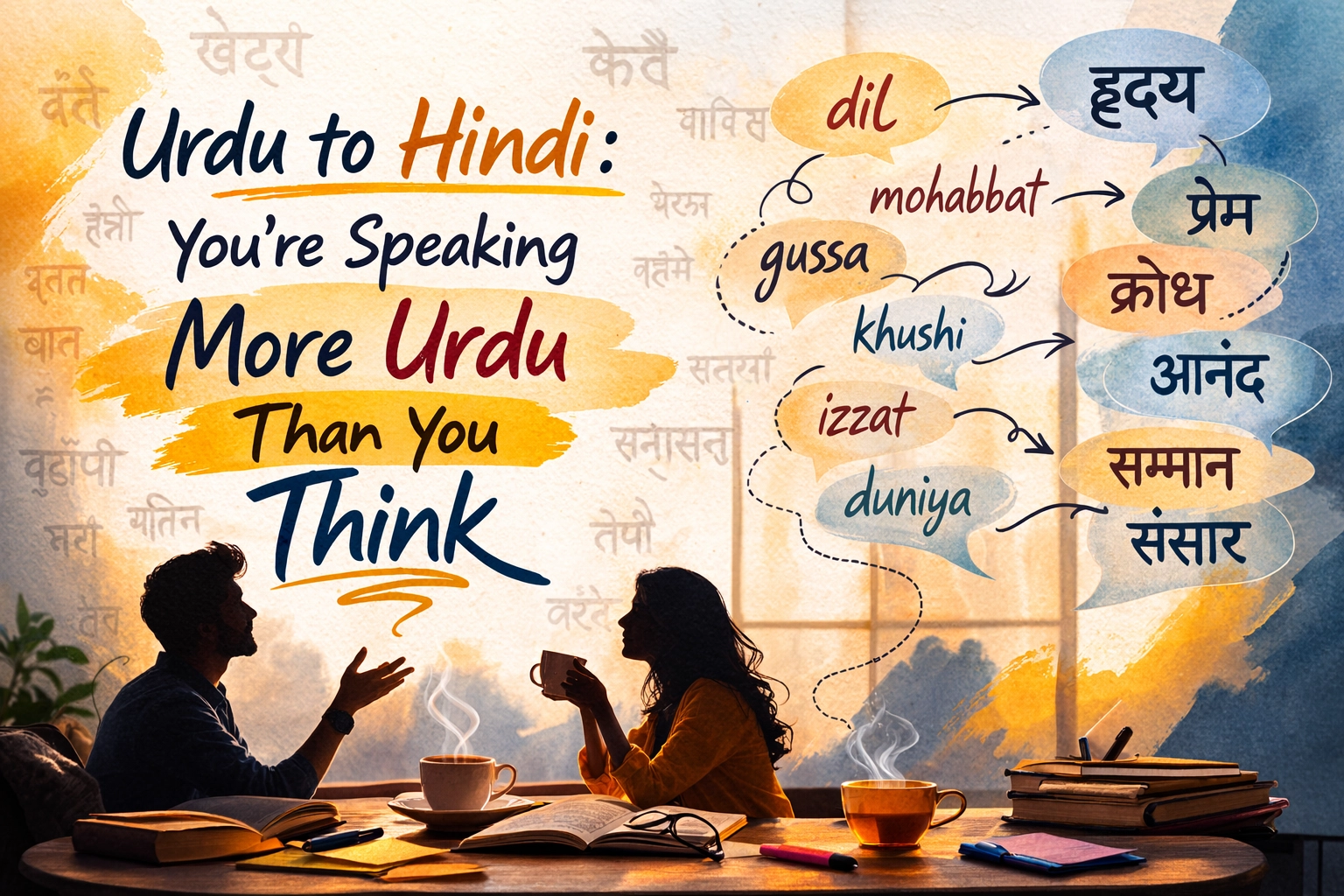
Urdu to Hindi is not just a shift in vocabulary, it is a journey through shared history and living culture. Language is not merely a tool for communication; it is the heartbeat of culture, the mirror of history, and the bridge between civilizations. Urdu and Hindi stand among the most expressive languages of the Indian subcontinent, yet they are often seen as opposites. In reality, they are like two rivers flowing from the same mountain diverging in script and certain word choices, but united in grammar, rhythm, sentence flow, and cultural memory.
- Urdu and Hindi - Two Voices of One Soul
- Emotions, Inner States & Human Sensitivity(भावनाएँ, मनोदशा और संवेदनाएँ)
- Relationships, Society & Human Interaction(संबंध, समाज और व्यवहार)
- Knowledge, Learning & Communication(ज्ञान, अध्ययन और संवाद)
- Effort, Progress & Achievement(प्रयास, प्रगति और सफलता)
- Conflict, Power & Challenges(संघर्ष, शक्ति और परिस्थितियाँ)
- Linguistic Comparison Table
- Why This Knowledge Transforms You
- Final Reflection
Urdu and Hindi - Two Voices of One Soul
Urdu draws its vocabulary richness from Persian and Arabic traditions, carrying with it the elegance of Mughal courts, Sufi poetry, and centuries of literary refinement. Hindi, on the other hand, roots itself firmly in Sanskrit - the ancient mother tongue of the Indian civilization and carries with it the weight of Vedic tradition, classical literature, and formal academic expression.
Understanding the parallel vocabulary of both languages does not mean choosing one over the other. Rather, it means expanding your linguistic universe - building a bridge between two extraordinarily powerful systems of human expression. For students preparing for competitive examinations, for writers seeking to elevate their craft, for speakers who wish to move seamlessly between formal and informal registers, this guide serves as both a reference and a revelation.
The benefits of mastering this parallel vocabulary are profound:
Stronger formal writing ability - knowing the Sanskrit-rooted Hindi equivalents immediately elevates your written expression in official, academic, and literary contexts.
Refined spoken expression - bilingual vocabulary gives you the power to adapt your speech to any audience, whether it's a casual conversation or a formal speech.
Competitive exam vocabulary - UPSC, SSC, NDA, and dozens of other examinations demand command over both registers.
Cultural literacy - understanding both forms unlocks access to ghazals, bhajans, classical prose, and folk traditions simultaneously.
Deeper poetic understanding - the finest Urdu shayari and Hindi kavita are best appreciated when you understand the nuance each word carries.
Let us now explore these parallel vocabularies category by category, in thoughtful and meaningful depth.
Emotions, Inner States & Human Sensitivity
(भावनाएँ, मनोदशा और संवेदनाएँ)
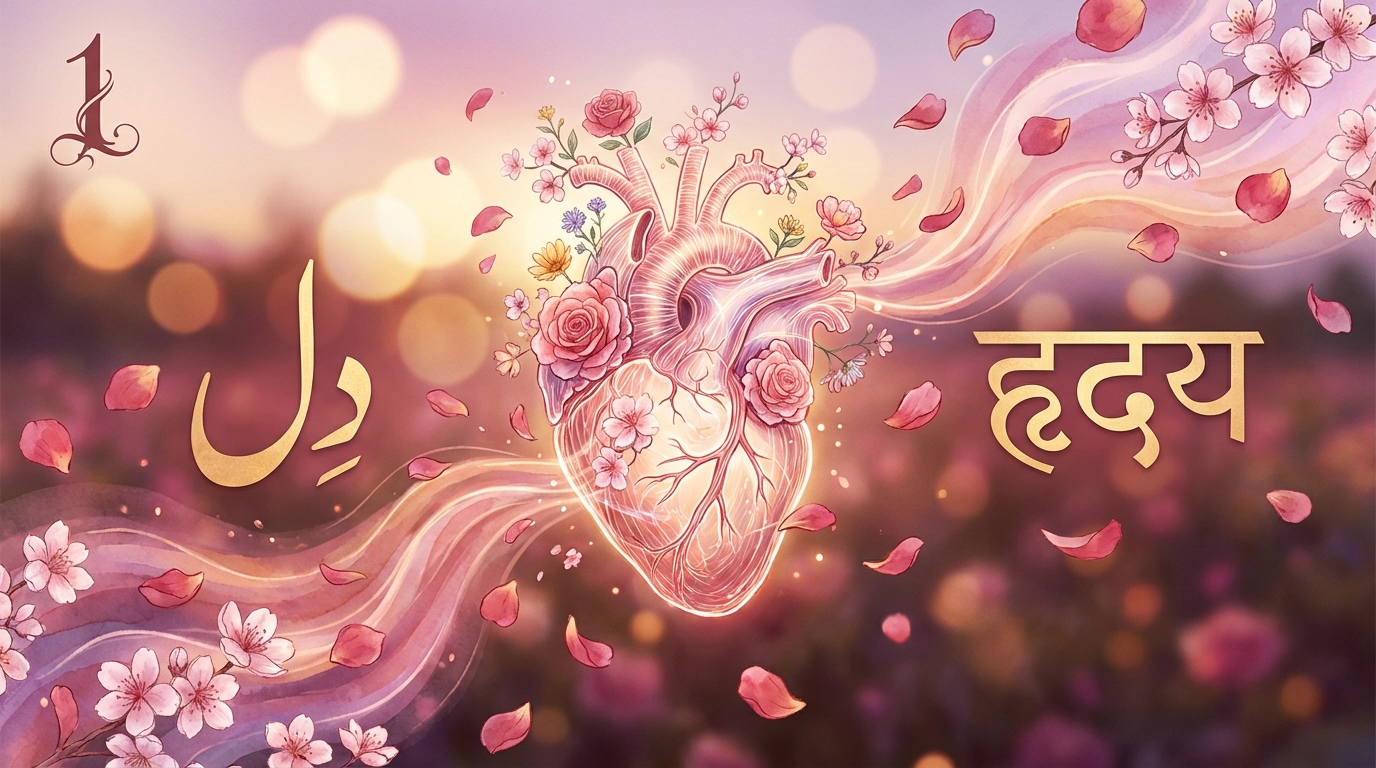
Emotional vocabulary is the most intimate layer of any language. It reveals how a culture perceives the inner world - its joys, its griefs, its rages, and its tenderness. Urdu expresses feelings with softness, rhythm, and an almost musical flow. Hindi conveys emotions with classical clarity, structural strength, and a certain dignified weight.
1. dil → hriday (Heart)
The word dil is perhaps the most beloved word in all of Urdu. It carries warmth, vulnerability, and emotion. The Hindi equivalent, hriday, carries the same meaning but stands taller in literary and spiritual contexts.
Urdu: Mera dil bahut udaas hai. (My heart is very sad.)
Urdu: Usne dil se dua di. (She prayed from the heart.)
2. gussa → krodh (Anger)
Gussa flows naturally in everyday Urdu speech and feels immediate, personal. Krodh, its Sanskrit equivalent, carries philosophical weight - it is the kind of anger discussed in the Bhagavad Gita and classical texts.
Urdu: Mujhe uski baat par gussa aa gaya. (Her words made me angry.)
Urdu: Gussa sehat ke liye theek nahi hai. (Anger is not good for health.)
3. khushi → anand / prasannata (Happiness)
Khushi is light, immediate, joyful. Anand is deeper - it is the bliss that transcends the ordinary. Prasannata suggests a calm, settled happiness.
Urdu: Mujhe tumhari safalta se bahut khushi hui. (I felt very happy about your success.)
4. ehsaan → upkaar (Favor / Kindness)
Ehsaan has a social warmth to it - it implies a personal debt of gratitude. Upkaar carries the spirit of selfless service, often found in moral teachings.
Urdu: Main tumhara ehsaan kabhi nahi bhoolunga. (I will never forget your kindness.)
5. museebat → sankat / vipatti (Trouble / Crisis)
Museebat is the word you whisper in distress. Sankat carries the weight of a formal crisis, and vipatti suggests something more profound - a calamity or misfortune.
Urdu: Museebat mein sab saath chhod dete hain. ( Everyone leaves in tough times.)
6. tabiyat → swasthya / prakriti (Health / Nature / Disposition)
Tabiyat in Urdu is wonderfully versatile - it refers to physical health, but also to one's natural temperament. Hindi uses swasthya for health and prakriti for inner nature.
Urdu: Aaj meri tabiyat theek nahi hai.(I am not feeling well today.)
Relationships, Society & Human Interaction
(संबंध, समाज और व्यवहार)
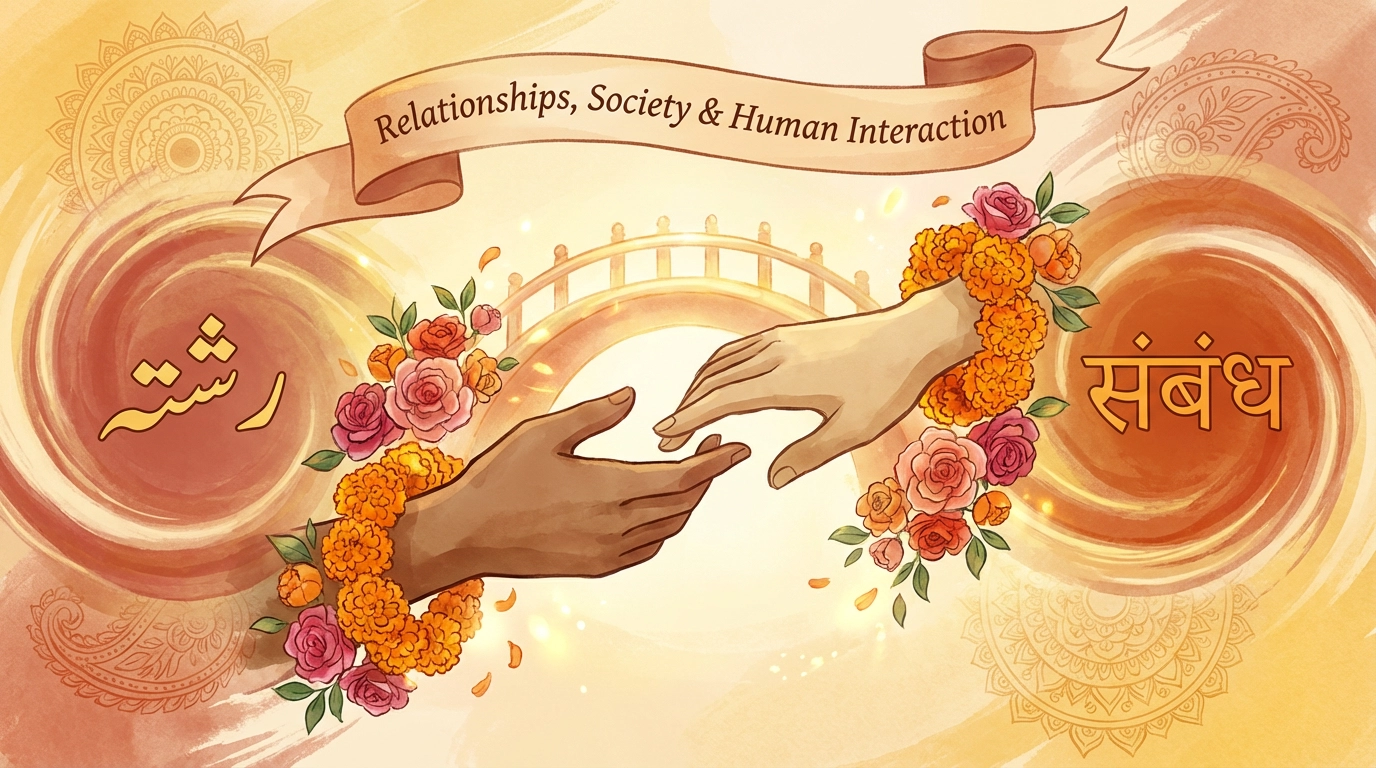
Social vocabulary forms the grammar of civilization. How a language names its relationships and social roles tells us everything about its values.
1. rishta → sambandh (Relationship)
Rishta has an intimacy that goes beyond formal connection - it is often used in the context of family bonds and marriage proposals. Sambandh is broader, more formal, and is used in both personal and institutional contexts.
Urdu: Hamara rishta bharose par bana hai.(Our bond is built on trust.)
2. izzat → samman / aadar / pratishtha (Respect / Honor)
Few words carry the cultural weight that izzat does. It encompasses honor, dignity, reputation, and self-worth. Hindi uses samman for general respect, aadar for reverence, and pratishtha for social prestige.
Urdu: Hamein buzurgon ki izzat karni chahiye. (We should respect our elders.)
3. duniya → sansar / jagat (World)
Duniya has a casual, worldly flavor - "the world out there." Sansar has philosophical depth - it is the world of illusion, cycles, and existence that appears frequently in spiritual texts. Jagat is slightly more poetic.
Urdu: Duniya ek imtehaan hai.(The world is a test.)
4. zimmedari → uttaradayitva / dayitva (Responsibility / Duty)
Zimmedari carries a practical, everyday tone something you are answerable for in daily life. Uttaradayitva feels more formal and administrative, often used in official, legal, or academic contexts. Dayitva is slightly softer and moral in tone, implying an ethical or social duty.
Urdu: Ye tumhari zimmedari hai. (This is your responsibility.)
5. mohabbat / pyaar → prem / sneh (Love / Affection)
Mohabbat and pyaar are both beloved Urdu words, but mohabbat carries a depth and ache that is quintessentially Urdu. Prem in Hindi has a spiritual dimension - the love of the divine, of the motherland, of a parent. Sneh is softer - a tender affection.
Urdu: Mohabbat ek ibadat hai.(Love is a form of worship.)
Knowledge, Learning & Communication
(ज्ञान, अध्ययन और संवाद)
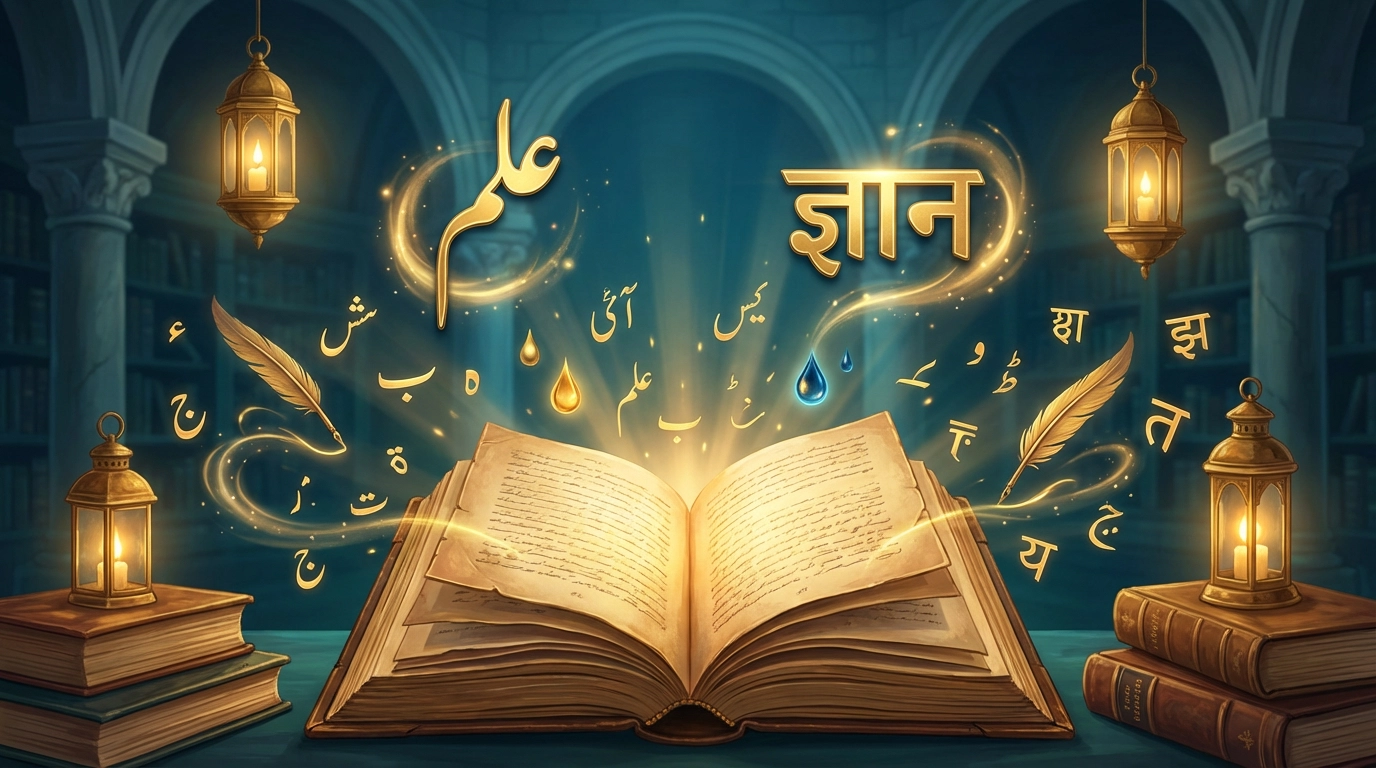
A language's intellectual vocabulary reveals how its speakers think, question, and discover.
1. sawal → prashn (Question)
Sawal is widely used in everyday conversation for a simple query or doubt. Prashn has a more formal and literary tone, commonly found in textbooks, examinations, and philosophical discussions.
Urdu: Usne mushkil sawal poocha. (He asked a difficult question.)
2. jawab → uttar (Answer)
Jawab is commonly used in everyday speech for a reply or response. Uttar is more formal and is frequently used in written Hindi, exams, and scholarly contexts.
Urdu: Mujhe iska jawab nahi pata. (I do not know the answer to this.)
3. tehkikaat → anusandhan (Investigation / Research)
Tehkikaat suggests practical, on-ground inquiry like police or detective work. Anusandhan carries a broader and more academic tone, including scientific and scholarly research.
Urdu: Police tehkikaat kar rahi hai. (The police are conducting an investigation.)
4. misaal → udaharan (Example)
Misaal is conversational and commonly used in daily Urdu speech. Udaharan feels more literary and formal, especially in academic or moral discussions.
Urdu: Main tumhe ek misaal deta hoon. (I will give you an example.)
5. ilm → gyan / vidya (Knowledge)
Ilm carries a deep, almost sacred resonance in Urdu, often linked with wisdom and enlightenment. Gyan reflects philosophical and spiritual knowledge in Hindi, while Vidya refers specifically to education and learned knowledge.
Urdu: Ilm ek roshan chirag hai. (Knowledge is a bright lamp.)
Effort, Progress & Achievement
(प्रयास, प्रगति और सफलता)
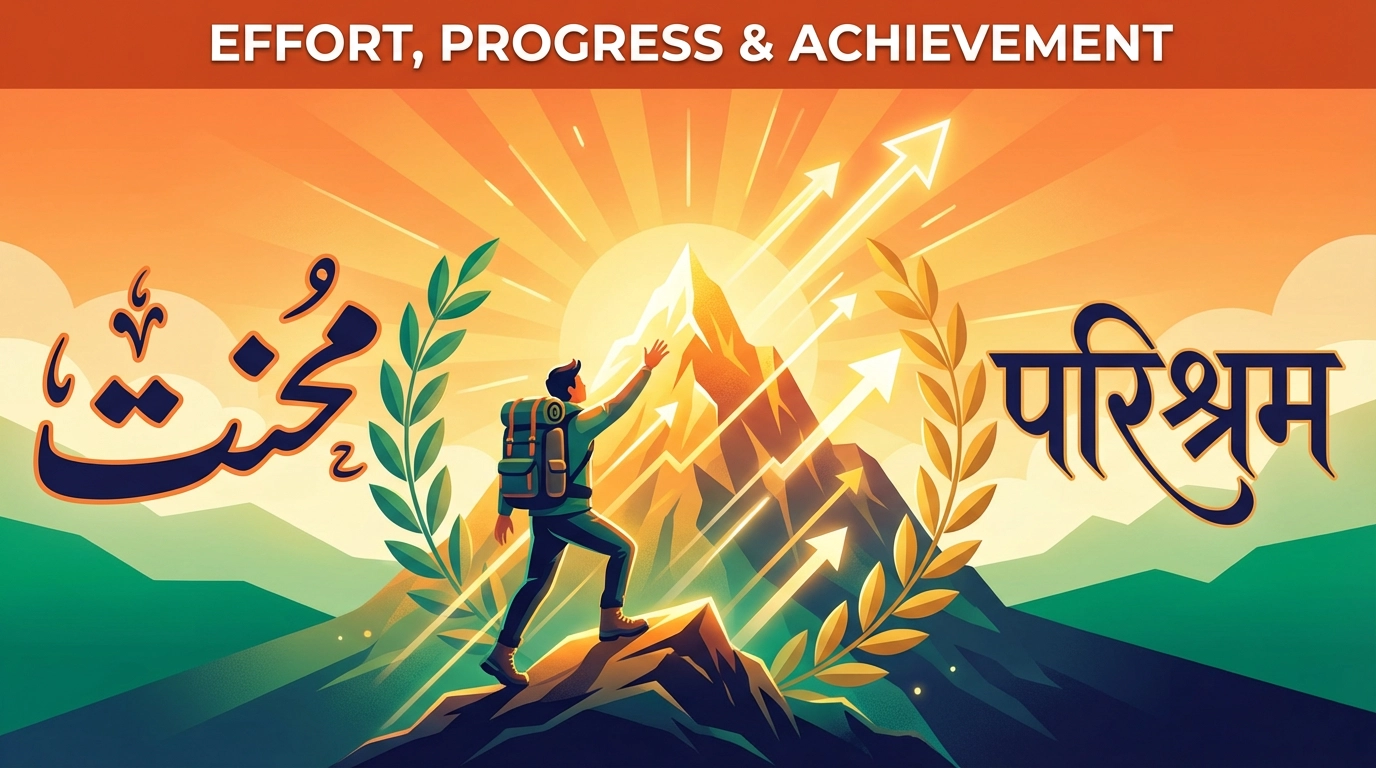
These words carry the energy of ambition, the spirit of perseverance, and the celebration of achievement.
1. tarakki → unnati / pragati (Progress / Development)
Tarakki is commonly used in daily speech to describe growth or advancement. Unnati has a refined and aspirational tone, often used in formal or literary Hindi. Pragati emphasizes steady development, especially in social, national, or economic contexts.
Urdu: Desh tarakki kar raha hai. (The country is progressing.)
2. manzil → lakshya / gantavya (Goal / Destination)
Manzil is poetic and emotional, it can mean both a traveler’s destination and a dreamer’s life goal. Lakshya is focused and purpose-driven, while Gantavya is more literal, referring strictly to a physical destination.
Urdu: Har manzil tak pahunchne ke liye safar zaruri hai. (To reach every destination, the journey is necessary.)
3. zarurat → avashyakta (Need / Necessity)
Zarurat is practical and used in everyday situations. Avashyakta sounds formal and is often used in academic, official, or policy-related language.
Urdu: Hamein paani ki zarurat hai. (We need water.)
4. mehnat → parishram (Hard Work / Diligence)
Mehnat is widely used in daily speech to describe effort and hard work. Parishram carries a more disciplined and dignified tone, often found in moral teachings and literature.
Urdu: Mehnat ka phal meetha hota hai. (The fruit of hard work is sweet.)
5. himmat → sahas / dhairya (Courage / Patience)
Himmat reflects everyday inner strength, the courage to keep going. Sahas implies bold bravery, especially in difficult or dangerous situations. Dhairya represents calm patience and emotional steadiness.
Urdu: Himmat rakho, sab theek ho jaayega. (Keep courage, all will be well.)
Conflict, Power & Challenges
(संघर्ष, शक्ति और परिस्थितियाँ)
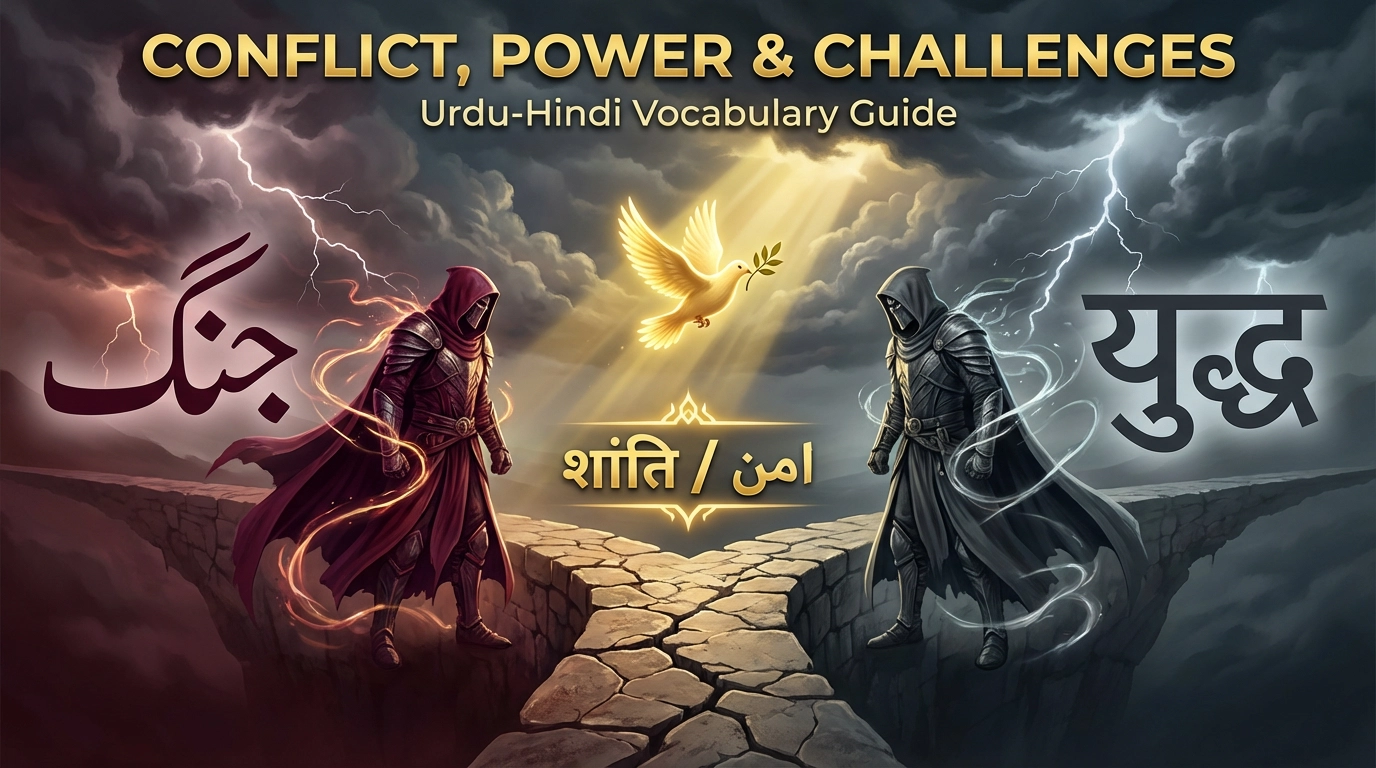
Words connected to struggle, strength, opposition, and freedom carry deep emotional and historical meaning. They reflect not only personal challenges but also collective movements, showing how language shapes our understanding of power and resilience.
1. jung → yuddh / sangram (War / Battle)
Jung feels immediate and intense in everyday speech. Yuddh is formal and associated with historical or epic wars. Sangram can mean battle, but is also used metaphorically for struggles and movements.
Urdu: Jung kisi masle ka hal nahi hai. (War is not the solution to any problem.)
2. dushman → shatru / vairi (Enemy)
Dushman is commonly used in daily speech for an opponent or enemy. Shatru is more formal and literary. Vairi often implies a deeper, moral or emotional hostility.
Urdu: Woh mera dushman hai. (He is my enemy.)
3. aazadi → swatantrata / mukti (Freedom / Liberation)
Aazadi carries powerful emotional and political resonance. Swatantrata is the constitutional and formal term for independence. Mukti adds a spiritual dimension, referring to liberation of the soul.
Urdu: Aazadi har insaan ka haq hai. (Freedom is every person's right.)
Linguistic Comparison Table
Feature | Urdu Vocabulary | Hindi Vocabulary |
|---|---|---|
Primary Root | Persian & Arabic | Sanskrit |
Tone | Soft, musical, poetic | Structured, classical |
Register | Conversational & literary | Formal & academic |
Script | Nastaliq (right to left) | Devanagari (left to right) |
Cultural flavor | Sufi, courtly, intimate | Vedic, classical, elevated |
Exam preference | Informal writing | Formal examinations |
Spiritual use | Sufi poetry & qawwali | Bhajans & Sanskrit shlokas |
Why This Knowledge Transforms You
When a learner understands both vocabularies - not superficially, but deeply something remarkable happens. Their speech gains new elegance. They shift registers naturally: warm and intimate in one moment, scholarly in the next. They move with ease between ghazals, bhajans, official documents, and street poetry.
In modern India, where Hindi and Urdu coexist as a shared heritage, this parallel mastery is powerful. A writer gains a wider palette, a speaker reaches a larger audience, and a student carries greater confidence into competitive exams.
Beyond practicality, learning parallel vocabularies is deeply human. The same emotions - grief, love, hope, determination - echo across words. When you realize dil and hriday both mean heart, you understand that feelings transcend language.
Final Reflection
Language is not a wall. It is not a boundary drawn between communities to separate them. Language, in its truest sense, is an invitation - an invitation to enter another person's world, to see through their eyes, to feel what their ancestors felt, and to express what you yourself have never quite been able to say before.
Urdu and Hindi, together, are not two languages in conflict. They are two wings of the same bird - and only with both wings extended can expression truly soar.
Learn both. Use both. Celebrate both.
Because language is not division - it is expansion.
"जो बोलता है, वह समझता है। जो दोनों में बोलता है, वह सब समझता है।" "He who speaks understands. He who speaks in both, understands all."


Comments