
As the calendar turns towards 2026, every chess player, from the enthusiastic beginner in Mumbai to the seasoned club player in Chennai, feels that familiar spark. It is the hope of a new beginning. We look at our chess ratings—stuck perhaps at 1200 or hovering frustratingly at 1600—and we promise ourselves, "This year will be different. This year, I will become a stronger player."
But let’s be honest with ourselves for a moment. How many times have we made this exact resolution? We start January with fire in our belly, solving puzzles every day. By February, life gets busy, and we are back to playing mindless blitz games on our phones while commuting to work or waiting for dinner. By March, the dream of gaining 200 rating points feels like a distant memory.
At Enthuziastic, we believe that improvement isn't about magic. It isn’t about finding a "secret opening" that wins every game. Real growth comes from a structured approach, a supportive community, and, most importantly, a fundamental shift in how we think. If you are tired of the same old cycle of excitement followed by disappointment, this guide is for you.
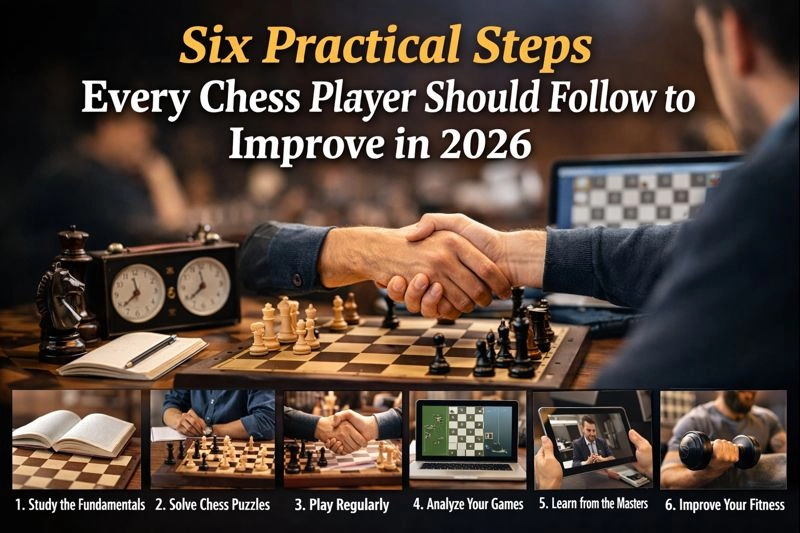
Inspired by the best practices of chess improvement and tailored for our community of learners, we have curated six practical, actionable steps to transform your game in 2026. These aren't just tips; they are a lifestyle change for your chess journey.
Step 1: Want new results? You must adopt new actions

If you want your rating graph to point upwards in 2026, you cannot just "try harder" at the same old things. You need new actions.
Breaking the "Junk Food" Chess Habits Think of your current chess habits. Do you spend hours scrolling through social media clips of chess traps? Do you play 20 bullet games in a row until 2 AM just to "win the last one"? These are what we call "junk food" habits. They feel good in the moment, giving you a quick dopamine hit, but they provide zero nutritional value to your chess brain.
To improve, you must first declutter. Just as we clean our homes before Diwali, you need to clean up your chess routine.
The Detox: For the first week of your new plan, stop playing blitz completely. Yes, it sounds harsh. But you need to break the addiction to "fast chess" to make room for "deep chess."
Audit Your Time: Look at where your chess time goes. If you have 5 hours a week for chess, and 4 of those are spent watching streamers play while you eat snacks, you are not training; you are being entertained. There is nothing wrong with entertainment, but don't call it study.
The "Unlearning" Process In India, we often talk about the importance of a Guru to show us the right path because unlearning bad habits is harder than learning new ones. If you have a habit of moving your queen too early or ignoring your opponent’s threats, simply "knowing" it’s wrong isn't enough. You have to actively practice the opposite behavior. This year, make a pact with yourself: "I will not settle for comfortable habits. I will choose uncomfortable growth."
Step 2: The "Karma" approach shift from results to process
If the rating goes up, we feel like a genius.
If the rating goes down, we feel like a failure.
This Results-Focused Mindset is the biggest enemy of improvement. When you sit down to play a game worried about losing rating points, you play with fear. You stop taking risks. You play hope-chess, waiting for your opponent to blunder rather than creating your own opportunities.
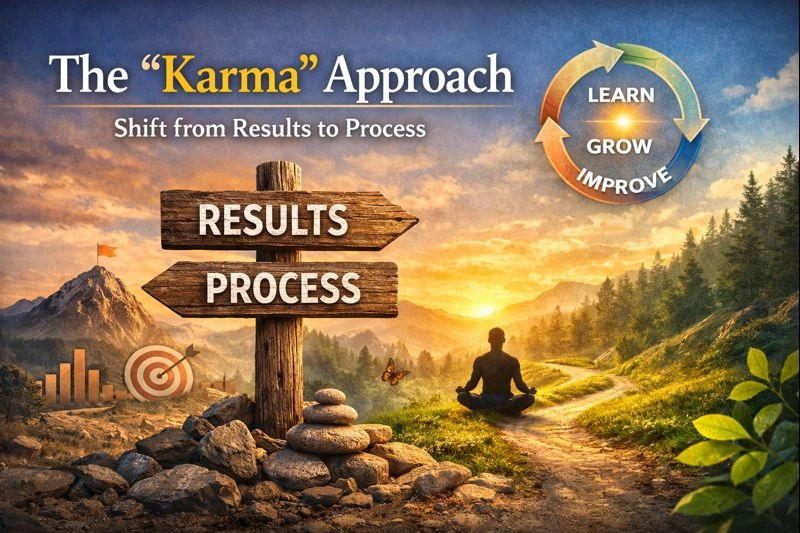
Embracing the Process (Karma) In 2026, we want you to adopt a Process-Based Mindset. This is deeply rooted in the philosophy of focusing on your Karma (action) without attachment to the Phala (fruit/result).
When you sit at the board, your goal should not be "I must win this game." Your goal should be "I will make the best possible move in every position."
Did you follow your opening principles? Good.
Did you calculate the tactics deeply? Excellent.
Did you check for your opponent’s threats? Perfect.
If you do these things and still lose, that is okay. You succeeded in your process. The loss is just data feedback telling you what to fix. When you stop fearing the result, you liberate your mind. You start enjoying the beauty of the game again. You become a student of chess, not just a collector of points. This shift reduces stress and, ironically, leads to much better results in the long run.
Step 3: Redefining "Hard training" Active vs. Passive learning
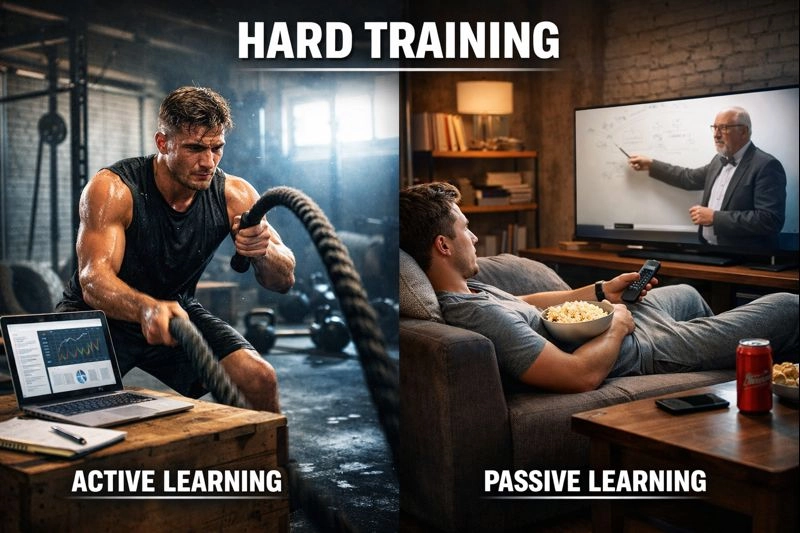
What Real "Hard Training" Looks Like To improve in 2026, you must switch to Active Learning. This is what we mean by "training hard." It is not about how many hours you train, but the intensity of those hours.
Imagine going to the gym. You can spend an hour taking selfies and lifting 1kg weights, or you can spend 20 minutes doing intense deadlifts. Which one builds muscle? The brain is the same. It needs resistance to grow.
Practical Ways to Train Hard:
Solve, Don't Guess: When doing tactics, do not move a piece until you have calculated the full variation in your head. If you get it wrong, don't just check the answer and move on. forceful yourself to understand why your move was wrong and why the correct move works.
The "Stuck" Method: If you can't solve a puzzle, sit with it. Struggle with it. That feeling of frustration? That is your brain growing. In our Enthuziastic classes, we encourage students to wrestle with positions rather than asking for the answer immediately.
Real Board Analysis: Set up a physical chessboard. Take a classic game or a difficult puzzle and play it out on the board. Move the pieces. Write down your thoughts. This connects your physical action with your mental calculation, creating a deeper memory trace.
"Hard training" should feel tiring. If you finish a study session feeling fresh and relaxed, you probably weren't pushing hard enough. If you feel mentally exhausted, congratulations you just got stronger.
Step 4: The pareto principle train what matters most

The Mistake: Obsessing Over Openings Most amateur players spend 80% of their time studying openings. They memorize the "Najdorf Sicilian" up to move 25. But here is the reality: In your actual games, your opponent will play a "weird" move on move 6, and all your memorization goes out the window. Then, on move 12, you blunder a knight because of a simple tactic. Studying complex openings is the least efficient use of time for players below 2000 Elo. It is fun, but it doesn't win games.
The Solution: Focus on the Vital 20% What actually decides chess games?
Tactics and Blunders: 90% of games at the club level are decided by a tactical mistake. If you can stop hanging pieces and start spotting simple forks and pins, your rating will skyrocket.
Endgames: This is where the game is truly understood. If you know how to win a King + Pawn ending, you can trade pieces confidently. Most players ignore endgames because they seem "boring," but they are the goldmine of points.
Calculation: The ability to see 3 moves ahead clearly is worth more than knowing 10 books of opening theory.
In 2026, flip your training. Spend 80% of your time on Tactics, Endgames, and Calculation, and only 20% on Openings. This is efficient training. It is training that translates directly to wins.
Step 5: Design a SMART chess improvement plan
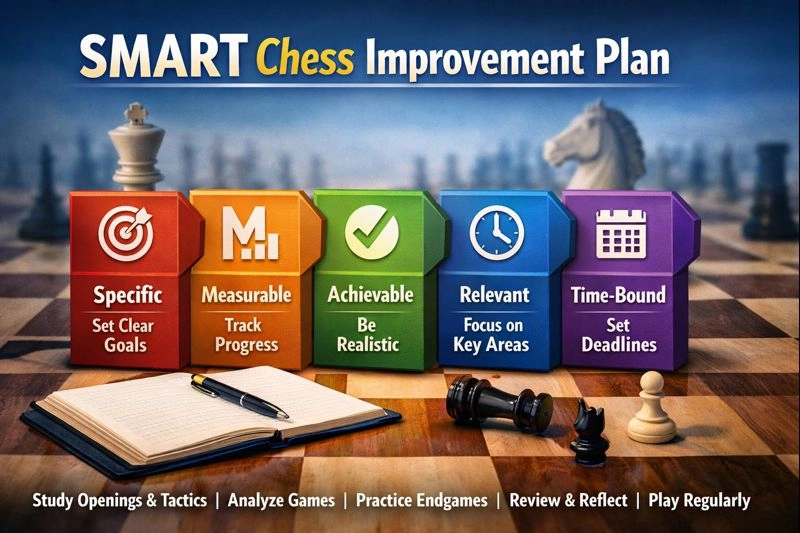
A SMART plan is your GPS for chess success.
S - Specific: Don't say "I will study chess." Say "I will solve 10 puzzles and analyze one master game."
M - Measurable: Can you track it? "Improving my intuition" is hard to measure. "Solving 50 puzzles a week" is easy to measure.
A - Achievable: Be realistic. If you work full-time, don't plan for 4 hours of study a day. You will fail by Day 3 and quit. Plan for 30 minutes. Consistency beats intensity.
R - Relevant: Does this help me? If you are an attacking player, studying quiet positional maneuvers might not be your priority right now. Study what fixes your weaknesses.
T - Time-Bound: Set a deadline. "I will finish this book on Pawn Endings by March 31st."
A Sample Plan for a Busy Improver
Monday (30 mins): Solve 5 difficult calculation puzzles. (Focus: Accuracy).
Tuesday (30 mins): Play 1 rapid game (15+10) and analyze it deeply without an engine first.
Wednesday: Rest Day. (Important! The brain needs rest to consolidate learning).
Thursday (30 mins): Endgame study (King and Pawn basics).
Friday (30 mins): Review my openings (just one specific line that troubled me recently).
Weekend (1-2 hours): Play a longer tournament game or join an Enthuziastic live workshop.
This plan is simple, doable, and covers all bases. It is better to stick to a small plan for a year than a huge plan for a week.
Six practical step: prepare for setbacks resilience is your armor
This is not a sign of failure; it is part of the sport. Chess is brutal. It exposes our mental fragility. Many players quit when they hit a "plateau" or a losing streak. They think, "I am just not talented enough."
Building Emotional Resilience At Enthuziastic, we teach our students that setbacks are actually setups for comebacks.
The Rule of Two: If you lose two games in a row, stop playing. Walk away. Drink some water. Your brain is likely "tilting" (emotional hijacking). Playing more will only lead to more losses.
Separate Self-Worth from Chess: You are not a "bad person" or "stupid" because you lost a game. You are just a chess player who made a mistake. Be kind to yourself.
Analyze the Pain: The games that hurt the most are the ones that teach the most. Don't hide your losses. Open them up. Stare at that blunder. Learn from it so you never make it again.
Growth is not a straight line. It is a jagged staircase. Sometimes you have to step down to find the footing to climb higher. Embrace the struggle.
Conclusion: Your Move for 2026
The year 2026 stands before you like a fresh chessboard 64 squares of infinite possibility. You have the pieces, and now you have the strategy. Improving at chess is not reserved for the "gifted" or the young. It is available to anyone willing to break old habits, trust the process, work hard, focus on the essentials, plan wisely, and stand up after falling down.
At Enthuziastic, we are more than just a platform; we are a community of learners cheering each other on. We believe that live learning, where you can ask questions, interact with mentors, and practice with peers, is the catalyst that turns these steps into reality.
Don't let another year slip by with the same old regrets. Make your move. Adopt these six steps, and let’s make 2026 the year you finally play the chess you are capable of.
Keep Learning, Keep Playing, Stay Enthuziastic!
Frequently Asked Questions (FAQs)
1. How many hours a day should I study to see improvement? You don't need to study for hours. Consistency is key. Even 30 to 45 minutes of focused daily practice is better than cramming 5 hours once a week. Quality matters more than quantity.
2. I get very nervous during rated games. How can I fix this? Nervousness usually comes from focusing too much on the result (winning/losing). Try to shift your focus to the board find the best move, enjoy the puzzle in front of you, and take deep breaths. Remember, it's just a game!
3. Is it necessary to hire a coach to improve? While self-study is possible, a coach can significantly speed up the process by identifying your specific weaknesses and keeping you accountable. Platforms like Enthuziastic connect you with mentors who guide your learning path.
4. Why is my puzzle rating higher than my actual game rating? In puzzles, you know there is a tactic to find. In real games, nobody tells you "White to play and win." You have to sense the danger or opportunity yourself. This requires practicing "board awareness" and playing longer time-control games.
5. Which chess books should I read first? Avoid heavy opening encyclopedias. Start with books on general principles, tactics, or logical game collections like Logical Chess: Move by Move by Irving Chernev or My System (simplified versions) to build a strong foundation.
6. Should I stop playing Bullet and Blitz chess completely? Not necessarily forever, but if you are in a "training phase," it is best to reduce them. Bullet chess relies on instinct, which can reinforce bad habits. Focus on Rapid or Classical games where you have time to think and calculate.
7. What do I do if I hit a rating plateau? Plateaus are normal. They mean your brain is consolidating what you've learned. Change your training routine slightly focus on a different aspect (e.g., switch from tactics to endgames) and give yourself a short break to recharge.
8. How do I use computer engines for analysis correctly? Don't turn on the engine immediately after a game. Analyze on your own first. Identify where you think you went wrong. Only then use the engine to check your analysis. Using the engine too early makes your brain lazy.
Comments