


By Enthuziastic Team
Hello, chess friends! Welcome back to another deep dive into the 64 squares that we all love so much.
If you have ever opened a chess app or walked into a tournament hall, you know the feeling of confusion. There are just so many options, isn't it? You see buttons for "1+0", "3+2", "15+10", or "90 minutes". For a beginner or even an intermediate player, this can feel like standing in a sweet shop with too many choices. You just want to play chess, but suddenly you have to decide how fast you want to play.
Many students at Enthuziastic ask us, "Sir/Ma'am, which time control is best for my improvement?" or "Why does my rating drop when I play fast games?" These are excellent questions. The truth is, choosing the right time control is not just about preference; it is about your goals. It is like choosing between T20 cricket and Test cricket. Both are cricket, but the skills you need are totally different, right?
In this complete guide, we will explore everything you need to know about chess time controls. We will break down what they mean, how they change your thinking process, and most importantly, how to pick the perfect one for your personal growth.
So, get your cup of tea or coffee ready, and let us understand the clock!
- 1. Understanding what time control really means
- 2. The menu of time controls: A detailed look
- 3. Defining your purpose: Why are you playing?
- 4. How different time controls develop specific skills
- 5. Practical advice: when to play Long vs. Short
- 6. Tips for different skill levels
- 7. The psychological and training aspect
- Conclusion: It is your journey
- Frequently Asked Questions (FAQs)
1. Understanding what time control really means
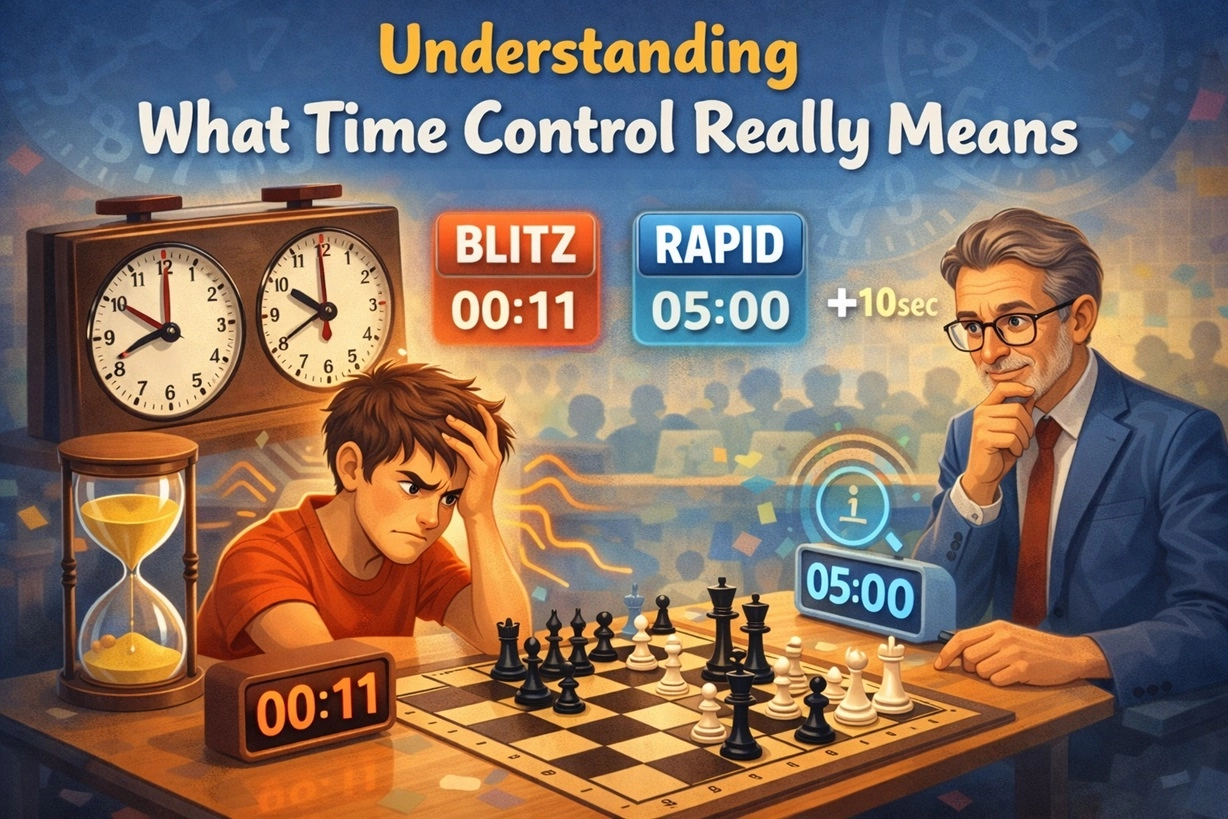
However, when you have only 3 minutes, your brain switches to "Survival Mode". You are not calculating deeply; you are relying on pattern recognition and intuition.
The components of time control
To choose wisely, you must understand the two main numbers you see, like 15+10 or 3+2.
Base Time: This is the first number. If it says "15", you have 15 minutes for the whole game. Once it hits zero, you lose (unless there is a draw condition).
Increment: This is the second number, and it is very important, friends. If it says "+10", it means every time you make a move, 10 seconds are added to your clock. This was invented by the legendary Bobby Fischer. Why is it important? Because it rewards good chess. If you have a winning position but only 5 seconds left, an increment allows you to stay alive and win. Without increment, you might lose simply because your hand wasn't fast enough.
2. The menu of time controls: A detailed look
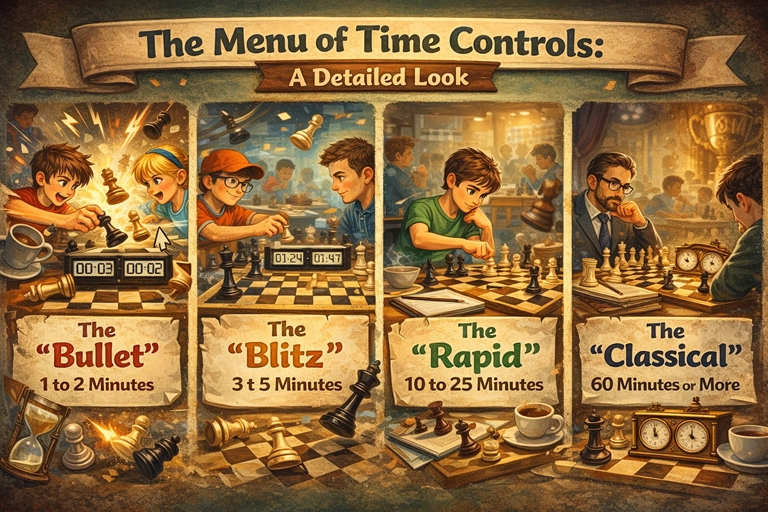
The "Bullet" (1 to 2 Minutes)
This is the T20 Super Over of chess. It is chaos, pure and simple.
What it is: Usually 1 minute or 2 minutes per side.
The Vibe: Your heart beats very fast. Pieces fly across the board. Often, the strategy is not "checkmate the king" but "confuse the opponent so their time runs out."
The Reality: We have to be honest here. Bullet is fun. It gives a big adrenaline rush. But is it chess? Many grandmasters say it is more about mouse skills than brain skills. If you want to improve your deep strategy, Bullet can actually be harmful. It teaches you to play hope-chess (playing a move and hoping the opponent misses the threat).
The "Blitz" (3 to 5 Minutes)
This is the most popular format online. If you go to any chess website, millions of people are playing Blitz right now.
What it is: 3 minutes to 5 minutes per side.
The Vibe: It is fast, but you have a little time to think. You can spot simple tactics.
The Trap: Many learners get addicted to Blitz. They play 20 games in a row, lose 15, and learn nothing. Because the game is so fast, you don't have time to reflect on why you lost. You just click "New Game" and repeat the mistake.
The "Rapid" (10 to 25 Minutes)
For most learners at Enthuziastic, we call this the "Golden Zone".
What it is: 10 minutes to 25 minutes (often with an increment like 15+10).
The Vibe: This feels like a real battle of ideas. You have enough time to check, "Wait, if I go there, will he take my knight?" You can formulate a basic plan.
The Benefit: This is where real learning happens for club players. You are not rushing, but you can't sleep either.
The "Classical" (60 Minutes or More)
This is the gold standard. This is what you see in the World Championship.
What it is: 60 minutes, 90 minutes, or even hours per side.
The Vibe: Silence. Intense concentration.
The Reality: In our busy lives, finding 3 hours to play one game is hard. But playing one Classical game is worth 20 Blitz games for your chess development. It teaches you patience and the art of calculation.
3. Defining your purpose: Why are you playing?
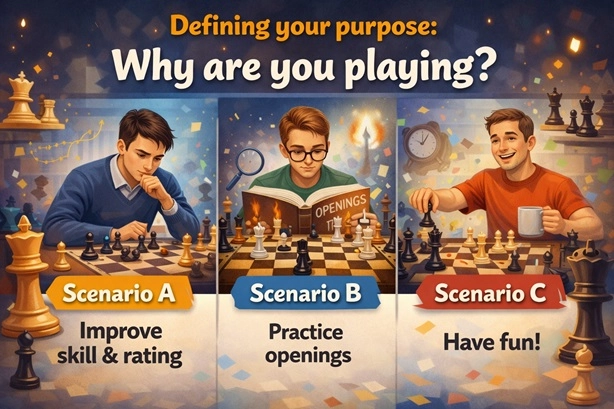
Scenario A: "I want to seriously improve my rating and skill."
If your goal is to become a strong player, to stop hanging pieces, and to understand strategy, then Speed is your Enemy.
When you are learning, your brain needs time to wire the connections. If you play Bullet, you are reinforcing bad habits. You are teaching your brain to panic.
Recommendation: Play Rapid (15+10) or Classical.
Why: You need the increment. You need the extra seconds to double-check your moves. As one wise coach said, "If you cannot find the right move in 10 minutes, you will definitely not find it in 10 seconds."
Scenario B: "I want to practice a new Opening I just learned."
Let us say you just studied the "Queen's Gambit". You know the first 10 moves, but you need to see how people react to it.
Recommendation: Play Blitz (3+2 or 5+0).
Why: Here, volume matters. You want to reach that specific opening position as many times as possible. Playing 20 Blitz games gives you 20 chances to test your opening. If you play one long Classical game, you might not even get to play your opening if your opponent plays something else!
Scenario C: "I just want to have fun and relax."
Maybe you had a long day at the office. You are tired. You don't want to calculate deep lines. You just want to push some wood (or pixels).
Recommendation: Play Bullet or fast Blitz.
Why: There is no pressure. If you lose, it’s just a 1-minute game. It is entertainment, like watching a cartoon. Just don't confuse this entertainment with "training".
4. How different time controls develop specific skills
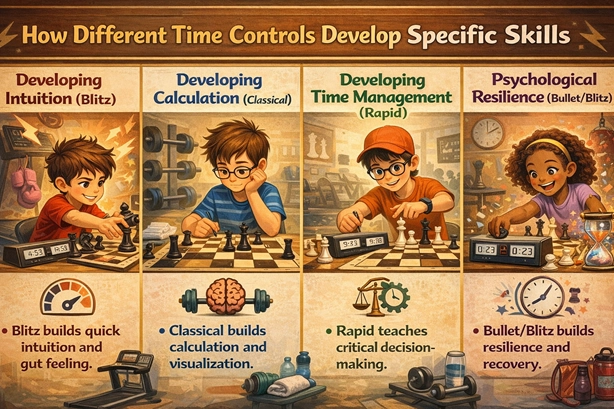
1. Developing Intuition (Blitz)
Intuition is that "gut feeling" that a move is good. Blitz helps develop this. Because you don't have time to calculate everything, you have to trust your gut. Over time, you start "feeling" where the pieces belong. But be careful if your intuition is wrong, Blitz will just reinforce the wrong intuition.
2. Developing Calculation (Classical)
Calculation is saying, "If I go here, he goes there, then I go here..." deeply. You physically cannot do this in Bullet. Classical chess forces you to visualize the board in your head. It is heavy mental lifting. This builds your "calculation muscle".
3. Developing Time Management (Rapid)
In Rapid chess, you have to balance. You cannot spend 10 minutes on one move, or you will flag. But you cannot play instantly either. It teaches you to identify critical moments. You learn to say, "Okay, this move is simple, I will play fast. But this move is dangerous, I will spend 3 minutes here." This decision-making is a vital life skill too, isn't it?
4. Psychological Resilience (Bullet/Blitz)
Short games teach you to handle loss. In a 1-minute game, you might blunder your Queen. It hurts! But 10 seconds later, you are playing a new game. It teaches you to shake off failure quickly. In Classical chess, a loss hurts much more because you invested 4 hours into it.
5. Practical advice: when to play Long vs. Short
So, how do we balance this in our daily or weekly routine? Here is a practical approach that we suggest to our community.
The "80/20" Rule for Improvers
If you are serious about getting better, 80% of your time should be on Longer Games (Rapid/Classical) and study. Only 20% should be on Blitz/Bullet.
Study Time: If you have 2 hours to study chess, don't spend 2 hours playing 30 Blitz games. Spend 1.5 hours playing two high-quality Rapid games and analyzing them. Spend the last 30 minutes playing Blitz for fun.
The "Warm-up" Strategy
Many players use Blitz as a warm-up. Before a tournament game or a serious Rapid session, play two or three Blitz games. It wakes up the brain. It gets the eyes moving. But stop after three games! Don't get sucked into the "one more game" loop.
The "Increment" Necessity
We cannot stress this enough: Always play with increment if you want to learn. Why? Imagine you play a beautiful game. You outplay your opponent. You have a King and Queen, and they have only a King. But you have 10 seconds left.
In 3+0 (No increment): You panic. You move your Queen randomly. You might accidentally stalemate or run out of time. You lose. You feel angry. You learned nothing except "move fast".
In 3+2 (With increment): You have 10 seconds. You make a move, you get 2 seconds back. You have time to calmly deliver a checkmate. You are rewarded for playing good chess.
6. Tips for different skill levels
Your choice of time control should change as you grow in your chess journey.
For Beginners (Rating 0 - 1000)
Avoid Bullet completely. We know it looks fun, but please resist. It will ruin your development. You need to learn how pieces move and how not to hang them.
Stick to Rapid (15+10 or 30 minutes). You need time to do a "Blunder Check" before every move. Ask yourself, "Is my King safe? Is my piece safe?" You cannot do this in 3 minutes.
Goal: Accuracy. Try to play a game with zero blunders.
For Intermediate Players (Rating 1000 - 1600)
Mix it up. You can introduce some Blitz (5+3) now. Your patterns are getting better.
Focus on Rapid for new concepts. If you are learning a new endgame technique, try it in Rapid first.
The 5+3 Sweet Spot: We often recommend 5 minutes with a 3-second increment. It is fast enough to be exciting, but the increment keeps the game "real" in the endgame.
For Advanced Players (Rating 1600+)
Use Blitz for openings. Use the volume of games to test your repertoire.
Classical for mastery. To cross the barrier to expert or master level, you need deep calculation. You need to play slow games where you calculate 10 moves deep.
Bullet is okay now. Since your intuition is strong, Bullet won't hurt you as much. It can be a good reflex sharpener.
7. The psychological and training aspect
Finally, let us talk about the mind. Chess is a mental sport. The time control you choose affects your psychology.
Handling "Clock Anxiety"
Do you feel your heart pounding when the clock goes under 1 minute? This is common. If you suffer from clock anxiety, do not avoid short time controls. Instead, use them as Exposure Therapy. Play 5+3 Blitz. The increment is your safety net. It tells your brain, "It is okay, I can always get more time if I move." Over time, the panic will fade.
The Danger of "Tilt"
We have all been there. You lose a Blitz game. You get angry. You play another one instantly to "win it back". You lose again. This is called "Tilting". Fast time controls like Bullet and Blitz are dangerous for Tilt because the games are so short. You can lose 50 rating points in 20 minutes.
The Rule: If you lose 3 Blitz games in a row, stop. Switch to a puzzle. Or go for a walk. Do not let the speed of the game dictate your mood.
Building Patience
In today's world of Instagram Reels and YouTube Shorts, our attention spans are shrinking. We want everything now. Playing a 60-minute chess game is an act of rebellion. It teaches you to sit still. To wait. To think deeply. This is a superpower, not just in chess, but in life, in studies, and in work. If you can focus on a chess board for 2 hours, studying for an exam feels much easier, doesn't it?
Conclusion: It is your journey
So, friends, which time control is the "right" one? The answer is: The one that fits your purpose today.
If you are sitting down to study and improve, choose Rapid with increment. Give your brain the space it needs to grow. Treat the game with respect.
If you are checking your opening lines or just want a quick warm-up, choose Blitz.
If you just want to laugh and have a crazy time, choose Bullet (but sparingly!).
At Enthuziastic, we always tell our students: Do not chase the rating. Chase the improvement. A high Blitz rating with poor understanding is like a house built on sand. Build your foundation with longer games, and your speed will naturally increase.
Remember, even the fastest Grandmasters started by thinking slowly. As the old saying goes, "Slow is smooth, and smooth is fast."
Keep playing, keep learning, and enjoy every move!

Frequently Asked Questions (FAQs)
Q1: Is playing Bullet chess (1+0) bad for my improvement? A: Generally, yes, especially for beginners. Bullet relies mostly on instinct and mouse speed rather than calculation. If you are still learning the basics, Bullet can create bad habits like playing superficially or ignoring your opponent's plans. It is better to treat Bullet as "fun" rather than "training."
Q2: Why do you recommend playing with an increment (like +10 seconds)? A: Increment is crucial for learning because it shifts the focus from "flagging" (winning on time) to playing good chess. With an increment, you can always win a winning position if you play accurate moves. It teaches you how to convert advantages properly, which is a vital skill.
Q3: My Blitz rating is much lower than my Rapid rating. Is this normal? A: Yes, this is very normal! In Rapid, you have time to think and find the best moves. In Blitz, you are punished heavily for slow thinking or hesitation. As your pattern recognition improves through study and practice, the gap between your ratings will slowly close.
Q4: How many games should I play a day to improve? A: Quality is more important than quantity. Playing 2 Rapid games and spending 20 minutes analyzing your mistakes is far better than playing 20 Blitz games without any analysis. Aim for a number that allows you to review your games afterwards.
Q5: Can I play different time controls on the same day? A: Absolutely. A good routine could be playing one serious Rapid game to train your calculation, followed by a few Blitz games to relax or practice openings. Just be mindful of your mental energy; don't play serious games when you are exhausted.
Q6: I get very nervous when my time runs low. What should I do? A: This is called time trouble anxiety. To fix this, practice playing with a small increment (like 3+2 or 5+3). Knowing that you can "earn" time back with every move helps calm the panic. Also, practice simple endgames so you can play them quickly without thinking too much.
Q7: Is 10 minutes considered Rapid or Blitz? A: It is on the borderline. On many online platforms, 10 minutes (10+0) is considered Rapid. However, because there is no increment, it can often turn into a "flagging" battle at the end, similar to Blitz. We recommend 15+10 for a true Rapid experience.
Q8: What is the best time control for kids starting chess? A: For kids, we strongly recommend longer time controls, like 30 minutes. Kids often have a habit of playing too fast. A longer clock encourages them to sit on their hands, look at the board, and think before they touch a piece. It builds the habit of patience.
Comments