

Welcome to another exciting learning journey with Enthuziastic! As a global people-to-people live learning network, we at Enthuziastic always believe in breaking down complex topics into simple, easy-to-understand lessons. Today, we are going to talk about something very special and incredibly important for anyone who wants to become a better chess player. We are talking about pawn structures in chess.
If you have been playing chess for a while, you must have noticed that beginners often ignore pawns. They focus mostly on the queen, the rooks, and the knights. But as you play more games and meet stronger opponents, you quickly realize that the humble pawns are actually the secret bosses of the chessboard. They dictate where your pieces should go, where you should attack, and how you should defend. In this detailed blog, we will take a deep dive into chess pawn structure strategy. We will see why understanding pawn structures is so crucial for chess positional planning and how proper pawn structure training can change the way you look at the game.
- Introduction to pawn structures in chess
- How pawn structures guide strategic planning
- How pawn structures help save thinking time
- The connection between pawn structures and openings
- Pawn structures and middlegame strategy
- Why pawn structures matter in the endgame
- Using pawn structures to gain positional advantage
- Pawn structures and attacking chances
- Using pawn structure knowledge to defend and save difficult positions
- How pawn structure changes the direction of the game
- Frequently asked questions about pawn structures
Introduction to pawn structures in chess
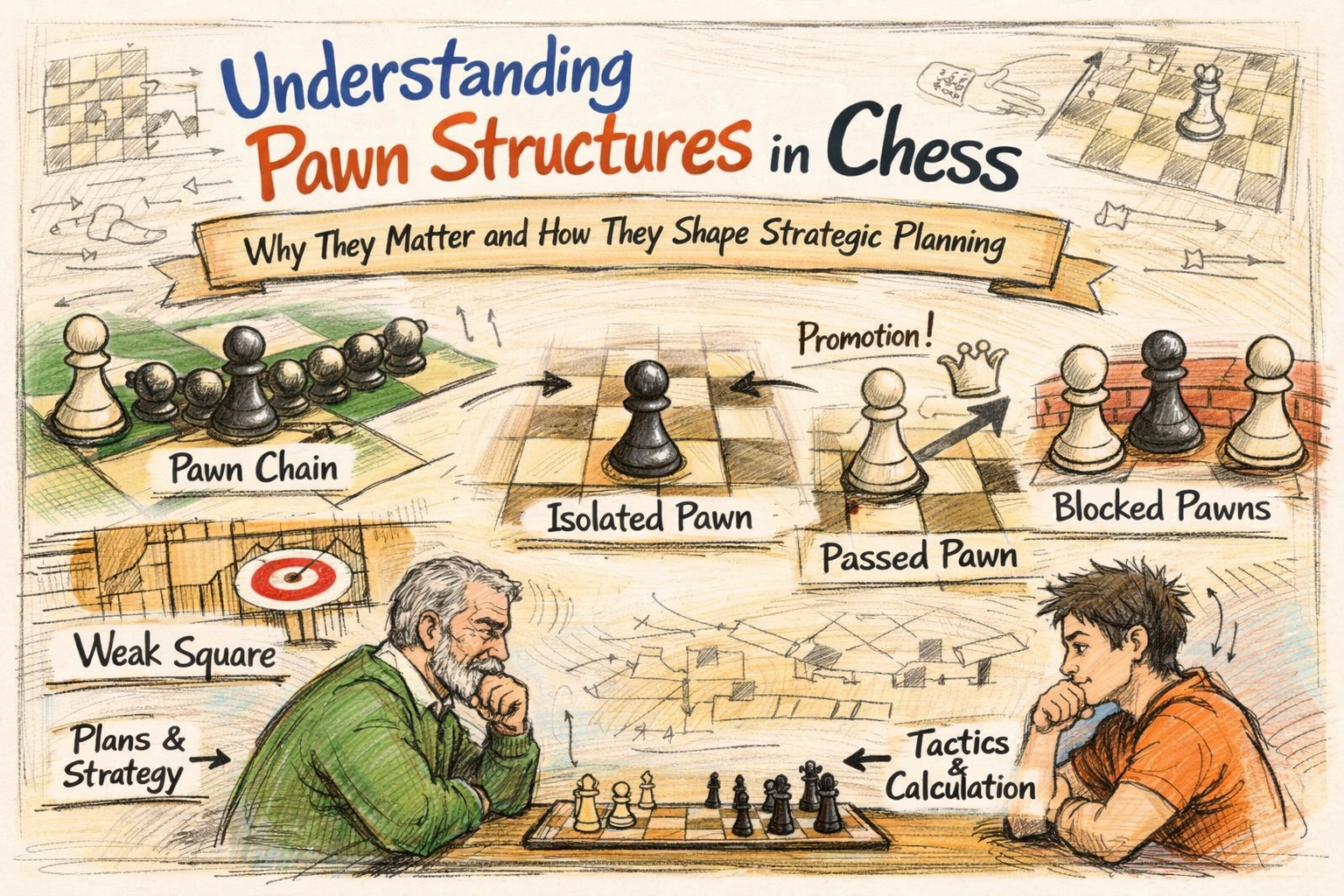
When we say "pawn structure," we are simply talking about the arrangement of pawns on the chessboard at any given point during the game. It is the skeleton of your chess position. While pieces like knights and bishops can move backward and forward, jumping all over the board, pawns can only move forward. They never go back. Because of this simple rule, every time you move a pawn, you permanently change the landscape of the board.

What pawn structures are and why they are fundamental in chess strategy
Imagine you are building a house. The pawns are like the walls and the foundation of that house. The pieces are like the furniture. No matter how nice your furniture is, if the walls are weak or built in the wrong places, the house will not be strong. This is exactly why pawn structures in chess are fundamental.
When pawns are arranged in a certain way, they create natural barriers. They block certain diagonals, they open up specific files, and they create safe squares (called outposts) where your knights and bishops can sit comfortably. Understanding pawn structures helps you read the board properly. It tells you exactly what kind of game you are playing. Are you playing a closed, slow positional game? Or are you playing a sharp, open attacking game? The pawns hold the answer to these questions.
The famous chess principle: pawns play a central role in shaping the game
Way back in the 18th century, a famous French chess master named François-André Danican Philidor said, "Pawns are the soul of chess." This is one of the most famous quotes in chess history, and it is 100 percent true. Pawns determine the character of the position. They shape the flow of the game.
Think of pawns as the map of a battlefield. If you have a mountain in front of you (a blocked pawn center), you cannot just charge straight through it. You have to find a way to go around it, maybe through the flanks (the sides of the board). The pawns tell your pieces what is possible and what is completely impossible. Without good pawn structure training, a player will just wander around the board aimlessly, making moves without a proper plan. But once you start understanding pawn structures, you begin to see the hidden harmony on the board.
How pawn structures guide strategic planning
One of the biggest problems club players face is not knowing what to do after the opening is over. You have developed your pieces, you have castled your king, and now you are sitting there wondering, "What is my plan now?" This is where chess positional planning comes into the picture, and it is entirely guided by the pawns.

How pawn formations indicate whether play should focus on the kingside or queenside
It is a very simple rule in chess: you should play on the side of the board where you have a space advantage, and that space advantage is pointed out by your pawns. Have you ever noticed how sometimes your pawns form a diagonal chain? For example, in the French Defense, White's pawns often sit on d4 and e5. Notice the direction this pawn chain is pointing. The base is on d4, and the tip is on e5. It points towards the black kingside. This is a very clear signal! The pawn structure is literally drawing an arrow for you, telling you, "Hey, you have more space on the kingside, so you should attack the enemy king!"
Similarly, Black's pawn chain in the same opening points towards the queenside (from e6 to d5). So, Black's natural plan is to try and break through on the queenside using pawn breaks like c5. When you understand this concept, you don't have to guess where to attack. The pawn formation acts like a traffic signal, guiding your pieces to the correct side of the board.
Why reading pawn structures helps players determine the correct plan
Chess is too complex to just play move by move. You need a long-term plan. Reading pawn structures is like reading a blueprint before you start a project. Let us say you look at the board and see that your opponent has an isolated pawn (a pawn with no friendly pawns on the files next to it). What does this tell you? It tells you that this pawn cannot be defended by another pawn. It has to be defended by valuable pieces.
So, your strategic plan automatically becomes: "I will block that isolated pawn so it cannot move, and then I will attack it with all my pieces until my opponent is completely tied down to defending it." You see? The plan practically writes itself! You don't need to be a grandmaster to figure this out; you just need good chess pawn structure strategy.
How pawn structures help save thinking time
In a real chess game, especially in tournaments, the clock is always ticking. Time management is a huge factor. If you sit and try to calculate every single possible move from scratch, you will run out of time very fast. This is another area where understanding pawn structures becomes a superpower.
Recognizing common structures allows players to rely on known plans instead of calculating everything from scratch
Top players and grandmasters do not calculate every move blindly. They rely heavily on pattern recognition. Over decades of chess history, grandmasters have identified certain common pawn structures that happen again and again. These are structures like the Carlsbad structure, the Hedgehog formation, the isolated queen's pawn structure, or the hanging pawns structure.
When a strong player reaches one of these structures, they don't panic. They simply remember the plans associated with that specific structure. For example, if you reach a Carlsbad pawn structure, you immediately know that one of the best plans is the "minority attack"—launching your queenside pawns to create weaknesses in the opponent's queenside pawns. Because you already know the plan, you save precious thinking time on the clock. You can play your moves confidently and quickly, using your saved time for critical tactical calculations later in the game. This is why pawn structure training is a regular part of any serious chess student's routine here at Enthuziastic.
The connection between pawn structures and openings
Many beginners make the mistake of trying to memorize opening moves step by step. They learn a long sequence of moves, but if the opponent plays something slightly different, they get completely confused. A much better way to learn chess is to focus on the pawn structures that arise from the openings.

Many different openings can lead to the same pawn structure
This is a beautiful and very important concept to grasp. Different opening moves can easily transpose (shift) into the exact same pawn structure. For instance, the isolated queen's pawn (IQP) is a very famous structure. You can reach this exact same structure from the Queen's Gambit, the French Defense, the Caro-Kann Defense, the Sicilian Defense, and many others.
If you just memorize opening lines, you have to memorize different lines for all these openings. But if you focus on understanding pawn structures, you just need to learn how to play the IQP positions. Once you know the strategic plans for playing with or against an isolated pawn, it does not matter how you reached that position. You will know exactly what to do.
Understanding pawn structures allows players to play multiple openings confidently
When you focus on chess pawn structure strategy, you become a very flexible player. You don't get scared when your opponent plays an opening you haven't memorized. As long as you understand the resulting pawn structure, you are perfectly fine. You will know where to place your pieces, which files to try and open, and which pieces are your best attackers. It gives you immense confidence to sit at the board knowing that you understand the soul of the position. It is the most practical way to expand your opening repertoire without getting a headache from memorizing thousands of variations.
Pawn structures and middlegame strategy
The middlegame is where the actual battle takes place. The opening is just preparation. In the middlegame, all your chess positional planning revolves around the strengths and weaknesses of the pawn structure.
Identifying weaknesses such as isolated pawns, doubled pawns, and weak squares
To play a good middlegame, you must have an eye for pawn weaknesses. Let us talk about a few of them.
First, we have isolated pawns. As we discussed earlier, an isolated pawn is weak because it requires pieces to defend it. If you are playing against it, your goal is to win it in the endgame. If you are playing with an isolated pawn, your goal is to use the extra space it provides to launch a powerful attack on the enemy king before the endgame arrives.
Then, we have doubled pawns. This happens when two pawns of the same color are sitting on the same file. Doubled pawns are clumsy. They cannot defend each other properly, and the pawn in the front blocks the pawn in the back. They also leave behind weak squares.
What is a weak square? It is a square in your opponent's territory that can no longer be defended by their pawns. If you can jump your knight into a weak square near the center of the board, it becomes a monster! It is what we call an "outpost." All these concepts outposts, isolated pawns, doubled pawns are core parts of understanding pawn structures in chess.
How positional advantages arise from structural imbalances
In most chess games, the pawn structures are not perfectly symmetrical. They are imbalanced. Maybe you have four pawns on the kingside and two on the queenside, while your opponent has three on each side. These structural imbalances are what create winning opportunities.
If the position was perfectly symmetrical, it would usually lead to a draw. But imbalances give each player different goals. If your opponent has compromised their pawn structure to win a piece or get a strong attack, and you manage to defend that attack successfully, you will automatically have a huge positional advantage because your pawns are much healthier. Proper chess pawn structure strategy teaches you how to create these tiny imbalances and slowly squeeze your opponent out of the game.
Why pawn structures matter in the endgame
If pawns are the soul of the middlegame, they are the absolute kings of the endgame. In the endgame, there are very few pieces left on the board. The queens are usually traded off, maybe a few rooks and minor pieces remain. Now, the main goal of the game shifts completely. The primary goal is no longer to checkmate the king directly. The primary goal is to promote a pawn into a new queen!
Certain structures become stronger or weaker when pieces are exchanged
A pawn structure that looked fine in the middlegame can suddenly become a complete disaster in the endgame. Let us take the example of the isolated pawn again. In the middlegame, the player with the isolated pawn has active pieces and attacking chances. The pawn is not a big problem because the heavy pieces are creating threats.
But imagine we trade all the queens, rooks, knights, and bishops. Now it is just kings and pawns. That isolated pawn suddenly becomes a massive weakness. The attacking potential is gone, and the defender has to use their precious king to passively guard that pawn. Meanwhile, the opponent's king will just walk over, eat the isolated pawn, and go on to win the game.
This is why we talk about "pawn islands." A group of connected pawns is called a pawn island. The fewer pawn islands you have, the better. If your pawns are scattered into three or four different islands, they are very hard to defend in the endgame. If they are together in one or two solid blocks, they are very strong.
Understanding this helps players evaluate whether to simplify the position
"Simplifying" in chess means trading pieces. When should you trade pieces? It is a very common question we get at Enthuziastic. The answer depends heavily on pawn structures.
If you look at the board and see that your opponent has ruined their pawn structure (maybe they have doubled pawns and an isolated pawn), your strategy is very simple: trade all the pieces! Force the game into an endgame. Once it is an endgame, those structural weaknesses will be fatal for your opponent. Conversely, if your pawn structure is worse, you must avoid trading pieces. You must keep the position complicated and look for attacking chances in the middlegame to compensate for your bad structure.
Using pawn structures to gain positional advantage
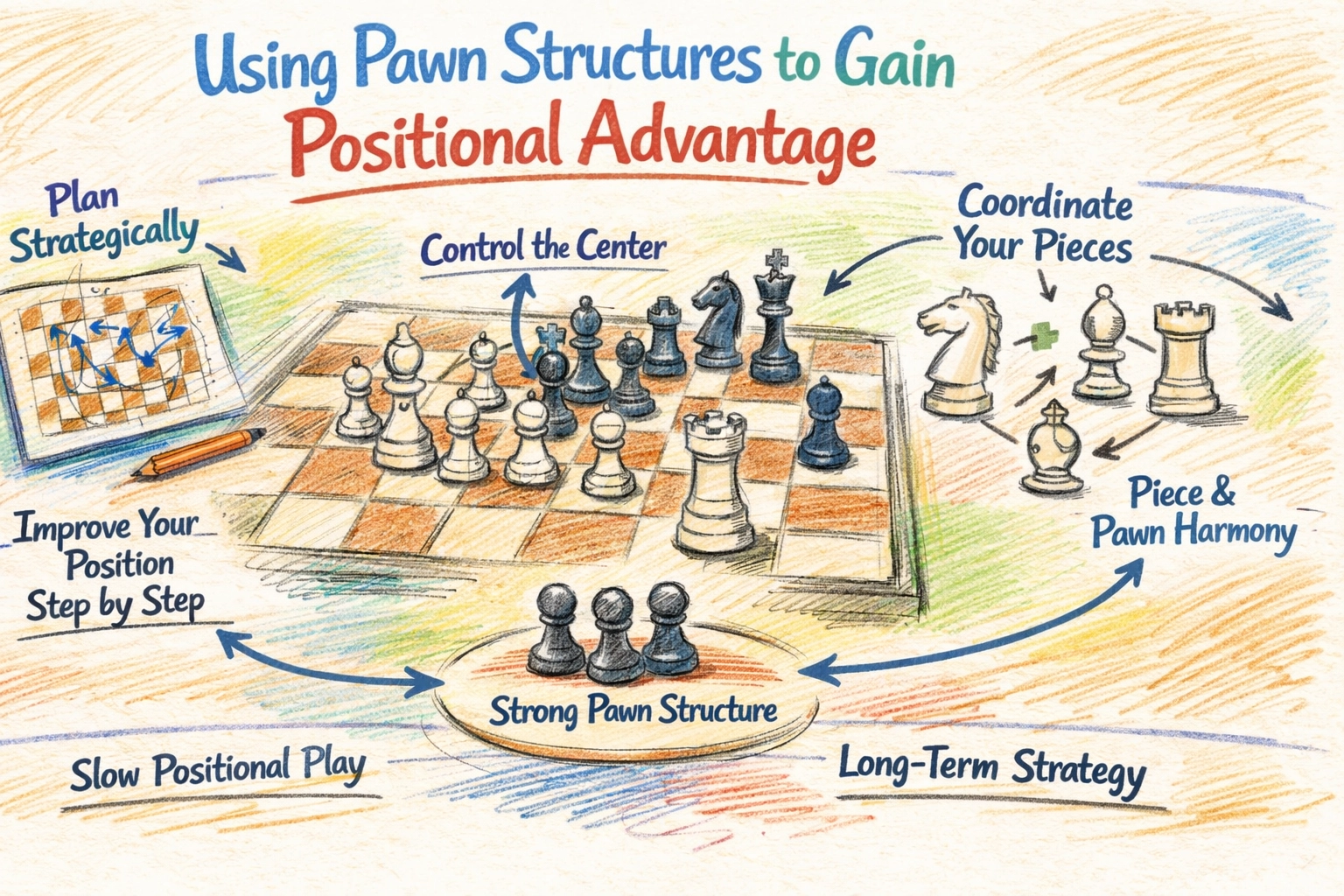
Chess positional planning is an art. It is the art of improving your position little by little without relying on immediate, flashy tactical tricks. And you do this by coordinating your pieces with your pawn structure.
Choosing which pieces to trade or keep based on the structure
Not all pieces are created equal. Depending on the pawn structure, a bishop might be much stronger than a knight, or a knight might be much stronger than a bishop.
Have you ever heard of a "good bishop" and a "bad bishop"? A good bishop is one that travels on the squares of the opposite color to your own pawns. Because your pawns are not blocking it, it has open diagonals to attack. A bad bishop, on the other hand, travels on the same colored squares as your own central pawns. It constantly bumps into its own pawns and feels like a big, useless pawn itself.
By understanding pawn structures, you know exactly which pieces you want to keep. If the center is completely locked with pawns, you want to trade your bishops and keep your knights, because knights can jump over the locked pawns, while bishops are completely blocked. If the board is open with very few central pawns, you want to keep your bishops, because they can sweep across the entire board.
Coordinating pieces with the pawn formation
Your pieces and pawns must work as a team. A very common strategy is to use your pawns to restrict the enemy pieces, while using your own pieces to pressure the enemy pawns. For example, if your opponent has a backward pawn (a pawn that has been left behind and cannot be defended by other pawns), you should place your heavy pieces (rooks and queen) on the open file right in front of that pawn. You block the pawn from moving forward, and you put immense pressure on it until it falls. This beautiful coordination is the hallmark of a master who has undergone proper pawn structure training.
Pawn structures and attacking chances
Many people think that positional chess and attacking chess are two different things. That is not true at all! A successful attack is almost always born out of a superior positional setup, and pawns are the ones that pry the enemy king's defense open.
Pawn breaks and sacrifices that can open lines and create attacks
If the center of the board is closed, it is very difficult to attack. Your pieces simply cannot reach the enemy king. To attack, you need open files for your rooks and open diagonals for your bishops. How do you open these lines? By using pawn breaks.
A pawn break is when you push your pawn to attack an enemy pawn, forcing an exchange. It is like using a battering ram to break down the castle door. Knowing when and where to play a pawn break is a crucial part of chess pawn structure strategy.
Sometimes, players will even sacrifice a pawn just to open up a file. Imagine you have a strong rook on the g-file, but there is one of your own pawns in the way. You might push that pawn forward and sacrifice it, just so your rook has a clear path to aim at the enemy king. These explosive attacking ideas are all guided by a deep understanding of the pawn structure. You read the structure, identify where the breakthrough needs to happen, and execute your pawn break.
Using pawn structure knowledge to defend and save difficult positions
Just as pawns help you attack, they are your best friends when you have to defend a difficult position. We all get bad positions sometimes. Your opponent plays a great opening, and suddenly you are under pressure. How do you survive?
Recognizing defensive resources and counterplay opportunities
When defending, your pawn structure acts like a shield. The golden rule of defense is: do not move the pawns in front of your castled king unless you absolutely have to! Every time you move a pawn near your king, you create permanent weak squares around it. If your opponent is attacking you, you should rely on your piece play to defend, keeping your pawn shield solid and compact.
Sometimes, you can use pawns to build a "fortress." A fortress is a special kind of positional setup where, even though you might be down on material (maybe you have less pieces), your pawn structure is so solid that the opponent simply cannot break through.
Another vital defensive technique is finding counterplay. If your opponent is attacking you on the kingside, the best defense is often a counterattack in the center. But to counterattack in the center, you need the right pawn breaks! If you understand pawn structures in chess, you will quickly spot the right moment to strike back in the center, forcing your opponent to stop their attack and deal with your new threats.
How pawn structure changes the direction of the game
Chess is a dynamic game. A position can be quiet and slow on move 15, and by move 20, it can turn into a wild, tactical brawl. The switch between these phases is almost always triggered by a change in the pawn structure.
Knowing when to maintain tension and when to change the structure with pawn breaks
"Tension" in chess refers to situations where pawns or pieces can capture each other, but haven't done so yet. Maintaining tension is a sign of a strong player. Beginners often capture at the first available opportunity because the tension makes them uncomfortable. But advanced players wait.
They use their understanding of pawn structures to decide exactly when to release the tension. If you capture an enemy pawn, you are changing the structure. You might open a file for your opponent's rook, or you might bring their pawn closer to the center. Before you make a capture or a pawn push, you must ask yourself: "How will this change the pawn structure, and does this new structure favor me or my opponent?"
Knowing when to keep the structure locked and when to blast it open is the ultimate test of chess positional planning. It requires patience, foresight, and a solid foundation in pawn structure training.
By paying attention to the humble pawns, you elevate your game from simple piece-shuffling to true strategic mastery. Remember, the pawns are not just barriers; they are the guiding lights of your entire chess journey.
Frequently asked questions about pawn structures
Here at Enthuziastic, we know that learning brings up lots of questions! We have collected some of the most common questions students ask us about pawn structures in chess.
1. What is the most important pawn structure to learn for beginners? For beginners, it is highly recommended to start by understanding the "Isolated Queen’s Pawn" (IQP) structure. It appears in so many common openings and teaches you both how to attack actively and how to play strategically against a permanent weakness.
2. How do I practice understanding pawn structures? The best way to practice is by reviewing games of grandmasters who played similar openings to yours. Don't just look at the piece sacrifices; look at how they arrange their pawns in the middle game. You can also join our specialized chess classes at Enthuziastic where we focus deeply on pawn structure training!
3. Is it always bad to have doubled pawns? Not always! While doubled pawns are generally a structural weakness because they are hard to defend, they can sometimes give you a huge advantage. For example, getting doubled pawns often opens up an adjacent file for your rook to attack. It is all about how you use the imbalance.
4. When should I push the pawns in front of my castled king? You should avoid pushing them unless it is absolutely necessary for defense or if the center of the board is completely locked. Pushing pawns in front of your king creates weak squares (like holes) where enemy pieces can land safely.
5. How do pawns dictate if a bishop is good or bad? A "good bishop" is on the opposite color of your central pawns, meaning its path is free and clear. A "bad bishop" is restricted because it shares the same color squares as your own locked central pawns, making it hard for the bishop to move around.
6. What does it mean to "play on the side where your pawn chain points"? When your central pawns are locked in a diagonal line (a chain), the "tip" of the chain naturally points towards one side of the board (either the kingside or the queenside). You usually have a space advantage on that side, making it easier to maneuver your attacking pieces there.
7. Should I trade pieces if I have a better pawn structure? Yes! If your pawn structure is fundamentally healthier (fewer pawn islands, no isolated or doubled pawns) than your opponent's, transitioning into an endgame by trading pieces is a fantastic strategy. The structural advantage often turns into a clear win in the endgame.
8. Can a bad pawn structure be fixed during a game? Sometimes, yes. If you have doubled or isolated pawns, you can look for opportunities to force pawn exchanges with your opponent. Trading off your weak pawns for their healthy pawns is a great way to repair your structure and equalize the game.

Comments