
Welcome to another deep dive into the beautiful game of chess, brought to you by Enthuziastic. If you have been playing chess for a while, you know the familiar routine. You wake up, solve a few tactical puzzles, study your opening lines, and maybe watch a masterclass by a grandmaster. You spend hours memorising variations and calculating forced mates. Yet, when you sit down to play a tournament game, something strange happens. The position on the board looks nothing like your puzzles. Your opponent plays a move you have never seen in your opening preparation. Suddenly, you are staring at a complex, messy board where there are no forced checkmates and no clear paths to victory.
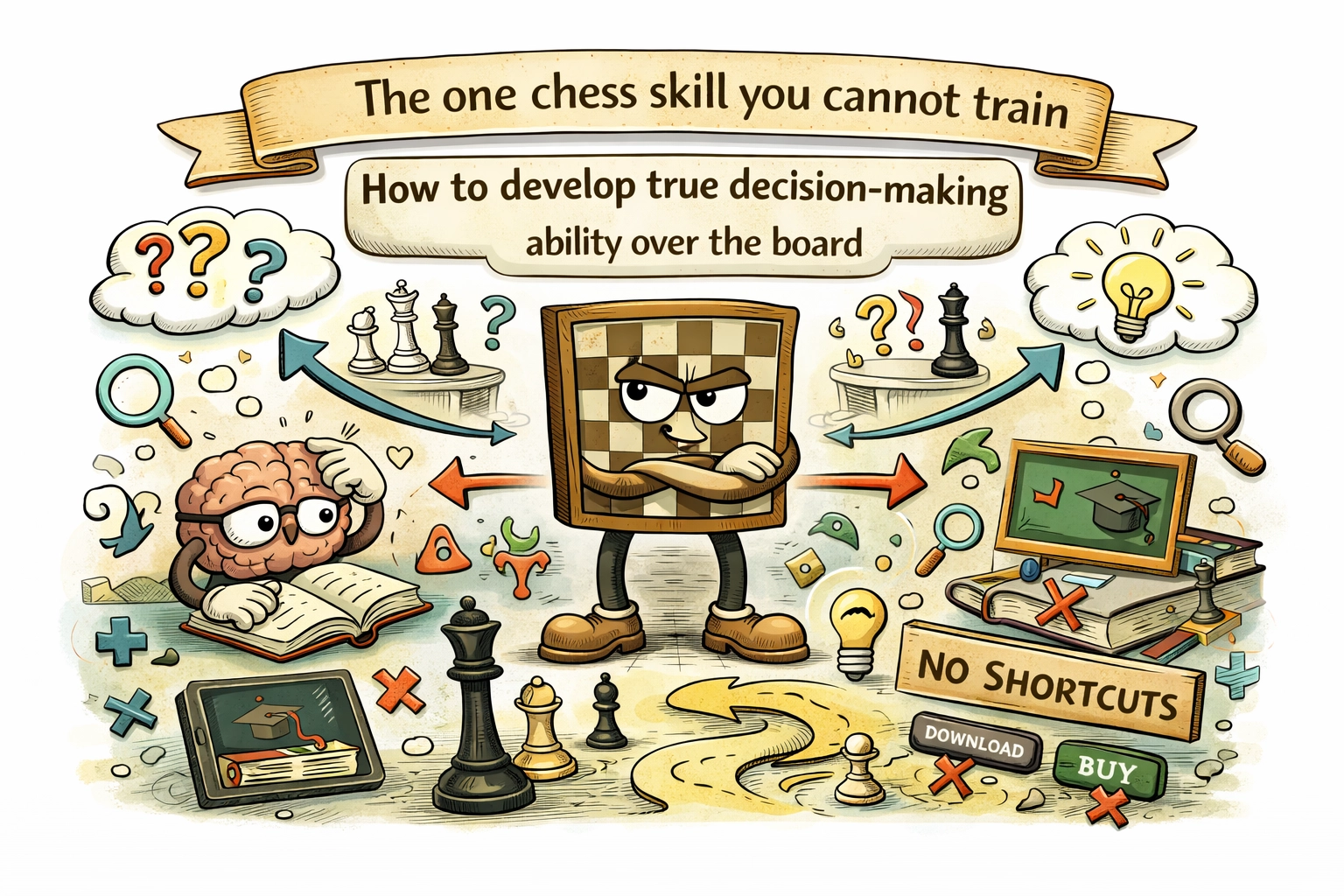
This is where the real game begins. In chess, players often focus heavily on training calculation, openings, and tactics. However, there exists a deeper skill: the ability to make the right decision in unclear positions. This is the one chess skill that cannot be trained in a direct or mechanical way. It is the art of chess decision making. In this comprehensive guide, we will explore why this skill is untrainable in the traditional sense, what chess intuition really means, and how you can naturally develop this true decision-making ability over the board.
- Introduction to the one chess skill
- What makes certain chess skills different from tactical or theoretical knowledge
- Why some abilities cannot be developed through simple repetition
- Why traditional training has limits
- The role of puzzles, openings, and memorisation
- Why these methods alone do not create strong decision-makers
- Understanding chess intuition
- What intuition means in chess
- How strong players feel the right move without full calculation
- The role of experience in decision making
- How playing many games shapes judgment
- Learning from wins, losses, and practical mistakes
- The gap between knowing and applying
- Why players know good ideas but fail to use them in real games
- The challenge of practical decision-making under pressure
- Calculation vs judgment
- Difference between calculating moves and choosing the right plan
- When calculation is not enough
- Pattern recognition and subconscious learning
- How the brain stores patterns over time
- Why exposure to different positions improves instinct
- Examples of real-game decision making
- Positions where no clear solution exists
- Choosing plans in unclear or balanced positions
- Psychological aspects of decision making
- Handling uncertainty during games
- Dealing with time pressure and doubt
- Common mistakes players make
- Over-reliance on calculation
- Blindly following rules without understanding
- Ignoring intuition completely
- How to indirectly train this skill
- Playing slow, thoughtful games
- Analysing your own decisions deeply
- Learning from master games
- Reflecting on critical moments
- Building a strong thinking process
- Asking the right questions during a game
- Balancing logic, intuition, and practicality
- Frequently asked questions (FAQs)
Introduction to the one chess skill
When we talk about chess improvement, we usually talk about things we can measure. We can track our puzzle rating. We can test our memory of the Najdorf Sicilian. We can count how many endgame principles we know. But the most crucial factor that separates a grandmaster from an average club player cannot be measured with a simple test. That factor is practical judgment.
What makes certain chess skills different from tactical or theoretical knowledge
Tactical knowledge is absolute. If you have a knight fork that wins a queen, it is an objectively correct move. Theoretical knowledge is also fixed. If theory says that the seventh move of a certain opening leads to equality, you can memorise that fact. These skills are explicit. You can read them in a book, memorise them, and apply them.
However, true chess decision making is entirely different. It is highly contextual. Imagine a position where you have to decide between exchanging your powerful bishop for the opponent's active knight, or keeping the tension. There is no simple mathematical formula to give you the answer. The right choice depends on the pawn structure, king safety, the psychological state of your opponent, and the time remaining on your clock. This kind of judgment is implicit. It is a fluid, dynamic understanding that cannot be reduced to a simple rule.
Why some abilities cannot be developed through simple repetition
You can develop tactical vision by solving ten thousand puzzles. Repetition works wonderfully for pattern recognition in forced sequences. But you cannot develop practical judgment through simple repetition, because no two complex chess positions are exactly the same.
When you face an unclear position, repeating a rule you learned yesterday might actually harm you. For example, the rule says "always put your rooks on open files." But in your specific game, putting the rook on the open file might allow a subtle tactic, or it might be needed for defence on a closed file. To make the correct choice, you need a holistic understanding. This ability to weigh competing factors, balance risks, and make a confident choice under uncertainty is what we call chess intuition and judgment. It refuses to be boxed into flashcards or simple drills.
Why traditional training has limits
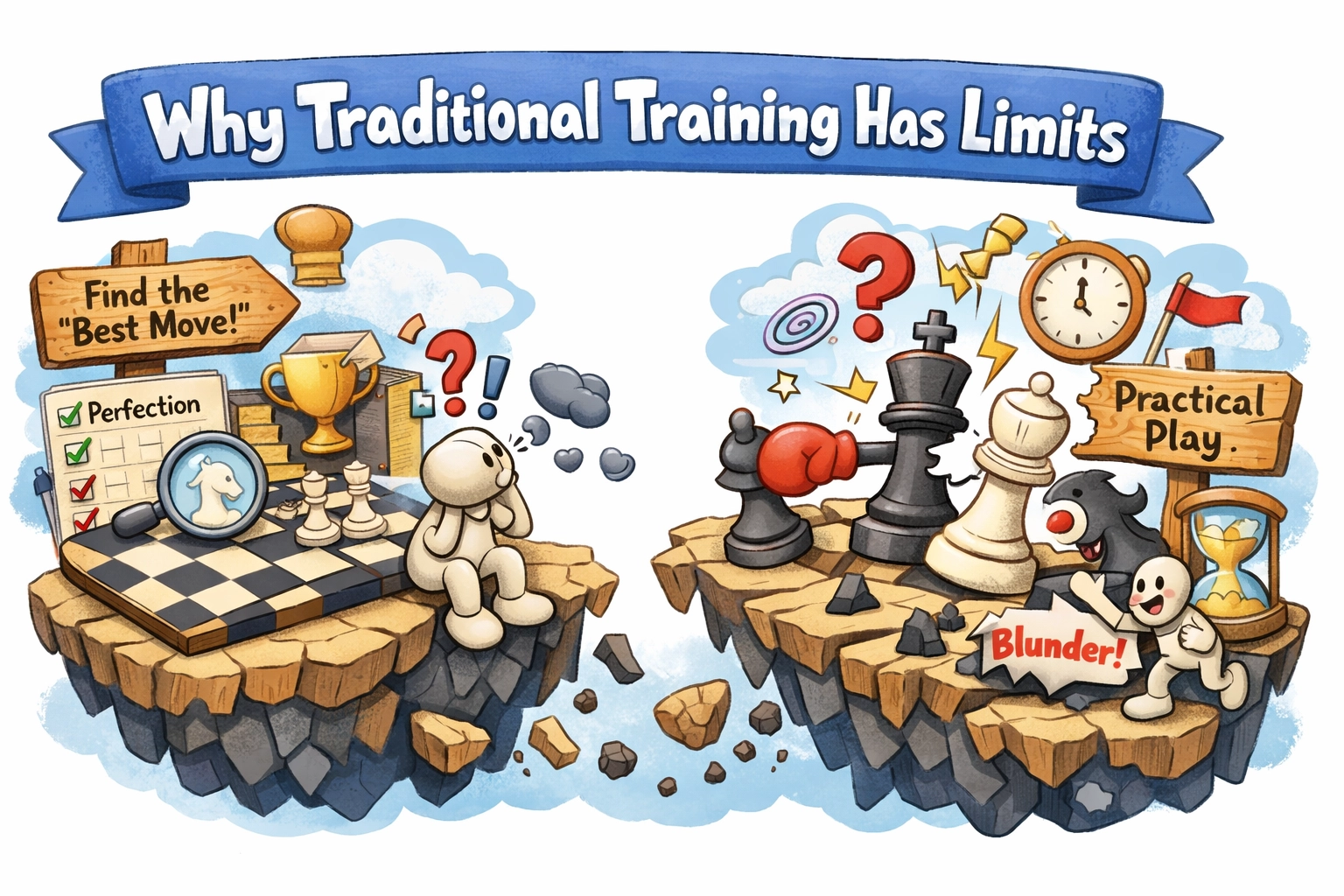
Traditional chess training is heavily focused on finding the "best move." We are trained to look for perfection. While this is necessary for building a strong foundation, it has serious limitations when preparing players for the harsh realities of practical play.
The role of puzzles, openings, and memorisation
Do not get this wrong; solving puzzles and studying openings are very important parts of how to improve in chess. Puzzles sharpen your calculation and help you spot immediate tactical opportunities. Opening study ensures you do not fall into early traps and helps you reach a playable middlegame. Memorisation gives you a safety net.
However, these training methods happen in a vacuum. When you solve a puzzle on a website, a magical prompt tells you, "White to play and win." This is a huge hint. It tells your brain to stop looking for positional manoeuvres and start looking for sacrifices. In a real game, nobody taps you on the shoulder to tell you there is a winning tactic. You have to figure out whether the position calls for a quiet developing move or a violent sacrifice.
Why these methods alone do not create strong decision-makers
When players rely only on mechanical training, they struggle in positions where there is no clear tactical shot. If you only train puzzles, you become a tactical monster who does not know how to maneuver. You might reach a totally equal endgame and feel completely lost because there is no king to attack.
Furthermore, traditional training does not teach you how to manage your energy and time. In an online puzzle, you can stare at the screen for thirty minutes to find the brilliant queen sacrifice. In a real tournament game, spending thirty minutes on one move might leave you with just five minutes to play the remaining twenty moves. Traditional training teaches you how to find the objectively best move in a calm environment, but it does not teach you the practical chess skills needed to make a "good enough" move when the clock is ticking and the pressure is high.
Understanding chess intuition
Chess intuition is often misunderstood. Many people think it is some kind of magical sixth sense that only geniuses possess. They think grandmasters just look at the board and the chess pieces whisper the right moves to them. This is not true. Intuition is a deeply logical process; it just happens faster than our conscious thought can process.
What intuition means in chess
In simple terms, chess intuition is a compressed experience. It is the brain's ability to quickly assess a position, identify the critical factors, and suggest a few candidate moves without needing to calculate every single variation. When a strong player looks at a board, they do not look at all 64 squares equally. Their intuition acts as a spotlight, instantly illuminating the key areas of the board: a weak pawn, an exposed king, or an important diagonal.
Intuition is the feeling that a sacrifice "must" work, even if you cannot calculate it to the very end. It is the sudden realisation that your king belongs on the queenside instead of the kingside. This inner voice guides the chess thinking process, saving precious time and mental energy.
How strong players feel the right move without full calculation
Former World Champion Viswanathan Anand is famous for his incredible speed and intuition. How do players like him "feel" the right move? It comes down to subconscious processing. Over decades of study and play, a grandmaster has seen thousands of pawn structures and piece configurations. When they face a new position, their brain instantly cross-references the current board with their vast mental database of past games.
They do not calculate A, then B, then C. Instead, their brain says, "This position looks very similar to a game played in 1985, where a knight sacrifice on f5 was crushing." This happens in a fraction of a second. This "feeling" allows them to make strong, natural moves almost instantly. They use their conscious calculation only to verify what their intuition has already suggested.
The role of experience in decision making
If intuition is compressed experience, then it goes without saying that experience is the master teacher of chess decision making. You cannot buy experience, you cannot read it in a book, and you cannot download it. You have to live it.
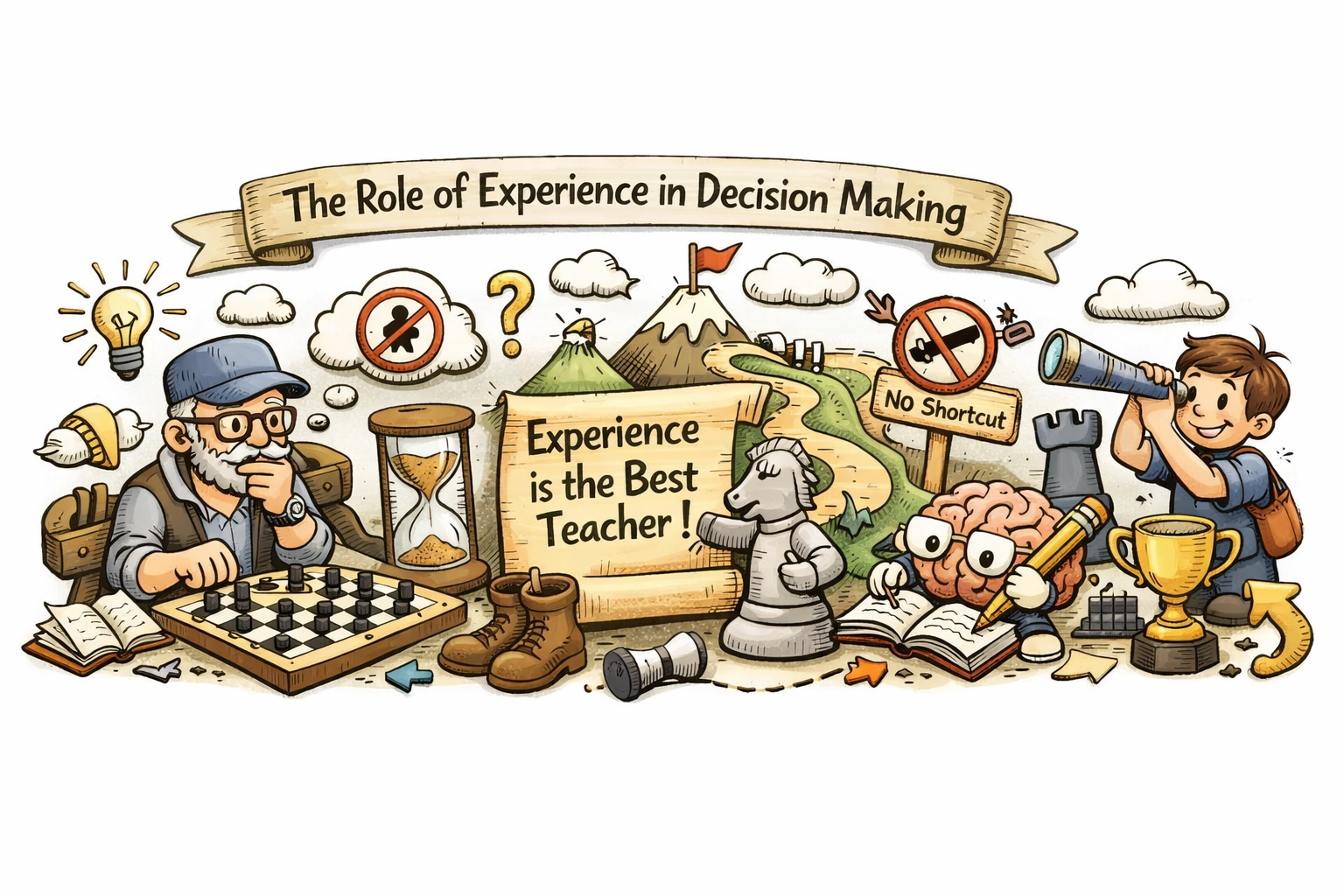
How playing many games shapes judgment
Every game you play leaves a mark on your chess understanding. When you play hundreds of games, you start to develop a sense of danger. You learn what happens when you leave your king uncastled for too long. You learn how fragile a seemingly strong pawn centre can be if it is not supported by pieces.
Playing many games helps you understand the flow of a chess match. You begin to recognise the natural transition from the opening to the middlegame, and from the middlegame to the endgame. You start to understand when to attack, when to defend, and when to sit tight and do nothing. This judgment is formed drop by drop, game by game. It is the slow accumulation of practical wisdom.
Learning from wins, losses, and practical mistakes
We often celebrate our wins and quickly try to forget our losses. But in terms of building practical chess skills, losses are far more valuable. A painful defeat teaches you a lesson that a puzzle never could. If you lose a critical tournament game because you played too passively in a superior position, the emotional sting of that loss will burn the lesson into your memory. The next time you face a similar situation, your intuition will scream at you to play actively.
Practical mistakes like blundering in time trouble, hallucinating a tactic, or playing a move out of fear are essential steps in your growth. They highlight the flaws in your chess thinking process. By analysing these mistakes, you slowly refine your decision-making engine. You learn not just about chess, but about yourself as a player.
The gap between knowing and applying
One of the most frustrating experiences for any chess player is the gap between theoretical knowledge and practical application. Have you ever watched a grandmaster commentary, understood all their brilliant ideas, and then sat down to play your own game only to play like a complete beginner? You are not alone.
Why players know good ideas but fail to use them in real games
Many players know the principles. They know that a knight on the rim is dim. They know they should control the centre. They know they should improve their worst-placed piece. But knowing is not the same as doing.
The main reason for this gap is that real games are complex and noisy. Principles often conflict with each other. In a given position, you might have the opportunity to improve your worst-placed piece, but doing so might allow your opponent to control the centre. Which principle is more important right now? Books usually show clear-cut examples where one principle shines. In reality, you are forced to weigh competing ideas. If your decision-making skill is weak, you will become confused by this conflict and end up playing a move that makes no sense.
The challenge of practical decision-making under pressure
In the comfort of your living room, with a cup of tea in hand, you can find the best move. But true chess decision making happens over the board, under immense pressure. Your opponent is glaring at you. The tournament hall is silent but tense. You have only ten minutes left on the clock. You are worried about losing your rating points.
Under these psychological pressures, knowledge often flies out the window. Fear takes over. You might see a strong attacking idea, but fear tells you, "What if I missed something? Let me play a safe pawn move instead." This is a failure of practical application. Developing the ability to apply what you know when the pressure is at its highest is a lifelong journey.
Calculation vs judgment
To truly understand how to improve in chess, we must draw a clear line between calculation and judgment. They are the two legs upon which a chess player stands, but they serve very different purposes.
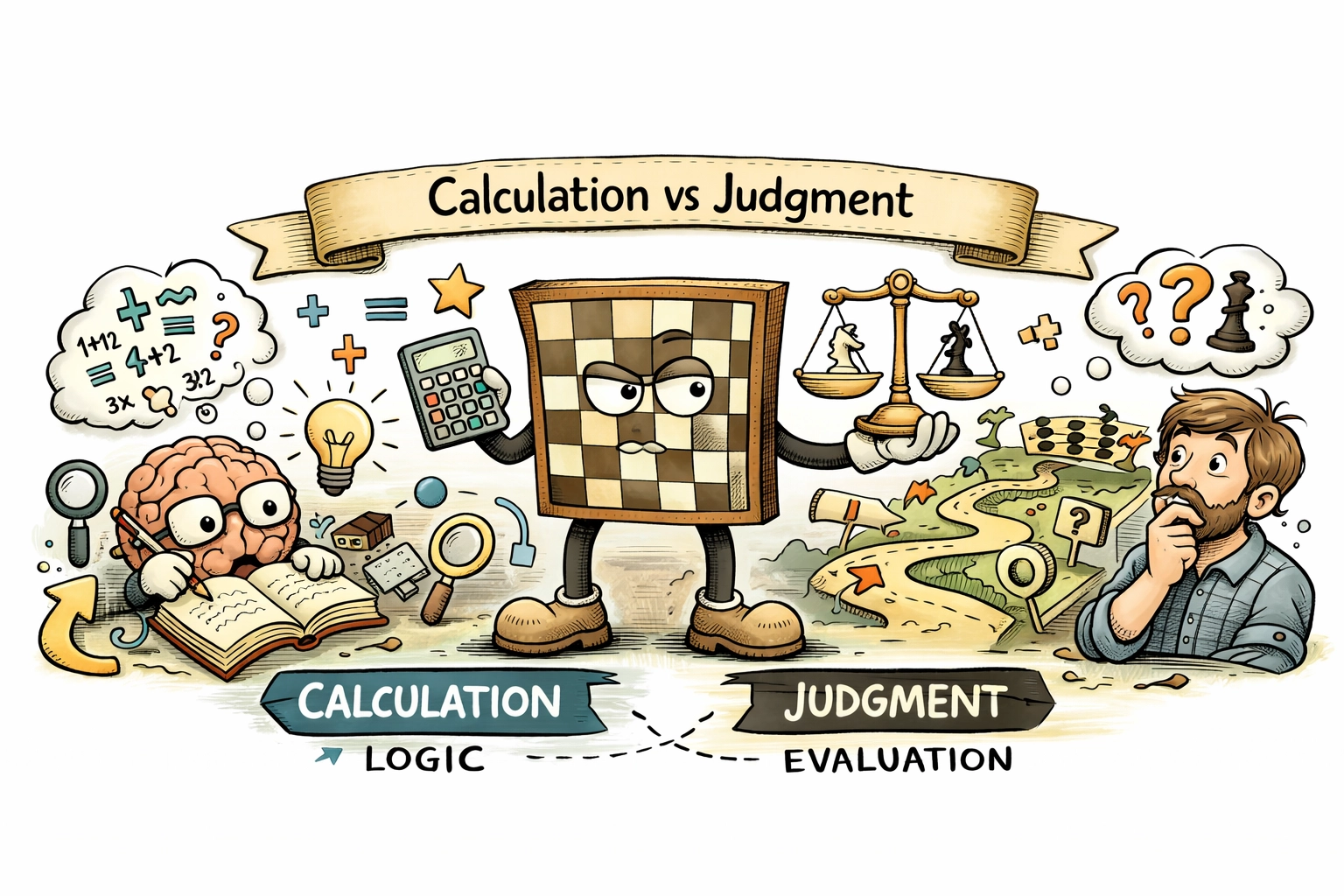
Difference between calculating moves and choosing the right plan
Calculation is the brute-force reading of variations. "I take, he takes, I check, he moves his king, I win the rook." It is concrete, analytical, and heavily relies on your working memory. Calculation is about answering the question, "What happens next?"
Judgment, on the other hand, is about evaluation. It is the ability to look at a position at the end of a calculated line and decide who is better. Choosing a plan relies on judgment. You look at the board and judge that your opponent's queenside is weak. Based on that judgment, you formulate a plan to attack the queenside. You have not calculated any specific moves yet; you have simply judged the landscape and set a direction.
When calculation is not enough
Many club players make the mistake of trying to calculate their way out of every problem. But in many positions, calculation is completely useless. Consider a quiet, closed position where the pawn structure is locked. The pieces are shuffling behind the pawn chains. There are no tactics. If you try to calculate "If I move my knight here, he moves his bishop there," you will exhaust yourself and see no clear end to the variations.
In these moments, calculation fails. You must rely purely on judgment. You have to ask yourself, "Which piece exchanges benefit me? Which pawn breaks should I prepare? Where do my pieces belong ideally?" Strong decision-making means knowing when to stop calculating and start relying on your positional understanding and intuition.
Pattern recognition and subconscious learning
The secret to fast and accurate chess decision making lies in the brain's incredible ability to recognise patterns. Chess is essentially a language of patterns, and the more fluent you become in this language, the less you have to consciously translate every word.
How the brain stores patterns over time
When a beginner learns how to read, they sound out every single letter. "C-A-T... Cat." It takes time and effort. An adult reader looks at the word "Cat" and instantly understands the meaning without reading the letters individually. The brain has chunked the letters into a single, recognisable pattern.
The same thing happens in chess. A beginner looks at a castled king and sees three pawns, a rook, and a king. A master looks at the exact same setup and instantly registers "safe king." Furthermore, they recognise the specific arrangement of the pieces. If the g-pawn is pushed forward, the master's brain instantly flashes a warning sign: "weakened light squares, potential attacking target." This massive library of patterns is built slowly over years of study and play. It cannot be rushed.
Why exposure to different positions improves instinct
If you only play one opening your entire life, your pattern recognition will be very narrow. You will become highly skilled at a specific type of position, but if you are ever dragged out of your comfort zone, your intuition will be blind.
To develop robust practical chess skills, you must expose yourself to a wide variety of positions. Play open games, closed games, tactical melees, and quiet positional grinds. Study games from the Romantic era, the positional masterpieces of the mid-20th century, and modern computer-assisted chess. The broader your exposure, the richer your subconscious library becomes. When your brain has a massive variety of patterns to draw from, your chess intuition becomes incredibly versatile and accurate.
Examples of real-game decision making
Let us bring these concepts to life by looking at the types of decisions players face in real, practical games. These are the moments where your puzzle-solving skills cannot save you, and your true judgment is tested.
Positions where no clear solution exists
Imagine a complex middlegame arising from the King's Indian Defence. The board is on fire. White is storming the queenside, and Black is launching a desperate attack against White's king. The engine evaluation says the position is 0.00 (completely equal).
But playing this position as a human is a nightmare. There is no clear, forced win for either side. You have to make a decision: Do you slow down your own attack to play a defensive move on the queenside, or do you ignore White's threats and go all-in on the kingside?
A traditional training tool cannot tell you the answer. The engine might suggest a brilliant, inhuman defensive move that holds the balance. But your practical judgment might tell you, "If I defend, I will slowly be squeezed to death. I am a dynamic player. I must attack, even if it is objectively slightly risky, because it creates the most practical problems for my human opponent." This is a masterclass in chess decision making.
Choosing plans in unclear or balanced positions
Another classic scenario is a totally symmetrical, balanced position. All the pawns are on the same files. The material is equal. It looks like a dead draw. A weak player will just shuffle their pieces aimlessly, waiting for the opponent to make a mistake.
A strong player uses their judgment to create imbalances out of nothing. They might decide to permanently weaken their own pawn structure just to get the bishop pair. They judge that in the long run, the power of the two bishops will outweigh the weak pawns. This requires immense courage and deep intuition. They are making a long-term commitment based entirely on their feeling for the position, a skill that is forged only through years of practical play.
Psychological aspects of decision making
We cannot discuss chess decision making without talking about the human mind. We are not machines. Our decisions are heavily influenced by our emotions, our energy levels, and the psychological atmosphere of the game.
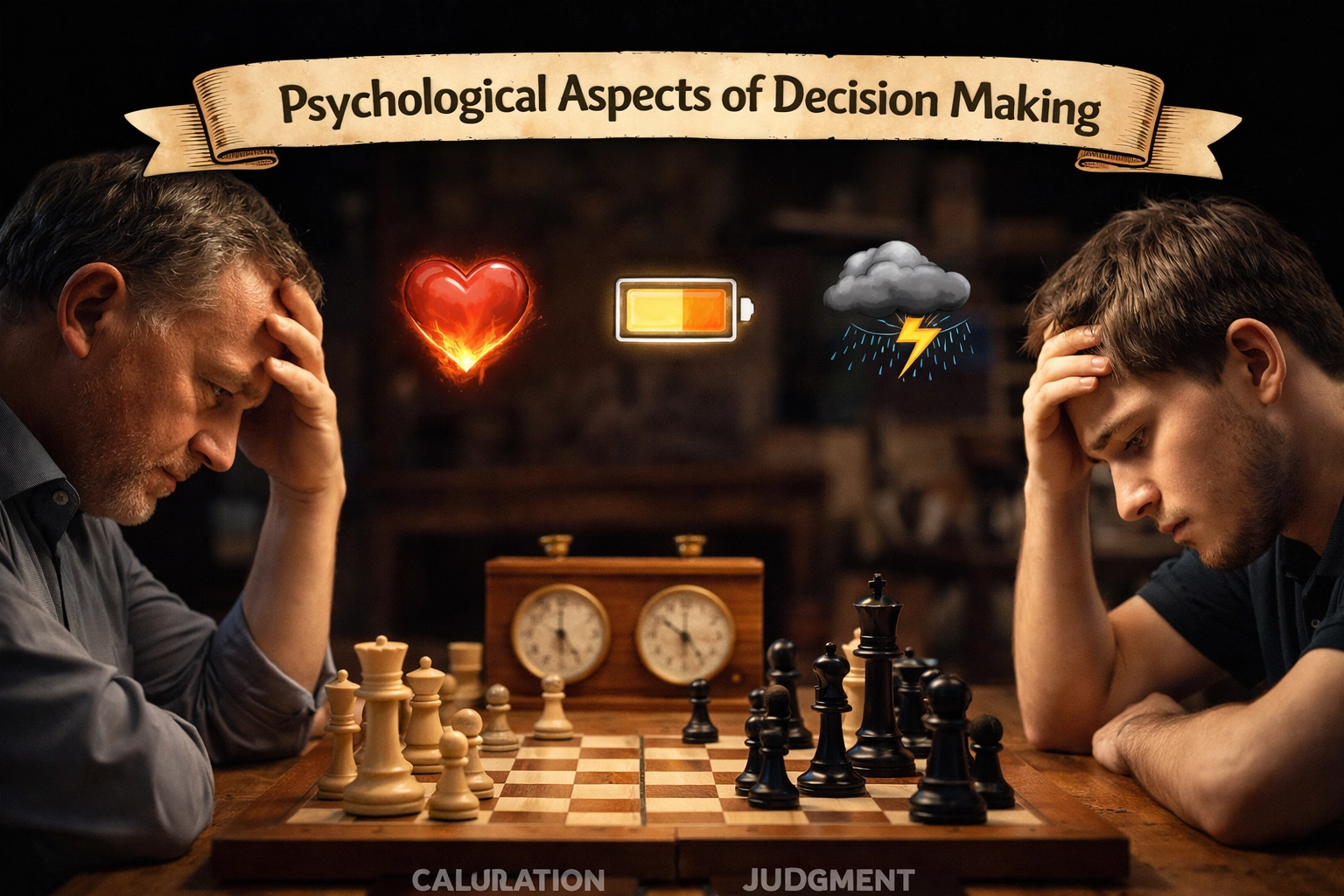
Handling uncertainty during games
Chess is a game of perfect information nothing is hidden from you. Yet, it is also a game of extreme uncertainty. You can never be entirely sure what your opponent is planning, and you can never be entirely sure if your calculation is flawless.
Learning to be comfortable with uncertainty is a massive part of practical chess skills. Many players panic when they cannot calculate a position to a clear conclusion. They hate the feeling of not knowing. As a result, they avoid complex positions, constantly trading down to simpler endgames. To improve, you must embrace the chaos. You have to accept that sometimes you must play a move purely based on your intuition, accepting the risk that you might be wrong. Trusting yourself in the fog of war is a skill that takes immense mental fortitude.
Dealing with time pressure and doubt
The chess clock is the ultimate tester of your decision-making abilities. It is easy to be a genius when you have unlimited time. But when you have two minutes left to reach move forty, the nature of the game changes completely.
Under time pressure, calculation breaks down. You simply do not have the seconds required to check every line. This is where your intuition must take the wheel. Doubt is your biggest enemy here. If your intuition suggests a move, but you spend thirty seconds doubting it and trying to calculate it, you will lose on time. Strong practical players make rapid decisions in time trouble by trusting their first instincts and accepting that a decent, fast move is far better than a perfect move played one second after the flag falls.
Common mistakes players make
In the quest for chess improvement, many players unknowingly sabotage their own decision-making process. Let us look at some of the most common pitfalls so you can avoid them.
Over-reliance on calculation
As mentioned earlier, calculating everything is a recipe for disaster. Some players try to calculate three or four moves deep for every single legal move on the board. This burns tremendous mental energy. By move twenty, they are exhausted and end up blundering a simple one-move tactic. Good chess thinking process involves using your intuition to filter the moves down to two or three realistic candidates, and only calculating those.
Blindly following rules without understanding
Rules are training wheels. "Knights before bishops," "Control the centre," "Do not move the same piece twice in the opening." These are great guidelines for beginners. But as you progress, dogmatic adherence to rules destroys your judgment.
If you refuse to push a pawn simply because a rule book told you "every pawn move creates a weakness," you are not playing chess; you are blindly following dogma. Every rule in chess has an exception. True judgment is knowing exactly when the position demands that you break the rules.
Ignoring intuition completely
In the modern era of engines, many players have lost faith in their own intuition. If Stockfish says a move is a blunder, we immediately dismiss it. But engines do not understand human psychology. Sometimes, an intuitively scary attack is extremely difficult for a human to defend against over the board, even if the engine defends it easily. By constantly ignoring your gut feeling in favour of what the computer says, you dull your natural chess instincts. You must cultivate and listen to your inner chess voice.
How to indirectly train this skill
If true chess decision making cannot be trained directly with a simple puzzle book, what can we do? We have to train it indirectly. We have to create the conditions under which judgment and intuition can naturally grow.
Playing slow, thoughtful games
Blitz and bullet chess are fun, but they rely entirely on the intuition you already have. They do not help you build new, deeper judgment. To improve your decision-making, you must play classical chess.
When you have 90 minutes on the clock, you are forced to think deeply. You have the time to sit with a complex position, explore different plans, weigh the pros and cons, and struggle with the uncertainty. It is in these long, painful moments of deep thought during a slow game that your chess judgment is actually forged. Playing one serious, slow game is worth a hundred mindless blitz games.
Analysing your own decisions deeply
After a serious game, the real work begins. The biggest mistake players make is rushing home, turning on the engine, and letting the computer tell them where they went wrong. This completely bypasses the learning process.
To improve your practical chess skills, you must analyse your game yourself first. Look at the critical moments the points where you had to make a tough decision. Ask yourself, "What was I feeling here? Why did I choose plan A instead of plan B? Was I afraid? Did I miscalculate, or did I simply misjudge the position?" By deeply reflecting on your own thought process without the engine's interference, you gain immense insight into your own decision-making flaws.
Learning from master games
Studying the games of strong grandmasters is not just about memorising opening traps. It is about trying to absorb their chess intuition. Take a well-annotated game collection for example, the games of Anatoly Karpov or Garry Kasparov.
Play through the game slowly. At critical junctures, cover up the next move and try to guess what the master played. When you guess wrong, do not just shrug and move on. Try to figure out why the master's move is better than yours. What positional nuance did they see that you missed? How did they evaluate the resulting endgame? This active guessing and comparing aligns your thought process with that of a champion, slowly upgrading your own intuition.
Reflecting on critical moments
During a game, there are always one or two moments where the entire nature of the struggle shifts. It might be the moment the queens are exchanged, or the moment the pawn centre is locked. These are the critical moments. Developing a habit of pausing at these moments and reassessing the entire board is crucial. Reflecting deeply on these crossroads during and after the game will vastly improve your ability to navigate unclear positions.
Building a strong thinking process
Ultimately, your goal is to build a reliable chess thinking process that serves you in both tactical brawls and quiet positional struggles. A good process acts as an anchor, keeping your decision-making steady when the pressure is on.
Asking the right questions during a game
Instead of just staring at the board hoping a good move pops into your head, learn to ask productive questions.
"What is my opponent's main threat?"
"What is the worst-placed piece in my camp, and how can I improve it?"
"If we trade these pieces, does the resulting endgame favour me?"
"What squares are weakened by my opponent's last pawn move?"
By asking these structural questions, you feed your brain the right data. Your intuition can then process this data and present you with logical, strong candidate moves.
Balancing logic, intuition, and practicality
The pinnacle of true chess decision making is achieving a perfect harmony between calculation, intuition, and practical play. You use your intuition to feel the critical moments and suggest candidate moves. You use your logic and calculation to verify those moves and ensure there are no simple tactical refutations. And finally, you use your practical sense to make a decision based on the clock, the tournament situation, and your opponent's psychology.
When these three elements work together, you stop playing mechanically. You stop playing hoping for cheap tricks. You start playing profound, resilient, and deeply human chess. This is a skill that cannot be rushed, cannot be bought, and cannot be forced. It is the reward of years of dedication, reflection, and a deep, enduring love for the game of chess. Let us continue to learn, play, and grow over the board. Do the needful, play slowly, and trust your journey.
Frequently asked questions (FAQs)
1. What exactly is chess intuition? Chess intuition is not a magical superpower. It is your brain's subconscious ability to quickly evaluate a position, recognise patterns from past experiences, and suggest strong candidate moves without needing to calculate everything move by move. It is essentially compressed experience and deep pattern recognition.
2. Why can't I improve my decision making just by solving puzzles? Puzzles are fantastic for calculation and spotting tactical shots, but they exist in a vacuum. In a puzzle, you already know there is a winning move. In real games, the board is messy, and you must decide whether to attack, defend, or quietly manoeuvre. Puzzles do not teach you this contextual judgment or how to handle uncertainty.
3. How do I stop blundering in winning positions? Blundering when winning is usually a result of poor psychological control or a breakdown in your chess thinking process. You might relax too soon, or let fear dictate your moves. To improve, treat winning positions with the same intense focus as difficult ones. Keep asking, "What is my opponent's only counterplay?" and crush their hopes methodically.
4. What is the difference between calculation and judgment in chess? Calculation is reading exact sequences ("If I go here, he goes there"). It is concrete math. Judgment is evaluating a position ("My knight is better than his bishop here" or "This endgame looks favourable"). Judgment helps you choose a plan when calculation is impossible because there are no forced moves.
5. How can I build practical chess skills for tournament play? The best way to build practical skills is to play long, classical games and analyse them deeply without a chess engine first. You need to experience time pressure, deal with the psychology of an opponent, and face the consequences of your decisions. You cannot replicate this environment through solo study alone.
6. Why do I play worse against real opponents than against the computer? Humans play differently than computers. A computer makes objectively perfect moves, but a human will play tricky, psychologically challenging moves to take you out of your comfort zone. Real over-the-board play involves managing nerves, dealing with unfamiliar opening surprises, and adapting to the chaotic nature of human error.
7. Should I always trust my intuition over the board? You should listen to your intuition, but always verify it with calculation. Intuition points you in the right direction and suggests candidate moves. However, if your intuition tells you to sacrifice a piece, you must use your logical calculation to ensure you do not get checkmated one move later. Balance is key.
8. How do I develop a better chess thinking process? Start by structuring how you look at the board. First, check for immediate threats. Second, evaluate the imbalances (piece activity, pawn structure, king safety). Third, come up with a plan based on those imbalances. Finally, select candidate moves and calculate them. Practise this process in slow games until it becomes second nature.

Comments