

Welcome to another comprehensive guide brought to you by Enthuziastic. If you have been playing chess for a while, you already know that the journey of mastering this beautiful game is filled with incredible highs and frustrating lows. One day you feel like an unstoppable grandmaster, seeing tactics effortlessly and executing brilliant checkmates. The very next day, you might drop a piece to a simple fork and wonder why you even play the game at all. This inconsistency is completely natural, and it all boils down to one critical aspect of chess development: understanding your flaws.
Chess improvement often begins with understanding your mistakes. Players should analyze their games objectively and learn from both wins and losses because every game contains moments where improvement is possible. By studying these moments carefully, players can identify patterns in their mistakes and develop training plans to fix them. In this detailed guide, we are going to explore chess improvement methods, focusing deeply on how Identifying and fixing chess mistakes can completely transform the way you approach the board.
- Introduction to Identifying and fixing chess weaknesses
- Why analyzing your own games is essential
- Learning to be objective about your play
- Recalling your thought process during a game
- Analyzing games without an engine first
- Recognizing patterns in your mistakes
- Creating a training plan to fix weaknesses
- Psychological aspects of improvement
- Using structured training for long-term progress
- Frequently asked questions
Introduction to Identifying and fixing chess weaknesses
When we talk about chess weaknesses, we are referring to the specific areas of the game where a player consistently struggles or makes suboptimal decisions. Chess is an incredibly complex game that tests multiple cognitive skills simultaneously. You have to calculate variations, evaluate positional advantages, manage your time, and handle psychological pressure all at once. Because the game demands such a wide variety of skills, it is virtually impossible for any human player to be equally good at all of them from the very beginning.

Why every chess player has strengths and weaknesses
Every single person who sits down to play chess brings their own unique personality, cognitive style, and life experiences to the board. This natural diversity is exactly why every chess player develops a distinct set of strengths and weaknesses. For instance, some players have highly analytical minds. They excel at calculating long, forcing variations and love sharp, tactical positions where the board is on fire. These players might spot a complex four-move checkmating combination in seconds. However, put this same attacking player in a quiet, maneuvering endgame where patience and subtle positional shifts are required, and they might feel completely lost, making impatient moves that slowly ruin their position.
On the other hand, you have players who possess a deep, intuitive understanding of harmony and piece coordination. They play solidly, slowly suffocating their opponents by controlling key squares and improving their pawn structure. Yet, these positional maestros might struggle when the position explodes into tactical chaos, missing sharp tactical blows because their mind is focused on long-term strategy rather than immediate, concrete threats. Understanding that having weaknesses is a universal part of the chess experience helps remove the frustration associated with losing. Even World Champions have phases of the game they are relatively less comfortable with compared to their peers.
How recognizing weaknesses is the first step toward improvement
If you do not know what is broken, you simply cannot fix it. This is a fundamental truth in engineering, in life, and certainly in chess. Many club players stay stuck at the same rating for years. They play thousands of blitz games online, hoping that sheer volume of play will magically increase their understanding. They might read random chess books or watch entertaining video streams, but their rating graph remains a flat horizontal line. This plateau happens because their training is entirely aimless.
Recognizing your specific chess weaknesses gives your training direction and purpose. When you clearly identify that you are losing games because you constantly mishandle pawn endgames, you suddenly know exactly what you need to study. Fixing weaknesses in chess is about turning a vague desire to "get better" into a concrete, actionable project. Once you shine a light on your flaws, the path to improvement becomes incredibly clear. You stop wasting time studying advanced opening theory when your real problem is dropping pawns in the middlegame.
Why analyzing your own games is essential
One of the most powerful chess improvement methods available to any player is the deep, critical analysis of their own games. You can read all the classic chess literature in the world, but nothing will teach you more about your personal playing style and your specific flaws than the moves you have actually played on the board. Your games are a mirror reflecting your current understanding of chess.
Importance of reviewing both wins and losses
It is human nature to want to quickly move on from a painful loss. When you blunder your queen or fall for a devastating trap, the psychological sting makes you want to close the chessboard and forget the game ever happened. Conversely, when you play a brilliant attacking game and win smoothly, you might want to look at the game again and again, simply to pat yourself on the back. Both of these natural tendencies are detrimental to your chess growth.
Analyzing your losses is non-negotiable. Your losses are the goldmines of your chess development because they highlight exactly where your understanding fell short. Was it a calculation error? Did you misunderstand the strategic requirements of the position? Did you manage your time poorly and blunder in time trouble? The answers to these questions are buried in your defeats.
However, it is equally vital to analyze your wins. A victory does not mean you played a perfect game. Very often, you might have made significant mistakes that your opponent simply failed to punish. If you win a game but your position was actually completely losing three moves prior, you cannot afford to ignore that mistake. Analyzing wins helps you identify these hidden errors, ensuring that you do not repeat them against stronger opponents who will not be so forgiving.
How game analysis reveals recurring mistakes and patterns
When you make a habit of thoroughly analyzing chess games, something fascinating starts to happen. You begin to notice recurring themes. Instead of viewing each mistake as an isolated incident, you start connecting the dots.
Perhaps you notice that in five out of your last ten games, you allowed your opponent's knight to settle on a powerful outpost in the center of the board. Or maybe you realize that you consistently miscalculate exchanges when there is high tension in the center. These are not random accidents; they are patterns. Identifying these patterns is the ultimate goal of game analysis. Once a pattern is identified, it ceases to be a mysterious piece of bad luck and becomes a tangible chess weakness that you can actively work to eliminate.
Learning to be objective about your play
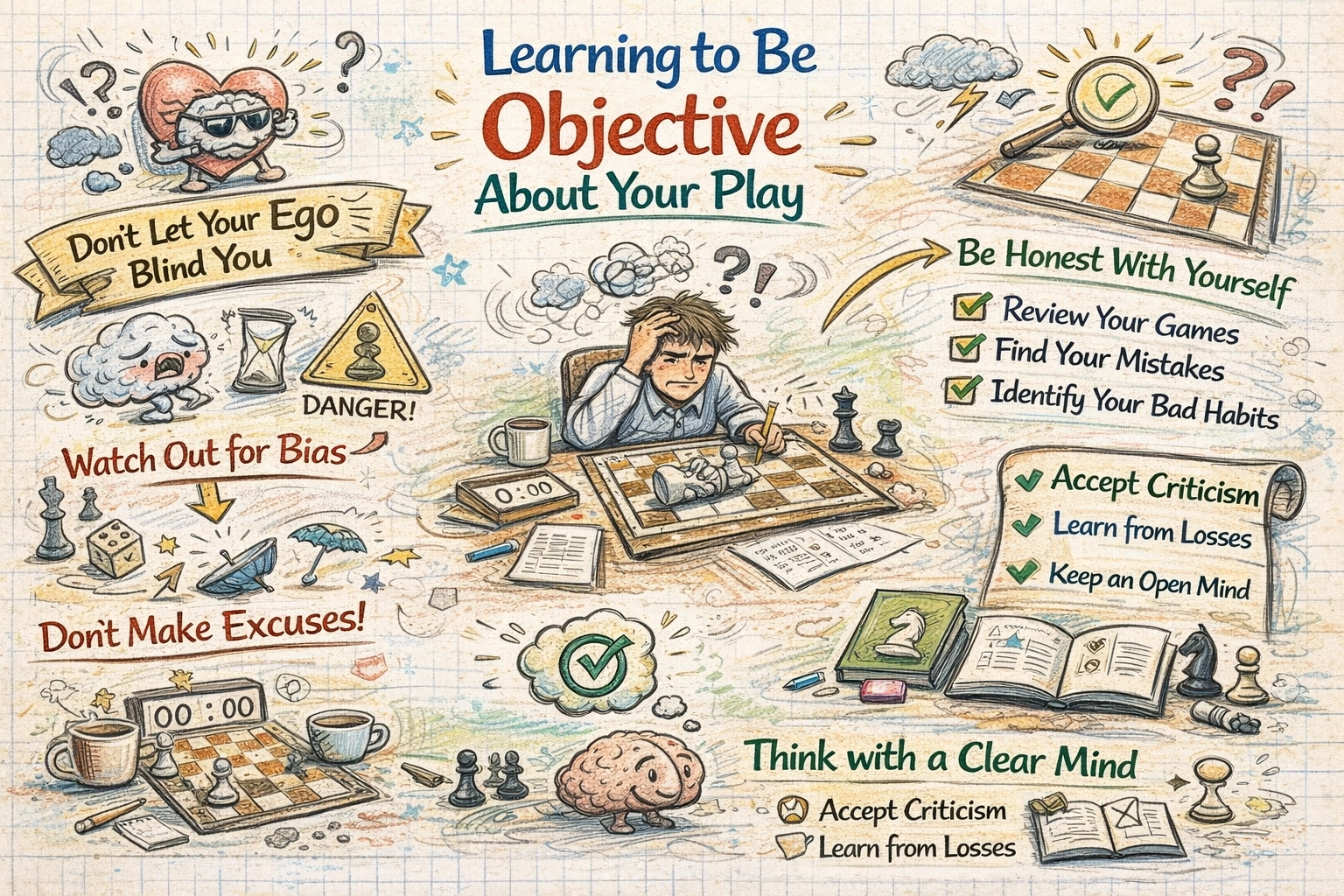
The greatest barrier to identifying chess mistakes is not a lack of chess knowledge, but a lack of objectivity. Chess is an intensely personal game. When you lose, there is no dice roll to blame, no teammates to point fingers at, and no wind or weather conditions to use as an excuse. It is just your mind against your opponent's mind. Because of this, it is very easy to let our ego protect us from the harsh truth of our mistakes.
The importance of removing emotional bias when analyzing games
To truly benefit from game analysis, you must approach your games like a detached scientist observing an experiment. You have to remove the emotional bias that clouds your judgment. During a game, you might feel a strong attachment to a particular plan or a specific piece. You might have spent twenty minutes calculating a brilliant sacrifice, only to have it fail miserably. When you analyze that game later, your ego might try to convince you that the sacrifice was actually sound, and you just missed one tiny detail, rather than admitting the whole concept was flawed from the start.
True objectivity means looking at the position exactly as it is, not as you wished it was. It means being brutally honest with yourself when you play a hopeful, tricky move instead of a fundamentally sound one. When you sit down to analyze, you must leave your ego at the door. You are not trying to prove that you are a genius; you are trying to find out why you made a mistake so you can become a better player.
How fear, pressure, or assumptions during the game can influence decisions
Chess is not played in a vacuum. It is played by human beings who experience a wide range of emotions during a game. Understanding how these emotions affect your decision-making is a crucial part of identifying your weaknesses.
Fear is a major factor. You might see a ghost a phantom threat that doesn't actually exist and play a passive defensive move that ruins your position. Pressure, especially time pressure, completely changes how we evaluate positions. When the clock is ticking down to the final seconds, even grandmasters make elementary blunders.
Assumptions are equally dangerous. You might assume your opponent will respond to your attack in a certain way, so you stop calculating other defensive resources they might have. Or, if you are playing a much lower-rated opponent, you might assume they will not find the best moves, leading you to play carelessly. When analyzing your games, you must ask yourself: "Did I play this move because it was objectively the best move, or did I play it because I was scared, rushed, or overconfident?"
Recalling your thought process during a game
One of the most effective chess improvement methods is learning to reconstruct your internal monologue. The final move played on the board is just the tip of the iceberg. The real substance of the game lies in the massive underwater portion: the thoughts, calculations, and evaluations that led to that specific move.
Why remembering your thinking process helps identify mistakes
If you look at a position where you blundered and simply say, "Oh, I hung a piece," you have not learned much. To actually fix the weakness, you need to know why you hung the piece. What were you looking at when you made the move? Were you so focused on your own attack on the kingside that you completely forgot to monitor your opponent's pieces on the queenside?
By recalling your exact thought process, you can pinpoint the exact moment your logic derailed. Did you calculate a line three moves deep, but stopped one move too early, missing your opponent's devastating response? Did you evaluate the resulting position incorrectly, thinking you were better when you were actually worse? Remembering your thoughts allows you to debug your mental software. It tells you whether you need to work on your board vision, your calculation depth, or your positional understanding.
Understanding whether the problem was calculation, planning, or evaluation
Mistakes in chess generally fall into three broad categories of thought process failures. Understanding which category your mistake belongs to is essential for creating a targeted training plan.

Calculation errors: This happens when you simply miss a tactical sequence. You fail to see a fork, a pin, or a forced mate. Calculation errors are concrete and objective. You thought move A led to a safe position, but you missed that your opponent had move B, which wins immediately.
Planning errors: This occurs when you do not understand the strategic needs of the position. You might play a series of moves that are tactically safe, but they do not improve your position or fight for any meaningful goals. You might place your pieces on the wrong squares or push pawns on the wrong side of the board because you lacked a coherent plan.
Evaluation errors: This is perhaps the most subtle type of mistake. You calculate a variation perfectly, and you reach the resulting position in your mind exactly as it will appear on the board. However, you misjudge who is actually better in that final position. You might trade into an endgame thinking it is drawn, only to realize later that your opponent's king is far more active, making it a lost position for you.
When you analyze your games, categorize your major errors into these three buckets. This will give you a clear picture of what specific cognitive skills you need to train.
Analyzing games without an engine first
In the modern era, chess engines like Stockfish are incredibly powerful and easily accessible. With a single click, your computer can tell you the absolute best move in any position in a fraction of a second. While engines are indispensable tools for chess improvement, they can also severely stunt your growth if used incorrectly.
How manual analysis helps players understand their own thinking
The most common mistake amateur players make is turning on the chess engine the moment their game finishes. They click rapidly through the moves, watching the evaluation bar jump up and down, and nodding their heads as the engine points out their blunders. This is not game analysis; this is just watching a computer solve a puzzle for you. It requires zero mental effort, and consequently, it yields zero actual learning.
To truly benefit from game analysis, you must do the hard work yourself first. You must analyze games without an engine. Set up a physical chessboard or open a blank digital analysis board. Go through the game move by move. Stop at the critical moments the points where the tension was highest, or where you felt confused during the game.
Ask yourself hard questions: What alternative moves did I have here? What was my opponent's threat? Can I find a better plan for myself now that the pressure of the clock is gone? Write down your thoughts and variations. By forcing your brain to grapple with the position independently, you are actively training your calculation, evaluation, and strategic muscles. You are also identifying the boundaries of your current chess understanding.
When and how to use chess engines effectively for deeper evaluation
Once you have exhausted your own analytical abilities and written down your conclusions, then and only then is it time to turn on the chess engine.
The engine should be used to check your manual analysis, not to replace it. Use the computer to see if the variations you calculated by hand are actually sound. Did you miss a hidden tactical defense for your opponent at the end of your line? Did the engine suggest a completely different positional plan that you never even considered?
When the engine suggests a move that seems bizarre to you, do not just accept it blindly. Turn off the engine again, look at the move, and try to figure out the human logic behind it. Why does the computer want to put the rook on that specific square? What long-term strategic goal does it serve? By translating the computer's cold calculations into understandable human concepts, you bridge the gap between machine perfection and human practical play. This disciplined approach is one of the most effective chess improvement methods available.
Recognizing patterns in your mistakes
As you diligently analyze your games manually and then verify with an engine, the patterns of your chess weaknesses will begin to emerge with startling clarity. Recognizing these patterns is the turning point in your journey toward mastery. Let us look at some of the most common categories of recurring mistakes.
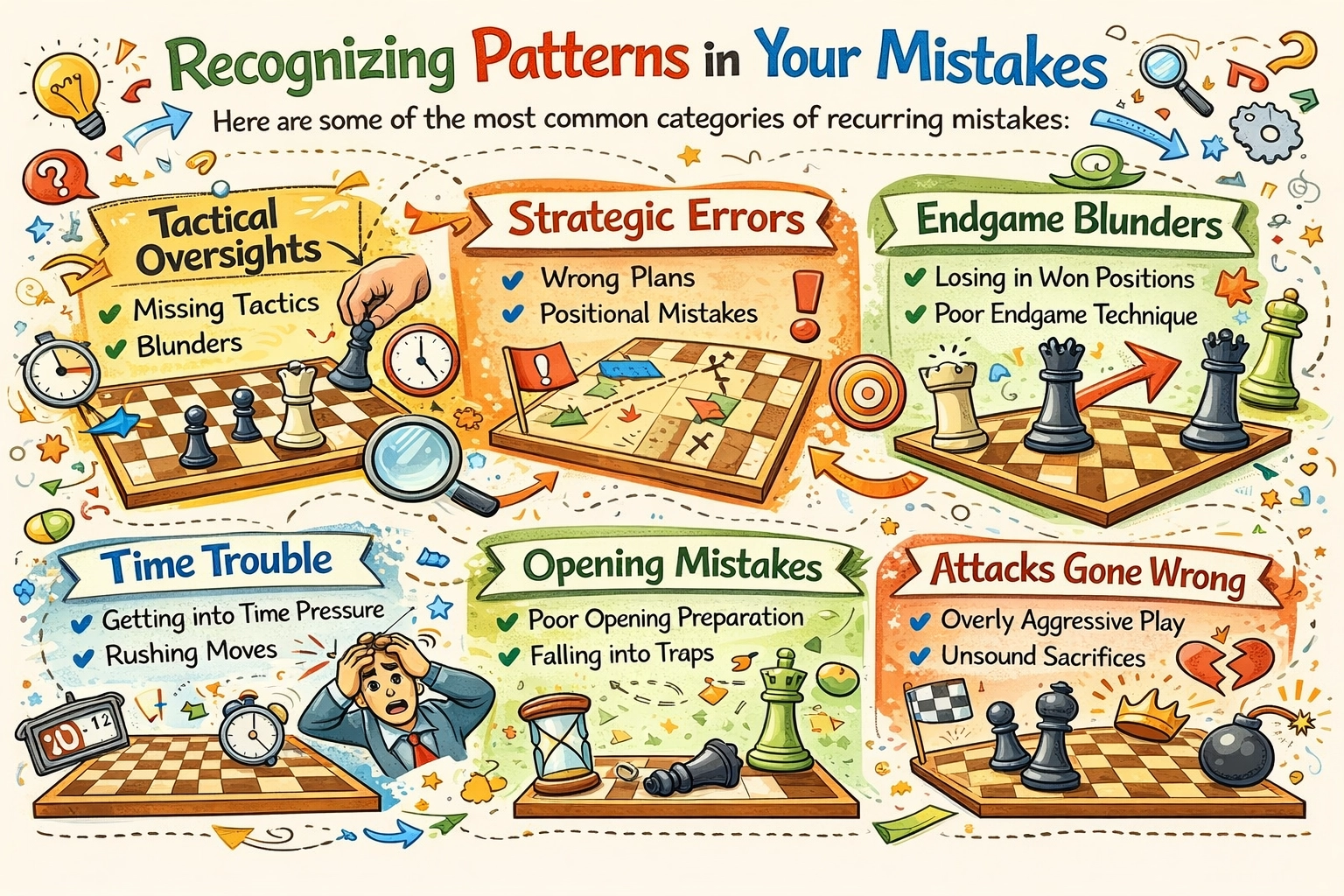
Missing tactics or calculation errors
Tactics are the vocabulary of chess; if you do not know the words, you cannot speak the language. A vast majority of games below the master level are decided by simple tactical oversights.
You might notice a pattern where you consistently miss discovered attacks. Or perhaps you always fail to see backward knight moves a very common human blind spot. Maybe your calculation breaks down specifically when there are multiple captures available on a single square, and you lose track of the move order.
If your game analysis reveals a high frequency of tactical blunders, you have identified a critical weakness. This means that spending hours studying deep positional concepts or obscure opening lines is a waste of your time until you fix the foundational issue of your tactical vision.
Poor planning in unfamiliar positions
Another very common pattern is the feeling of being completely lost after the opening phase ends. You might memorize your opening moves perfectly, but the moment you reach move twelve and you are out of your prepared "book," you do not know what to do.
This indicates a weakness in strategic understanding and planning. You might find yourself making random, one-move threats, or simply shuffling your pieces back and forth aimlessly because you do not know how to evaluate the pawn structure, identify weak squares, or formulate a long-term plan. If your analysis shows that your position slowly deteriorates in quiet, maneuvering games without any obvious tactical blunders, poor planning is likely your primary weakness.
Automatic moves without proper evaluation
Many players suffer from the habit of playing "automatic" moves. These are moves played instinctively, without taking the time to properly evaluate the specific nuances of the position.
For example, when an opponent captures a piece, the automatic human reaction is to instantly recapture it. However, sometimes there is a powerful intermediate move (an inbetween move or zwischenzug) that is far stronger than the automatic recapture. Another common automatic move is habitually castling as early as possible, even when the center is closed and an immediate kingside attack might be more effective.
If your analysis reveals that you are throwing away advantages because you play the first natural-looking move that pops into your head without pausing to look deeper, you have identified a serious flaw in your thought process. This weakness requires training yourself to sit on your hands and force a mandatory pause before executing any obvious move.
Creating a training plan to fix weaknesses
Identifying chess mistakes is only half the battle. The next, and arguably more difficult, phase is fixing weaknesses in chess through dedicated, structured effort. Once you know what your problems are, you need to design a personalized training plan to address them directly. A generic approach will not work; your training must be tailored to your specific diagnostic results.
Practicing tactical puzzles for tactical errors
If your analysis highlighted calculation errors and missed tactics as your primary weakness, your training plan must heavily emphasize tactical puzzle solving. However, simply doing random puzzles mindlessly is not enough.
You need to focus on pattern recognition. Use online platforms that allow you to sort puzzles by specific themes. If you struggle with pins, spend a week solving nothing but pin puzzles. If endgames are your weakness, solve endgame studies.
Furthermore, you must train your calculation depth. When solving a puzzle, do not just guess the first move and see if you are right. Force yourself to calculate the entire variation to the end in your head before you make a move on the screen. This mimics the conditions of a real game, where you cannot ask the board if your move is correct before you play it.
Studying positional exercises to improve strategic understanding
If poor planning and a lack of positional understanding are holding you back, your training needs to shift away from pure tactics and toward strategy. This is often harder to train than tactics because positional concepts are more abstract.
You can improve this by studying specialized books on chess strategy that explain concepts like pawn structures, piece activity, outposts, and weak color complexes. You can also practice positional exercises where the goal is not to find a forced checkmate, but to find the best plan to improve your position marginally.
Set up middle-game positions from master games and try to guess the next move, not looking for a tactic, but looking for the correct strategic idea. Why did the master reroute their knight? Why did they choose to exchange their good bishop for a seemingly passive knight? Answering these questions builds your strategic intuition.
Reviewing master games to learn correct plans
One of the most enriching and enjoyable ways to fix strategic weaknesses is by deeply studying the games of grandmasters. Master games are textbook examples of how chess should be played. When you are struggling to find plans in your own games, studying how the greats handled similar structures provides invaluable blueprints.
We can learn an immense amount by looking at the diversity of styles among top players. For instance, studying the games of legendary women in chess can provide incredible insights. If you struggle with passivity and want to improve your attacking intuition, analyzing the aggressively brilliant, tactical masterpieces of Judit Polgar is a fantastic exercise. Her ability to create initiative and attack the king is deeply instructive. Alternatively, if you want to improve your solid, positional understanding and smooth maneuvering, studying the games of Koneru Humpy or Hou Yifan can teach you how to slowly outplay an opponent without taking unnecessary risks.
When reviewing master games, try to guess the master's moves. Cover up the notation, look at the position, and decide what you would play. Then, compare your move to what the grandmaster actually played. When your moves differ, spend time figuring out why the master's move is superior. This active engagement is far more effective than just passively reading through the moves.
Psychological aspects of improvement
Chess is as much a psychological battle as it is a logical one. The mental fortitude required to endure the rigorous process of identifying and fixing chess weaknesses is immense. Many players fail to improve not because they lack intelligence, but because they lack the correct psychological approach to training and competition.
Handling losses constructively
As we discussed earlier, analyzing losses is essential. But the psychological aspect of actually handling those losses without losing motivation is a massive challenge. It is very common for players to go "on tilt" a poker term that applies perfectly to chess. After a painful loss, a player might immediately start another game in a state of anger and frustration, desperate to win their rating points back. This almost always leads to playing worse, making rash decisions, and suffering a string of subsequent losses.
Handling losses constructively means learning to disconnect your self-worth from your chess rating. A loss is not a reflection of your intelligence; it is simply a data point indicating that there is a gap in your chess knowledge. When you lose, take a deep breath, step away from the board or screen, and let the emotional wave pass. Only return to the game when you are calm and ready to view it objectively as a learning opportunity. Celebrate the fact that your opponent just gifted you a clear lesson on what you need to study next.
Developing discipline and patience during training
Fixing weaknesses in chess is not an overnight process. If you have spent five years developing a bad habit of playing too fast in the opening, you are not going to cure it with a single weekend of training. It requires discipline and immense patience.
There will be times when you feel like you are doing all the right training solving puzzles, analyzing games, reading books but your rating refuses to budge. You might even experience a temporary rating drop as you try to implement new, unfamiliar concepts into your play. This is the plateau where most players give up.
You must trust the process. Chess improvement often happens in sudden leaps rather than a smooth, continuous line. You absorb information, your brain slowly rewires itself to understand new patterns, and suddenly, weeks or months later, concepts that used to be confusing become crystal clear. Developing the discipline to stick to your training plan even when immediate results are not visible is the hallmark of a dedicated player.
Using structured training for long-term progress
To ensure that your efforts to identify and fix your chess weaknesses translate into actual rating gains and a deeper enjoyment of the game, your training must be structured and balanced. Sporadic, disorganized study yields sporadic, disorganized results.
Combining tactics, strategy, endgames, and game analysis
A common trap is to over-focus on one area of the game while completely neglecting the others. A player might spend months exclusively studying complex opening traps, only to realize they are still losing games because they cannot convert a winning endgame.
A structured training plan must be holistic. It should allocate specific time to different phases of the game. For example, your weekly routine should include dedicated time for tactical puzzles to keep your calculation sharp. It should include time for studying master games or reading a strategy book to deepen your positional understanding. Crucially, it must include dedicated time for endgame study. The endgame is where the fundamental properties of the pieces are revealed, and improving your endgame technique often has a profound ripple effect on your middlegame planning. And, of course, the cornerstone of this structure must be the regular, deep analysis of your own serious games.
Maintaining a balanced training routine
Balance is key to long-term sustainability. If you create a training schedule that demands four hours of intense study every single day on top of your regular work or school commitments, you will inevitably burn out within a few weeks.
Start small and be realistic about the time you can dedicate. Even 30 to 45 minutes of highly focused, active training every day is infinitely more valuable than a four-hour marathon session once a week where you are half-asleep and distracted. Consistency is the secret ingredient to chess improvement.
At Enthuziastic, we strongly believe in the power of continuous, structured learning. Whether you are aiming to win your local club championship or simply want to beat your neighbor in a friendly weekend game, the journey is the same. By courageously identifying your chess mistakes, maintaining objectivity, and dedicating yourself to a structured training plan, you can systematically dismantle your weaknesses and transform yourself into a much stronger, more confident chess player. The board is waiting; it is time to get to work.
Frequently asked questions
1. How many games should I analyze to find a pattern in my weaknesses?
You do not need hundreds of games to start seeing patterns. A focused review of your last 10 to 15 serious games (preferably rapid or classical time controls) is usually enough to highlight recurring issues. Blitz games can be analyzed, but they often reflect time pressure errors rather than deep knowledge gaps.
2. I keep making the same mistake even after analyzing it. What should I do?
This is very common. Simply identifying a mistake doesn't instantly reprogram your brain. You need to actively practice the specific scenario. If you keep missing knight forks, do hundreds of knight fork puzzles until the pattern becomes instinctual. Force a mental checklist during your games: "Are there any knight jumps?" before you move.
3. Is it worth analyzing my blitz and bullet games?
Bullet games (1-2 minutes) are generally not worth deep analysis as they are mostly about reflexes and mouse speed. Blitz games (3-5 minutes) can be reviewed quickly to check opening knowledge or spot glaring tactical blind spots, but they shouldn't form the core of your deep analytical training. Focus your serious analysis on games with longer time controls where you actually had time to think.
4. How do I know if I have a positional weakness or a tactical weakness?
If you frequently lose material outright (hanging pieces, missing simple mates, stepping into forks), your primary weakness is tactical. If you reach middlegames where you have equal material but feel cramped, have no active plans, and are slowly squeezed off the board, your weakness is likely positional and strategic.
5. At what point in my analysis should I turn on the chess engine?
Only turn the engine on after you have gone through the entire game yourself, identified the critical moments, and written down your own variations and thoughts. The engine should be the final step to verify your human analysis, not the first step that does the thinking for you.
6. I get very angry when analyzing my losses. How can I stop this?
This is a natural ego defense mechanism. Try delaying your analysis. Don't look at the game immediately after losing. Wait a day or two until the emotional sting has faded. Approach the game as if you are analyzing a game played by two strangers, rather than your own game.
7. Can playing against stronger opponents help identify my weaknesses?
Absolutely. Playing against weaker opponents might let you get away with dubious plans and unsound attacks. Stronger opponents will mercilessly punish your inaccuracies, rapidly exposing the flaws in your understanding. Reviewing games where you were outplayed by a stronger player is highly instructive.

Comments