

Welcome to another deep dive into the beautiful game of 64 squares, brought to you by Enthuziastic, your global people-to-people live learning network. Whether you are playing a friendly match on a Sunday evening or competing in a serious tournament, there is one skill that stands between a good player and a great player. That skill is calculation.
Chess is a game of pure information. Unlike card games, nothing is hidden from you. The board is right there in front of your eyes. But seeing the pieces and truly understanding what they can do are two very different things. When you look at a position and try to see the future imagining your move, your opponent's reply, and your counter-reply you are doing what chess players call calculation in chess.
Today, we are going to explore how to calculate in chess from the ground up. We will look at proper chess calculation techniques, how to find the right candidate moves in chess, and the exact calculation steps you need to follow to improve your game. Grab your chessboard, set up your pieces, and let us begin this journey to improve chess thinking.

- Introduction to calculation in chess
- The steps of effective calculation
- Tools to improve calculation
- When and where to calculate in a game
- Common calculation mistakes and how to fix them
- How calculation ties into broader chess thinking
- Structured practice routines for calculation
- Frequently asked questions (FAQs) about chess calculation
Introduction to calculation in chess
Calculation is the engine of your chess mind. It is the raw ability to see ahead. Many beginners think that grandmasters are simply born with a magical ability to see twenty moves deep. But the truth is much simpler and more encouraging. Calculation is a structured habit. It is a mathematical process of elimination and imagination that anyone can learn with proper guidance.
Why calculation is a critical skill for players of all levels
You might wonder why we need to calculate so deeply if we already know basic chess principles like controlling the centre and developing our pieces. The answer is that general principles only guide you when the position is quiet. When the board catches fire and pieces are attacking each other, general rules fly out the window.
In sharp, tactical positions, a single mistake in your calculation steps can cost you the game immediately. You can play forty brilliant strategic moves, but if you miscalculate one capture, you might lose your queen. That is why building a strong foundation in calculation is completely non-negotiable for players who want to grow.
Calculation gives you confidence. When you have calculated a line properly, you do not play your move and hope for the best. You play your move knowing exactly what is going to happen next. It removes fear from your game.
How calculation differs from intuition and pattern recognition
It is very important to understand the difference between calculation and intuition. Intuition in chess is your gut feeling. It is that voice in your head that says, "This move looks good." Intuition comes from pattern recognition. After you have solved thousands of puzzles, your brain automatically recognises a back-rank weakness or a pinned knight.
Pattern recognition is fast. It happens in seconds. Calculation, on the other hand, is slow, deliberate, and requires hard work.
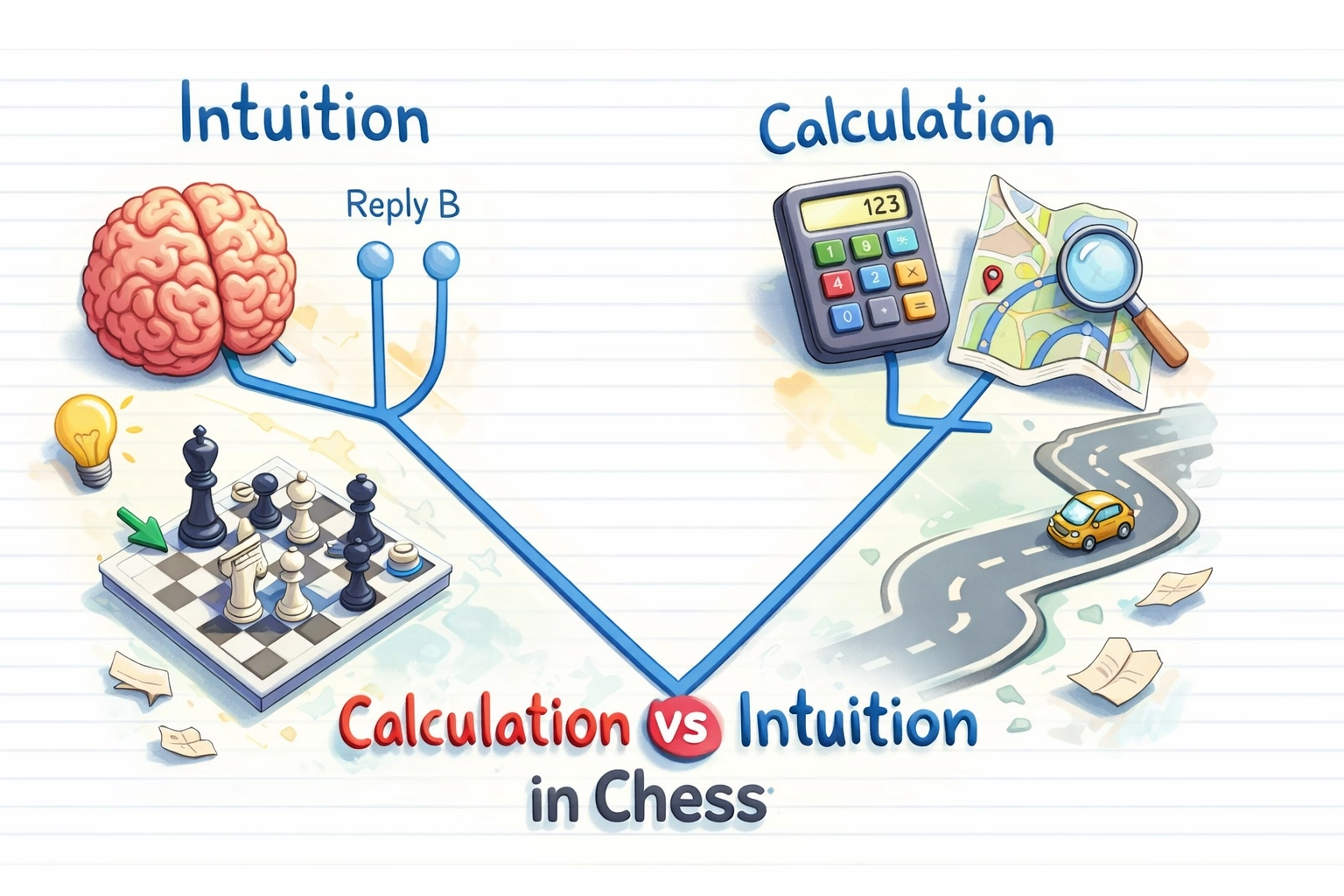
Think of it like driving a car. Intuition is knowing how to steer and brake without thinking about it. Calculation is reading the map, checking the traffic signs, and planning the exact route to your destination. You need both to reach your goal safely. Intuition tells you where to look, but calculation proves whether your idea actually works on the board.
The steps of effective calculation
If you want to know how to calculate in chess properly, you cannot just look at the board and start guessing moves randomly. You need a systematic approach. The best players in the world use a structured set of calculation steps to make sure they do not miss anything important.
How to identify candidate moves in chess - the moves worth thinking about
The biggest mistake amateur players make is calculating the very first move that pops into their head. If that move does not work, they look for a second one. This is a very inefficient way to think. Instead, you must start by finding candidate moves.
Candidate moves are all the logical moves available to you in a specific position. Before you calculate any single move deeply, you should scan the board and list out your options. A good rule of thumb is to find two to four candidate moves.
How do you find these moves? Always look for forcing moves first. Forcing moves are moves that demand an immediate response from your opponent. The hierarchy of forcing moves is:
Checks: Does this move put the opponent's king in check?
Captures: Does this move take an opponent's piece?
Threats: Does this move threaten to checkmate or win material on the next turn?
By identifying candidate moves first, you organise your thoughts. You build a menu of options before deciding what to order.
Techniques for visualising future positions and sequencing variations
Once you have your list of candidate moves, the real hard work begins. You have to visualise the board after each move is played. Visualisation is the ability to hold the image of the chess pieces in your mind's eye even after they have moved.
When you are practicing chess calculation techniques, you must calculate one candidate move at a time. Let us say you have Candidate A and Candidate B. You start with Candidate A. You imagine playing it. Then, you must find your opponent's best reply. Do not hope your opponent plays a bad move. Always assume they will find the absolute best defence.
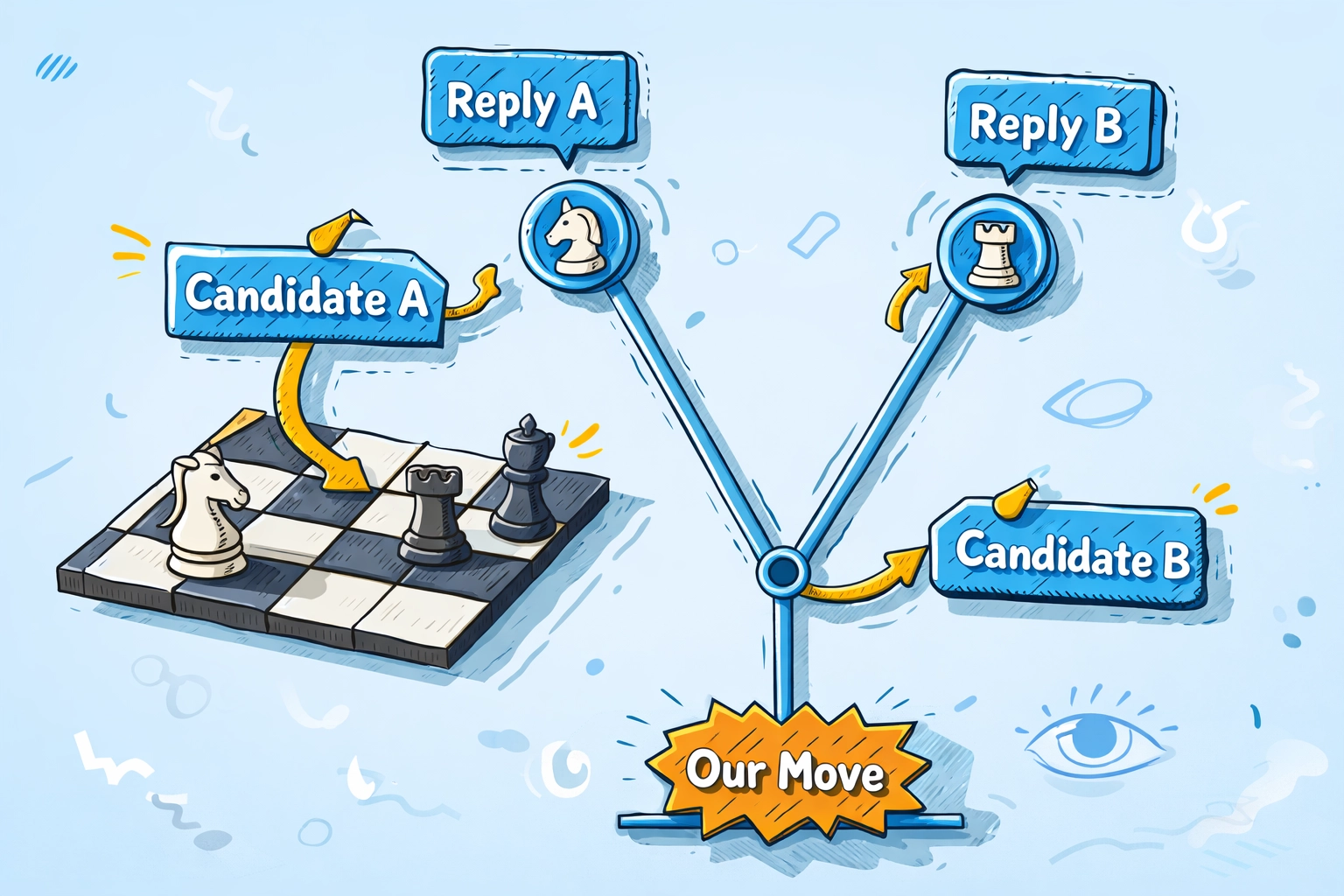
After you see their reply, you look for your next forcing move. This back-and-forth sequencing is called a variation. You follow this variation until the position becomes quiet again, meaning there are no more immediate checks, captures, or big threats.
If you struggle to hold the pieces in your head, do not worry. This is very normal. A great technique is to literally close your eyes for a few seconds during a game. It blocks out the physical pieces and helps you focus entirely on the mental image of the future board.
How to judge resulting positions once a line is calculated
Calculating a variation perfectly is useless if you do not know how to evaluate the final position. When you reach the end of your mental line, you must stop and ask yourself, "Who is better here?"
To judge the resulting position, you need to weigh several factors. First, count the material. Did you win a pawn? Did you sacrifice a knight for a rook? Material is the easiest thing to judge.
Next, look at king safety. Even if you are up a full queen, if your king is about to be checkmated, the variation is bad. Finally, look at piece activity and pawn structure. Are your pieces coordinating well? Are your pawns weak or strong?
You must evaluate the final position of Candidate A. Then, you wipe your mental slate clean. You go back to the starting position and calculate Candidate B. Finally, you compare the resulting position of A with the resulting position of B. Whichever end result is better, that is the candidate move you choose to play.
Tools to improve calculation
Improving your ability to see ahead requires the right mental tools. Just like a carpenter needs a hammer and a saw, a chess player needs specific thinking techniques to build a solid game.
Methods like blunder checking, candidate move lists, and what if analysis
One of the most powerful tools you can develop is the blunder check. A blunder check is a final safety mechanism before you physically touch a piece. After you have done all your deep calculation and decided on your move, pause for five seconds. Ask yourself one simple question: "If I play this, what is my opponent's most dangerous reply?"
This simple habit saves hundreds of lost points. It stops you from hanging pieces or walking into simple one-move checkmates.
Another great tool is writing down candidate move lists during your training sessions. When you are studying at home, do not just calculate in your head. Write your candidate moves on a piece of paper. This forces you to be disciplined.
"What if" analysis is also incredibly helpful. When evaluating a complex position, ask yourself, "What if my opponent's knight was not defending that square?" or "What if I could put my bishop on that diagonal?" This type of reverse engineering helps you find creative tactical ideas that you might normally miss.
How to avoid common calculation errors like tunnel vision or rushing
Tunnel vision is a massive problem for club players. This happens when you fall in love with a beautiful attacking idea. You focus so hard on making your brilliant sacrifice work that you completely ignore the other side of the board. You get tunnel vision on the enemy king, and you fail to see that your opponent is pushing a pawn to promote on the queenside.
To avoid tunnel vision, you must force yourself to scan the entire board on every single move. Look at all 64 squares. Pay attention to what your opponent is trying to achieve, not just what you want to do.
Rushing is another major error. Many players calculate the first two moves of a variation very quickly, get excited, and immediately play the move. They forget to calculate to the very end of the line. Patience is the key to chess calculation techniques. Sit on your hands if you have to. Take deep breaths and do not rush the process.
Exercises and puzzles that develop deeper analytical skills
If you want to improve chess thinking, you cannot just play fast games on the internet. You have to solve puzzles. But not all puzzle training is equal.
To specifically improve your calculation, you need to do long-form puzzle solving. Set up a difficult tactical puzzle on a real, physical board. Do not use a computer screen. Sit back and try to solve it entirely in your head without moving the pieces.
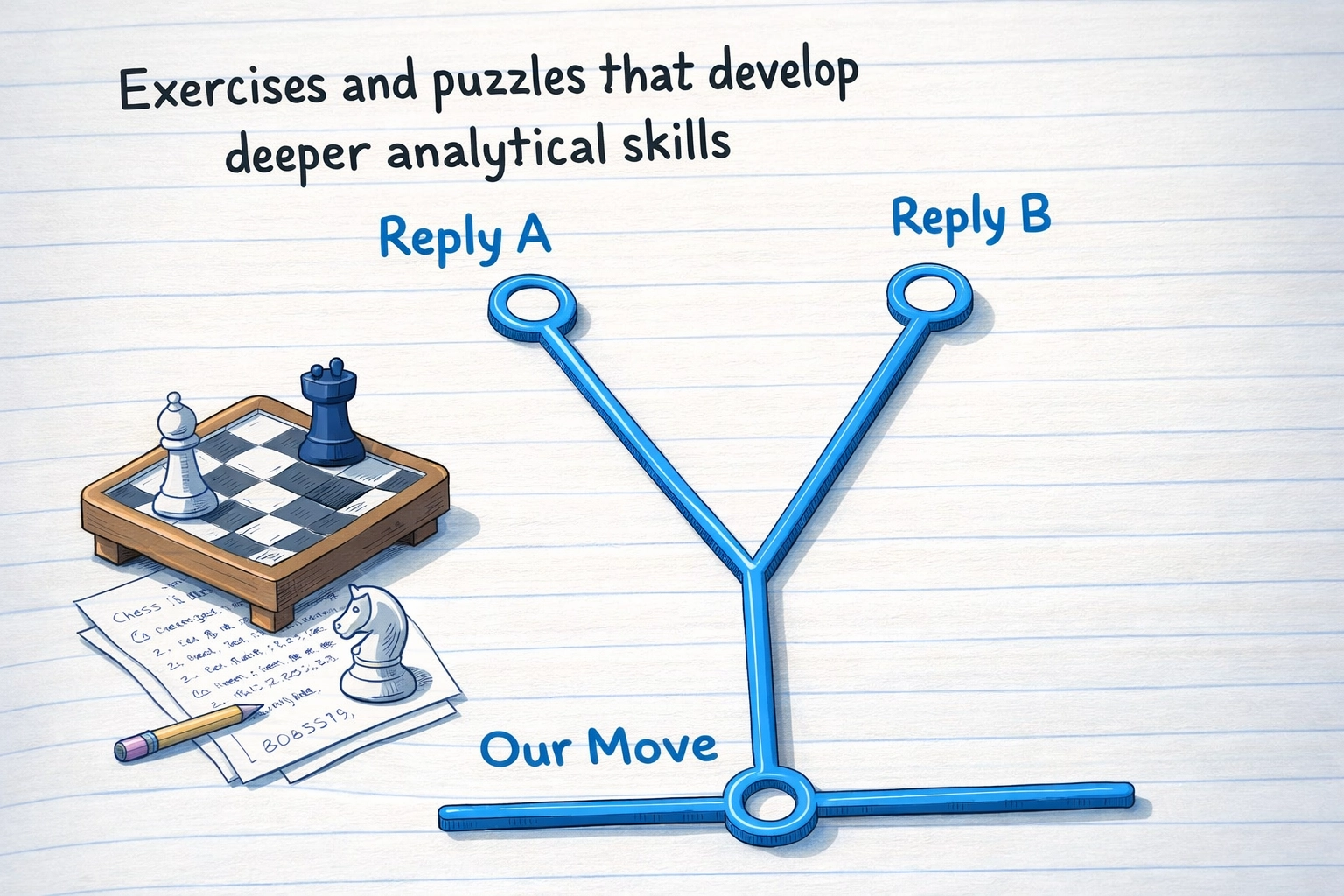
Give yourself fifteen to twenty minutes for a single complex puzzle. Write down every variation you calculate. When you are finished, compare your written notes with the actual solution. This exercise is incredibly tiring, but it is exactly like lifting heavy weights at the gym. It builds immense mental stamina and calculation strength.
When and where to calculate in a game
One of the greatest secrets of chess mastery is knowing when to think deeply and when to play quickly. You cannot calculate ten moves deep on every single turn. Your brain will melt, and your clock will run out.
Recognising critical moments that require deeper thought
A chess game flows like a river. Sometimes the water is calm, and sometimes there are fierce rapids. You need to identify the rapids the critical moments.
A critical moment usually happens when the tension on the board is at its highest. This occurs when multiple pieces are attacking each other, when the pawn centre is about to be broken, or when either player is launching a direct attack on the king.
Another critical moment is when the character of the game is about to change. For example, transitioning from the middlegame to the endgame. When you sense a critical moment, that is the time to slow down. That is when you apply all your calculation steps and invest your time heavily.
Balancing calculation with time management during a game
Time is a chess piece. It is just as important as your bishops and knights. If you spend forty-five minutes calculating a beautiful tactic in the early middlegame, you might find a good move. But if you only have three minutes left for the rest of the game, you will likely blunder later under time pressure.
Good time management requires discipline. In quiet positions, where you are just improving your pieces or completing development, rely on your intuition and general principles. Play relatively fast. Save your precious minutes for the critical moments we discussed above.
If you are stuck choosing between two candidate moves that both look completely fine, and you cannot find a clear advantage after ten minutes of thinking, just pick one. Do not burn your clock trying to squeeze water from a stone.
How to decide when to stop calculating and trust your evaluation
Knowing when to end a variation is an art. Many players calculate a line, get confused, and then calculate the exact same line again from the beginning. This is a huge waste of energy.
You should stop calculating a line when it reaches a state of rest. A state of rest means there are no more forcing checks, no immediate captures, and no crushing threats. Once you reach this quiet position in your mind, stop. Evaluate the position based on material, king safety, and piece activity.
Trust your evaluation. Once you have judged that the resulting position is good for you, do not second-guess yourself. Have confidence in the hard work your brain has just done, make your decision, and play the move.
Common calculation mistakes and how to fix them
Even grandmasters make calculation mistakes. The human brain is not a computer. However, by understanding the most common pitfalls, you can dramatically reduce how often they happen in your own games.
Typical pitfalls such as ignoring opponent threats or miscounting moves
The most common mistake by far is playing "hope chess." Hope chess is when you calculate a variation and simply hope your opponent will play a weak reply so your trick works. True calculation requires you to always look for your opponent's strongest, most annoying, and most destructive replies.
Another typical pitfall is miscounting material at the end of a long sequence of trades. You might calculate a massive series of captures on a single square. You take with the knight, they take with a bishop, you take with a rook, they take with a queen. By the end of the mental sequence, it is easy to forget who actually won a piece. A great way to fix this is to literally count the pieces in your head as they leave the board. "I give three points, I take three points. I give five points, I take nine points."
Forgetting about intermediate moves, or "zwischenzugs", is also deadly. You might expect your opponent to recapture a piece immediately, but instead, they throw in a surprising check first, ruining your entire calculated plan. Always check for intermediate forcing moves.
Practical ways to train yourself out of bad calculation habits
Breaking bad habits takes conscious effort. If you constantly play too fast and miss opponent threats, you need a physical trigger to slow you down. A popular method among coaches is the "sit on your hands" rule. During training games, literally sit on your hands. It forces you to look at the board, identify candidate moves in chess, and do a blunder check before you are physically able to touch a piece.
If you struggle with holding variations in your head, practice the "empty board" technique. Get an empty chessboard. Look at a complex position in a book. Try to move the pieces in your mind on the physical empty board. This bridges the gap between seeing the real pieces and visualising the imaginary ones.
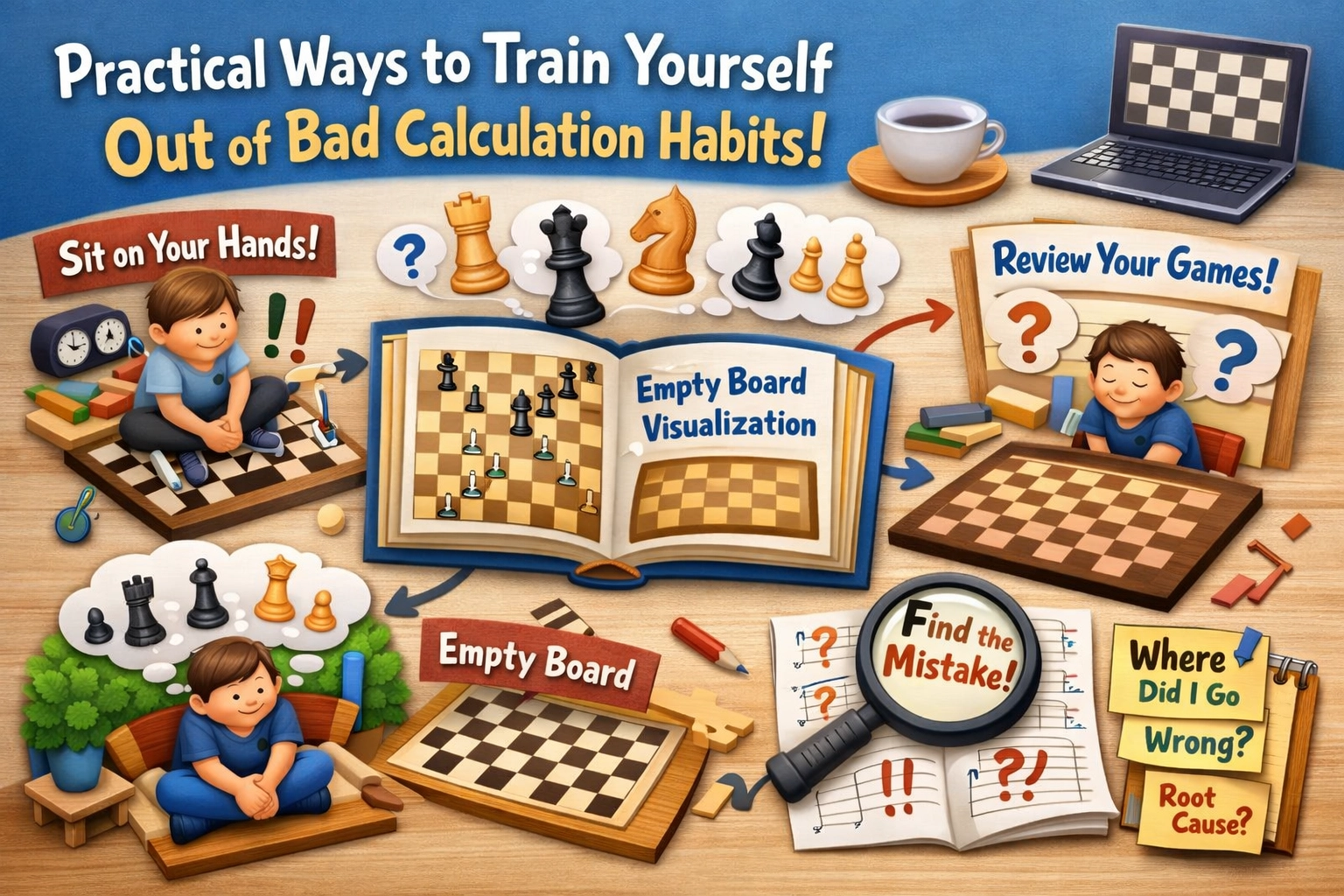
Review your games rigorously, especially your losses. When you find a mistake, do not just let the computer engine show you the right move. Ask yourself, "Where exactly did my calculation steps fail?" Did you miss a candidate move? Did you evaluate the final position poorly? Identify the root cause.
How calculation ties into broader chess thinking
Calculation does not exist in a vacuum. It is deeply connected to everything else you do on the chessboard. It is the bridge between your grand ideas and the reality of the game.
The role of calculation in planning, strategy, and tactics
Strategy is your overall plan. It is asking yourself, "What do I want to achieve in this position?" Tactics are the specific sequences of moves that help you achieve that plan. Calculation is the tool that makes tactics work.
You might have a brilliant strategic plan to attack the queenside. But to execute that plan, you have to calculate exactly how to push your pawns, where to place your rooks, and how your opponent will defend. Without calculation, strategy is just a daydream.
When you learn how to calculate in chess efficiently, your strategic planning also improves. Because you can see further ahead, you can create deeper, more complex plans that your opponents simply cannot understand until it is too late.
How improving calculation improves overall chess performance
When your calculation improves, every single aspect of your game gets stronger. Your defence becomes like a fortress because you can accurately see your opponent's threats before they happen. Your attack becomes deadly because you can accurately sequence your forcing moves to land a checkmate.
Most importantly, good calculation saves your energy. When you know a structured process, you stop panicking in complex positions. You look at a messy board, take a deep breath, and calmly start listing your candidate moves. This clear, reliable thinking style much like how we teach here at Enthuziastic brings a sense of peace and control to your tournament play.
Structured practice routines for calculation
To see real improvement, you cannot just study calculation techniques once a month. You need a consistent, daily routine. Consistency is the secret to mastering any complex skill.
How to design daily training routines that strengthen calculation skills
A good daily routine does not have to be long. Even thirty minutes of highly focused practice is better than three hours of lazy playing.
Start your day with a warm-up. Spend ten minutes solving easy tactical puzzles. This gets your brain engaged and sharpens your basic pattern recognition.
Then, move to the core workout. Take twenty minutes to solve just one or two very complex calculation puzzles. Do not use a board. Do it entirely in your head. Write down your candidate moves, your variations, and your final evaluation. Push your brain until it feels tired.
Finish your routine by reviewing a master game. But do not just click through the moves. When the game reaches a critical moment, pause. Cover the moves. Try to calculate what the grandmaster played next. Compare your calculation steps with the actual game.
Suggested drills, puzzles, and review methods for consistent growth
One of the best drills you can do is the "mate in two" drill. Set up ten different mate-in-two puzzles. Try to solve all ten in your head as quickly as possible. This builds tremendous speed and forces you to look at every single check and forcing move instantly.
Endgame studies are also fantastic for calculation. In endgames, there are fewer pieces on the board, which makes visualisation slightly easier. However, the calculation needs to be incredibly precise, often going ten or fifteen moves deep, because pawn races are purely mathematical.
Finally, never underestimate the power of reviewing your own games without a computer. After a tough tournament game, go home and write down your thoughts. Write down what you calculated during the game. Then, and only then, turn on the computer engine to see where your human calculation failed. This process of self-correction is how champions are built.
We hope this comprehensive guide from Enthuziastic helps you understand the deep, fascinating world of chess calculation. It is a journey of continuous learning. Be patient with yourself, stick to your calculation steps, always look for those crucial candidate moves, and watch your chess rating climb steadily. Happy playing, and keep learning!
Frequently asked questions (FAQs) about chess calculation
1. What is the difference between tactics and calculation? Tactics are specific patterns or tricks (like pins, forks, and skewers) used to win material or give checkmate. Calculation is the mental process you use to see if those tactics actually work in your specific position by thinking several moves ahead.
2. How deep should a beginner try to calculate in chess? Beginners should not worry about calculating ten moves deep. Start small. Aim to calculate two to three full moves ahead (your move, their reply, your move, their reply, your final move). Accuracy is much more important than depth when you are just starting out.
3. Why do I lose track of the pieces when trying to see ahead? This is completely natural. Your working memory is acting like a muscle that has not been trained yet. Visualisation takes time to develop. Practising without moving the pieces, and closing your eyes to picture the board, will slowly strengthen this ability.
4. What are candidate moves in chess, and why do I need them? Candidate moves are a shortlist of the best possible moves in a given position. You need them because if you just calculate the first random move you see, you will miss stronger, more forcing options. It organises your thinking process before you commit time to deep calculation.
5. How can I stop blundering simple pieces when calculating complex lines? Always perform a "blunder check" at the very end of your calculation. After you decide on your final move, take a deep breath, and spend five seconds looking strictly for immediate, simple threats from your opponent, like one-move captures or checks.
6. Should I calculate during my opponent's turn? Yes, but you should not calculate specific variations, because you do not know what move they will play yet. Instead, use their turn to think about broader strategy, identify their candidate moves, and understand their general plans. Save your deep calculation energy for your own clock time.
7. Can playing fast time controls like bullet or blitz improve my calculation? Generally, no. Bullet and blitz rely entirely on fast intuition and pattern recognition. To improve deep chess calculation techniques, you need time to practice the structured steps. Playing longer time controls (like rapid or classical) is essential for practicing calculation.

Comments