

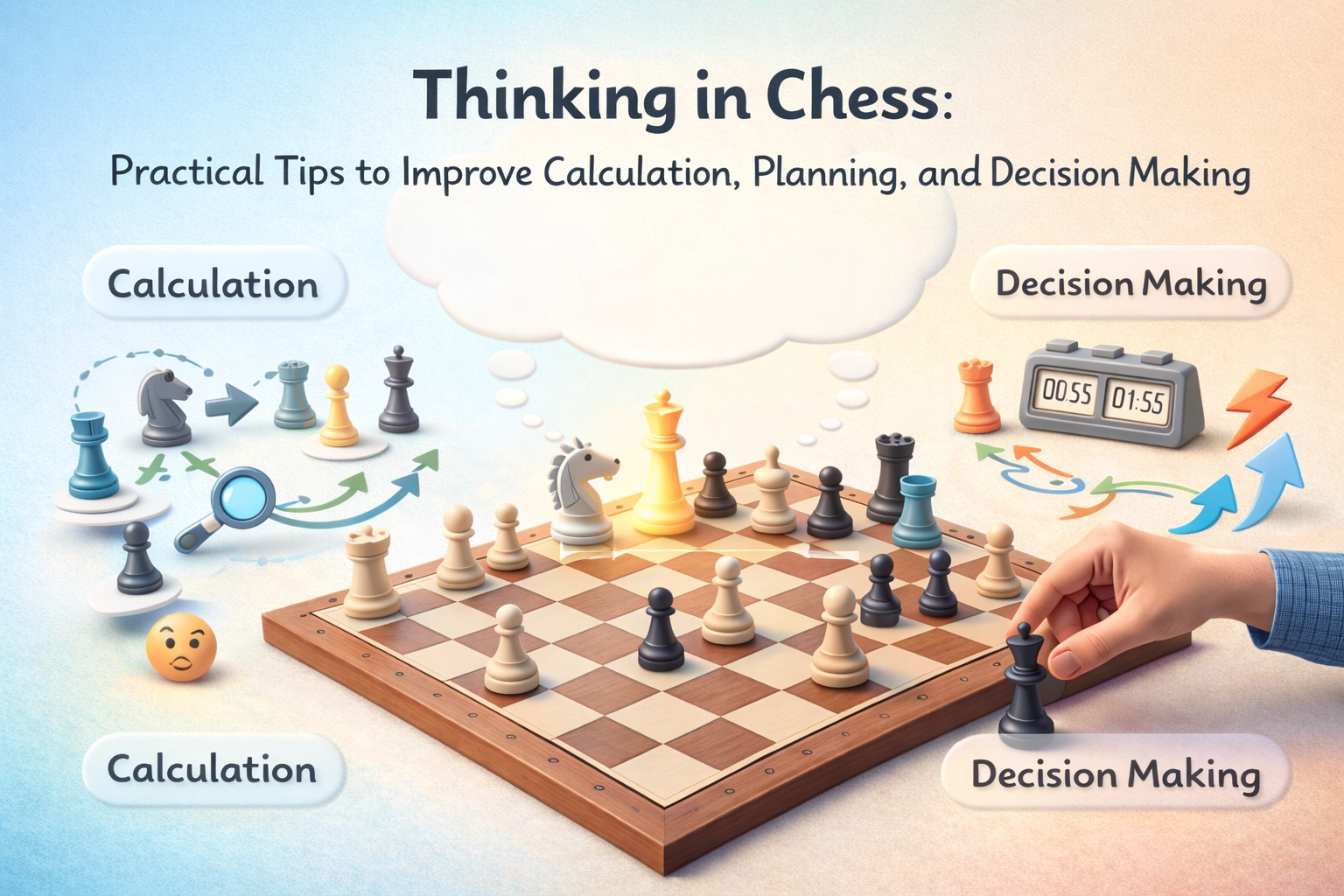
Welcome to another learning journey with Enthuziastic. If you have ever played a game of chess, you know that the real battle does not happen on the board. The real battle happens inside your mind. Moving the pieces is easy, but knowing which piece to move, when to move it, and why to move it is what separates a beginner from a master.
Thinking in chess is a fascinating subject. Every time it is your turn, you are faced with a universe of possibilities. How do you narrow them down? How do you avoid blunders? How do you create a master plan that completely crushes your opponent's position?
At Enthuziastic, we are building a global people-to-people live learning network where we believe that anyone can master these skills with the right guidance. In this detailed guide, we are going to dive deep into the mechanics of chess decision making. We will explore practical chess planning tips, how to improve calculation in chess, and ultimately, how to think better in chess. Let us get started on this journey to upgrade your chess mind.
- Introduction to chess thinking: why it matters
- Understanding the phases of thought during a game
- Practical calculation techniques for chess players
- Planning and long-term strategy in chess
- Chess decision making under pressure
- Common thinking errors and how to correct them
- Training drills to improve thinking in chess
- Applying thinking skills in real games
- Conclusion: becoming a better thinker with Enthuziastic
- Frequently asked questions (FAQs)
Introduction to chess thinking: why it matters
When we watch grandmasters play, it looks like magic. They play their moves so confidently, and their pieces seem to coordinate perfectly. But there is no magic involved. It is all about having a highly structured thinking process.
The foundation of playing better chess
Thinking in chess is not just about calculating ten moves ahead. It is about understanding the position in front of you. Many beginners think that if they just learn a few clever opening traps, they will win games. But traps only work against unprepared opponents. Real chess strength comes from having a reliable thought process that works in any position, whether you have seen it before or not.
When you improve your thinking process, your results become consistent. You stop losing pieces for free. You start noticing what your opponent is trying to do. Most importantly, you start feeling in control of the game instead of just reacting to what happens.
Intuition, calculation, and planning: what is the difference?
To understand how to think better in chess, we first need to understand the three main tools our brain uses during a game: intuition, calculation, and planning.
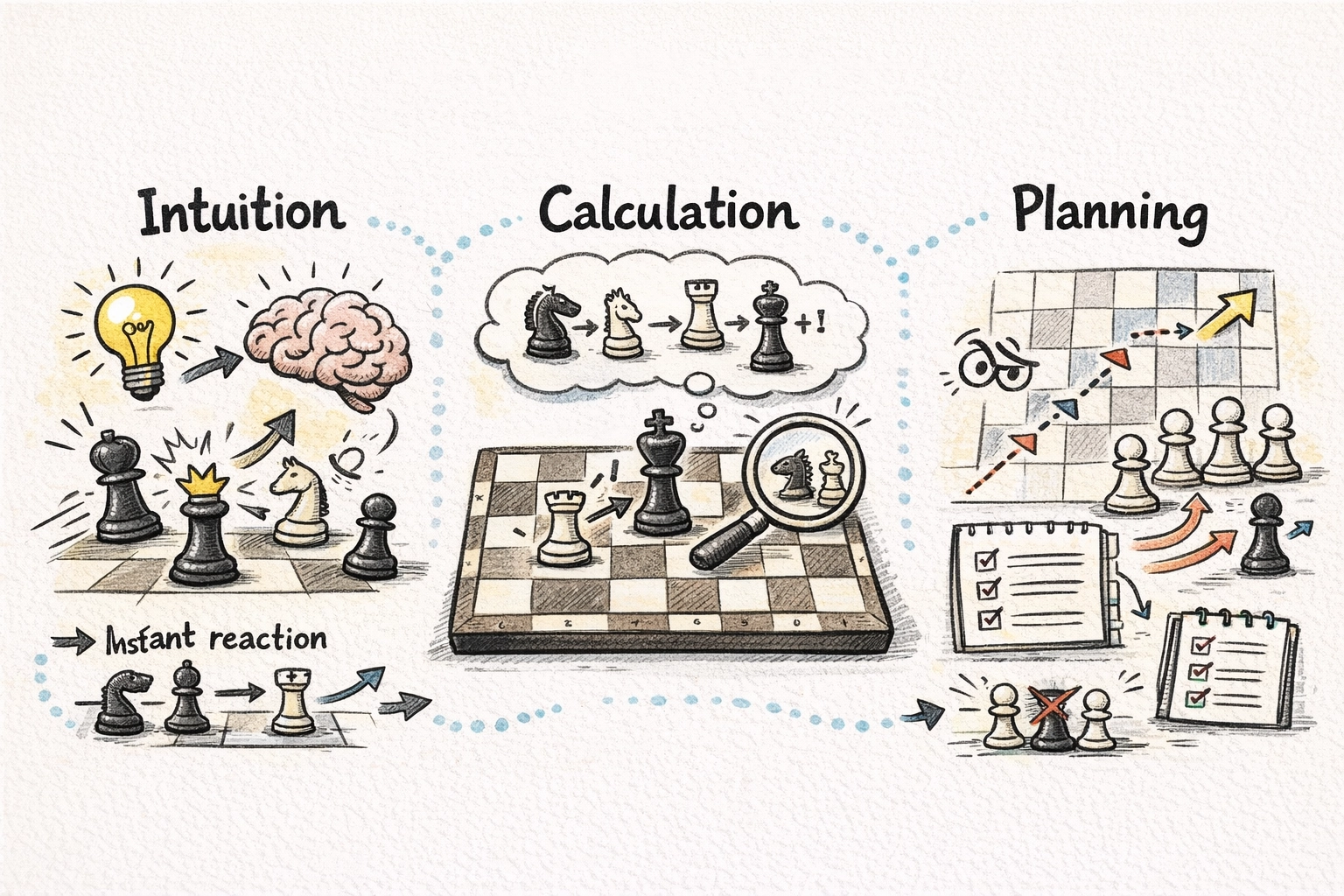
Intuition is your chess instinct. It is that gut feeling that tells you a move is good or bad without you having to calculate it. Intuition is built over time by looking at thousands of chess patterns. For example, when you see your opponent's king exposed in the center, your intuition tells you to open up the position and attack.
Calculation is hard work. It is the concrete, step-by-step visualisation of future moves. "If I go there, he captures this, then I give a check, and I win the rook." Calculation is strictly about forcing variations. It requires intense focus and a clear mind.
Planning is your long-term roadmap. While calculation deals with immediate tactics, planning deals with strategy. A plan could be, "I will slowly maneuver my knight to this strong square, trade off his best defending bishop, and push my pawns on the queenside."
A strong chess player uses all three smoothly. Intuition suggests the ideas, planning gives them a purpose, and calculation checks if they actually work safely.
Understanding the phases of thought during a game
Your brain should not be doing the same type of thinking on every single move. If you try to calculate deeply on every move, you will exhaust yourself and run out of time on the clock. You need to know when to use which mental tool.
Recognising key moments for calculation and strategy
A key moment is a critical point in the game where the nature of the position is about to change. Recognizing these moments is a massive part of chess decision making.
How do you spot a key moment? Look for tension. Are there multiple pieces attacking each other? Is there a pawn break available that will open up the center? Has your opponent just made a move that looks very aggressive or very strange? These are the moments where you need to stop playing on autopilot and start calculating deeply.
On the other hand, if the position is closed, the center is locked, and no pieces are in direct contact, calculating 10 moves ahead is a waste of time. Your opponent has too many possible replies. In these quiet moments, you should switch from calculation mode to strategy mode. This is the time to improve the position of your worst-placed piece or slowly advance a pawn storm.
The power of pausing to avoid blunders
One of the most common reasons players lose games in club-level chess is playing too fast. Even if you are playing a longer time control, the urge to reply instantly to your opponent's move can be very strong.
You must develop the habit of pausing. When your opponent makes a move, sit on your hands. Ask yourself one simple question before doing anything else: "What is the threat?"
Did their move attack a piece? Did it create a sneaky checkmate threat? Did it prepare to push a dangerous passed pawn? By simply pausing for ten seconds to understand the opponent's idea, you will instantly eliminate a large percentage of your simple blunders.
Practical calculation techniques for chess players
Calculation in chess is often what scares beginners the most. The idea of holding multiple invisible board positions in your head sounds impossible. But just like a muscle, your calculation skills can be trained using structured methods.
Step-by-step methods to calculate variations
When you need to calculate, you cannot just guess moves randomly. You need a disciplined approach. Here is a practical method to improve your calculation in chess:
First, identify the forcing moves. Forcing moves are moves that limit your opponent's replies. The hierarchy of forcing moves is: Checks, Captures, and Threats. Always look at checks first, even if they look silly. A check forces the opponent to deal with it immediately. If there are no good checks, look at captures. If there are no good captures, look at threats (like attacking a queen or threatening checkmate).
Second, calculate the main line to the end. Choose the most forcing sequence and follow it in your mind until the exchanges stop and the position becomes quiet again.
Third, evaluate the final position. Ask yourself, "At the end of this sequence, am I better or worse?" Count the material. Look at king safety. If the resulting position is bad for you, you must reject that line and look for another one.
Finding candidate moves to avoid superficial thinking
One of the best chess planning tips you will ever receive is to use the "candidate moves" technique. Before you start calculating deeply, you should scan the board and pick two or three moves that look promising. These are your candidate moves.
Many amateur players see one move that looks decent, calculate it for a bit, and then just play it. They suffer from "first move bias." The problem is, the first move you see is rarely the best move on the board.
By forcing yourself to find at least three candidate moves before you calculate, you open your mind to creative ideas. Maybe there is a quiet positional move on the other side of the board that is much stronger than the obvious capture you were looking at. List your candidates, then calculate them one by one.
Planning and long-term strategy in chess
While tactics and calculation win material, strategy and planning win games. A bad plan is always better than no plan at all. Let us look at how to structure your thoughts strategically.
Connecting the opening, middlegame, and endgame
A very common mistake is treating the three phases of a chess game as completely separate events. Players memorize opening moves, survive the middlegame, and then try to figure out the endgame. This disjointed thinking leads to lost positions.
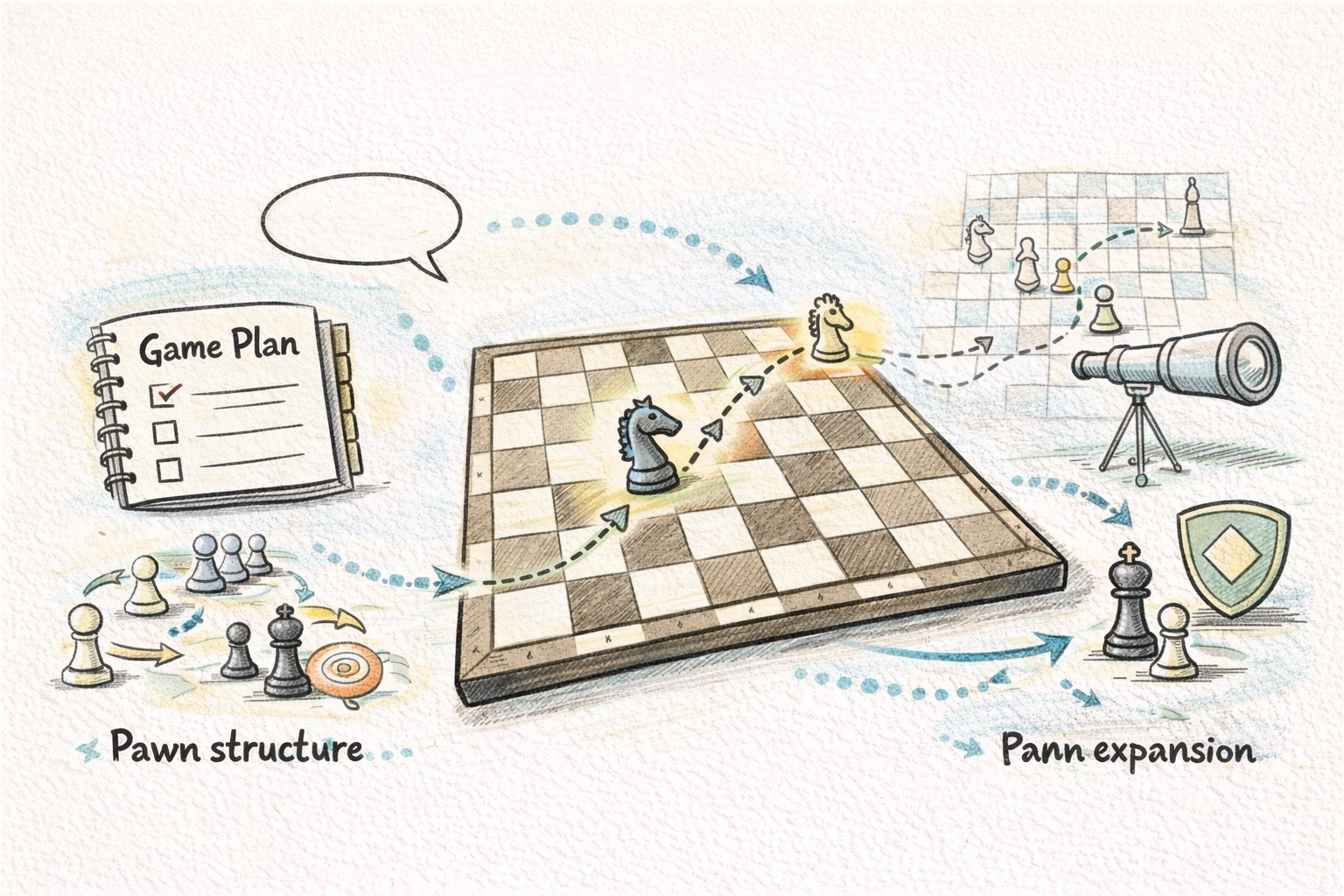
True thinking in chess requires you to see the game as one continuous flow. The opening you choose dictates the pawn structure. The pawn structure dictates the plans you must use in the middlegame. And the pieces you choose to trade in the middlegame dictate what kind of endgame you will play.
For example, if you play an opening that gives your opponent an isolated queen's pawn, your middlegame plan should be to block that pawn, attack it, and trade off the minor pieces. Why? Because an isolated pawn becomes a massive weakness in the endgame when there are fewer pieces to defend it.
Strategic plans based on pawn structure and piece activity
If you ever feel completely lost in a game and do not know what plan to come up with, look at the pawns. The pawns are the skeleton of the chess position. They tell you where to attack and where to defend.
If the pawn center is completely locked, your plan should be to attack on the wings (the kingside or queenside). If your opponent's pawns are shattered and broken up into small islands, your plan should be to attack those weak pawns.
Another great way to form a plan is to look at piece activity. Ask yourself, "Which of my pieces is the most unhappy?" Maybe you have a knight stuck on the edge of the board, or a bishop blocked by its own pawns. Your entire plan for the next five moves could simply be maneuvering that one bad piece to a beautiful, active square in the center of the board.
Prioritising king safety in your plans
No matter how beautiful your strategic plan is, it means nothing if your king gets checkmated. King safety must always be the foundation of your chess decision making.
Before you launch an attack on the opposite side of the board, evaluate your own king. Are the pawns defending your king intact? Do you have enough defensive pieces nearby? If your king is feeling a little airy and exposed, your priority must be consolidation. Bring a piece back to defend, or move your king to a safer square. Only when your house is secure should you go out looking for trouble.
Chess decision making under pressure
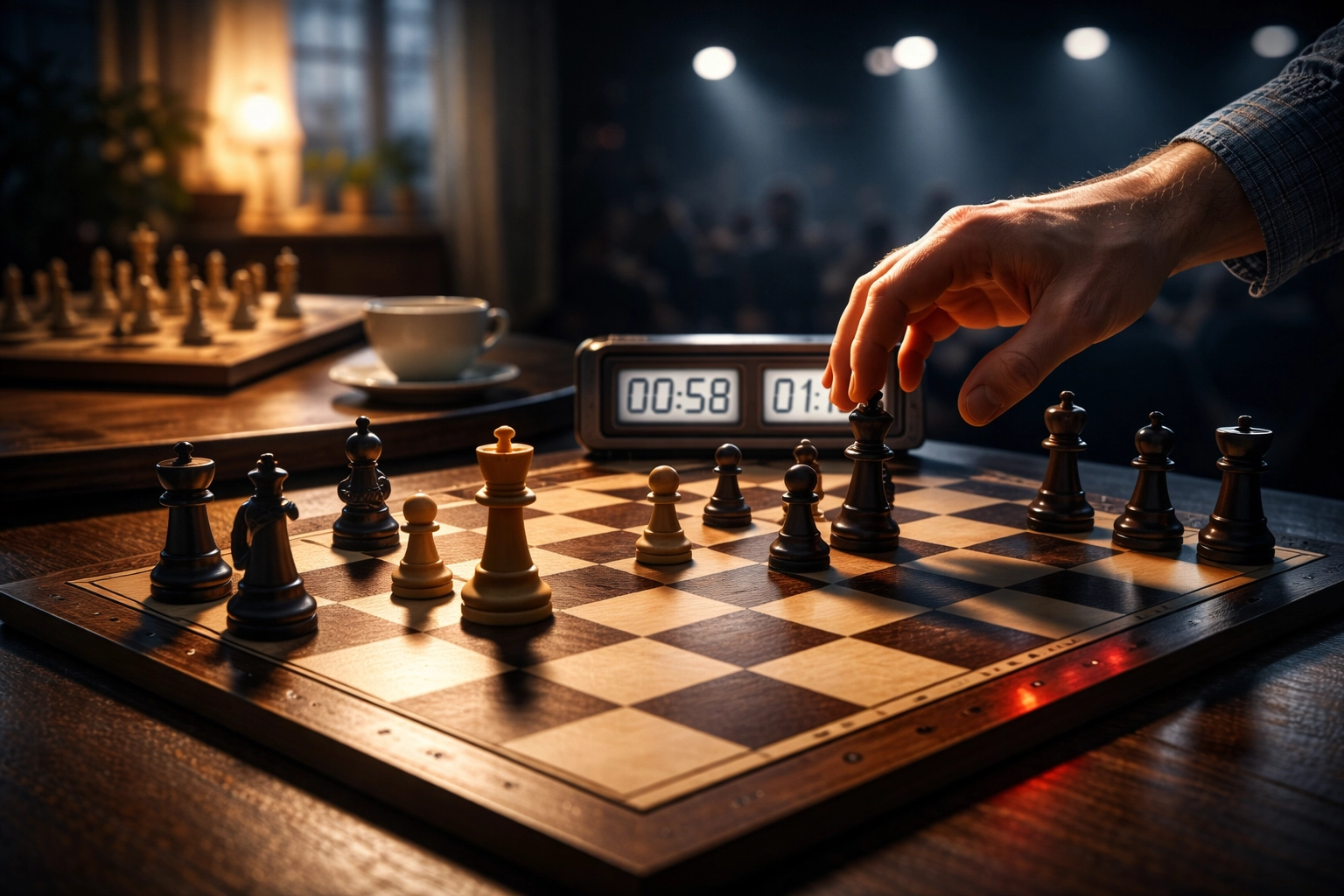
Playing chess at home with a cup of tea is one thing. Playing in a tournament hall, with the clock ticking down and your heart pounding, is a completely different experience. Managing your psychological state is a huge part of learning how to think better in chess.
Staying calm in time-trouble situations
Time trouble is the enemy of good calculation. When you have only a few minutes or seconds left on the clock, panic sets in. Your structured thinking process goes out the window, and you start making random moves just to beat the clock.
The first rule of time trouble is acceptance. Accept that you cannot play perfect chess anymore. You do not have the time to find the absolute best move. You only have time to find a safe, practical move.
Stop calculating long, complicated variations. Play solid, forcing moves that do not weaken your position. Keep your pieces defended. Do not create new weaknesses. Make your opponent do the hard work of trying to break through. Often, the player who simply stays solid in time trouble wins, because the opponent will over-press and make a blunder.
Handling mistakes and psychological stress
Every chess player, from a beginner at Enthuziastic to a world champion, makes mistakes. Making a blunder is painful. You instantly feel a drop in your stomach. But how you handle that mistake defines your chess strength.
The absolute worst thing you can do after making a mistake is to play your next move quickly out of frustration. This leads to a chain reaction of blunders, commonly known as "tilt."
If you realise you have made a mistake, force yourself to stop. Take a deep breath. Drink some water. Look away from the board for a few seconds. Then, look back at the board with fresh eyes. Accept the new reality. Do not cry over the lost piece. Focus entirely on the position as it is right now and look for the best defensive resources available.
Common thinking errors and how to correct them
We all fall into bad thinking habits. Recognizing these habits is the first step to eliminating them. Let us look at some typical pitfalls in chess thinking.
Rushing and ignoring your opponent's threats
Chess is a conversation between two minds, but many players treat it like a monologue. They are so focused on their own brilliant ideas that they completely ignore what the opponent is trying to do.
You might have a beautiful plan to deliver a checkmate in three moves, but if your opponent can checkmate you in one move, your plan is useless. This error often comes from excitement. When we see a good move for ourselves, our brain gives us a rush of dopamine, making us blind to the opponent's resources.
To correct this, you must train your brain to be slightly pessimistic. Always assume your opponent is going to play their absolute best move. Always look for their hidden threats before you execute your own plans.
Overestimating your own plan and playing hope chess
"Hope chess" is a dangerous disease. It happens when you play a move that contains a trap, and you just hope your opponent falls for it. "If he plays here, I will win his queen!" But what if he does not play there? What if he plays the correct defending move? If the correct defending move completely ruins your position, then your initial move was bad.
Never play a move hoping your opponent will make a mistake. You must always evaluate your moves based on the assumption that your opponent will find the best reply. If your move is still good even against the best defense, then it is a truly strong move.
Building habits that reduce everyday errors
Good thinking in chess relies on good habits. You need a mental checklist that you run through on every single move. Here is a simple checklist you can adopt:
What is my opponent threatening?
Are any of my pieces undefended?
What are my candidate moves?
If I play my chosen move, does it leave anything vulnerable behind?
Double-check before touching the piece.
It might feel slow and robotic at first, but with practice, this checklist will take only a few seconds to run through in your mind.
Training drills to improve thinking in chess
You cannot improve your chess thinking just by playing fast online games. You need dedicated training sessions to rewire how your brain processes chess information. Here are some of the best training methods.
Using puzzles and tactical drills effectively
Solving tactical puzzles is fantastic for improving calculation in chess, but only if you do it the right way. Many players just guess the first move in a puzzle and see if the computer says it is correct. This is terrible for your calculation skills.
When you solve a puzzle, treat it like a real game. Do not touch the mouse or move a piece until you have calculated the entire sequence in your head. You should be able to see the final checkmate or material gain clearly in your mind's eye before you make the first move on the screen. This forces your brain to actually stretch and hold the variations.
Learning from annotated games and deep analysis
One of the most powerful ways to learn how to think better in chess is to study the thought processes of master players. Do not just look at the moves of grandmaster games; look for annotated games where the master explains why they chose a certain move.
At Enthuziastic, we highly recommend reading through classic game collections. As you play through the game on a board, cover up the master's next move. Look at the position and try to guess what the master played. Write down your candidate moves and your plan. Then, reveal the master's move. Compare your thoughts with theirs. Where did your thinking diverge? Did you miss a tactical detail? Did you misunderstand the pawn structure? This kind of active learning is incredibly effective.
Combining tactical and strategic study
Your training should be balanced. If you only study tactics, you will be a dangerous attacker but you will struggle in quiet positions. If you only study strategy, you will have beautiful positions but you will blunder your pieces away.
Dedicate some days to intense calculation exercises, and other days to studying positional themes like weak squares, pawn structures, and endgame principles. A well-rounded thinker is the hardest type of opponent to face.
Applying thinking skills in real games
All the training in the world is useless if you cannot apply it when you are sitting across from a real opponent. Transferring these skills takes conscious effort.
Transferring practice insights into tournament play
When you play a serious game, try to actively consciously engage your new thinking habits. Remind yourself to look for candidate moves. Remind yourself to sit on your hands and ask what the opponent's threat is.
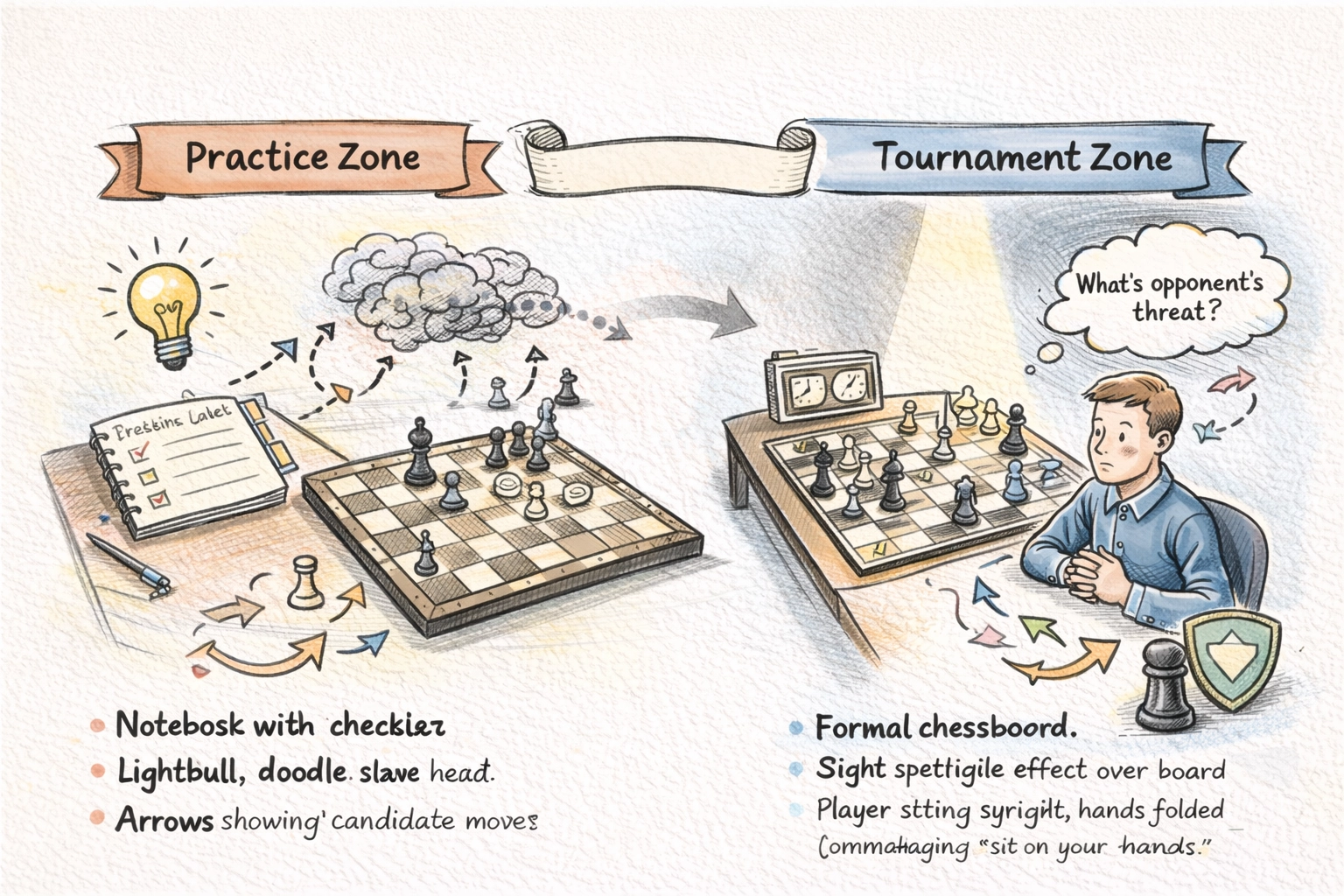
It is very common for players to revert back to their old, lazy thinking habits when they get nervous in a real game. You have to fight against this instinct. Trust the process. Even if applying the new thought process makes you play a little slower at first, it is worth it for the long-term improvement.
Staying focused and evaluating positions properly
Chess requires deep concentration. Distractions are the enemy of calculation and planning. During your opponent's turn, try to keep your eyes on the board. Look at the pawn structure. Try to anticipate what their plan might be.
Regularly evaluate the position using a structured method. Mentally check the material balance, the safety of both kings, the activity of the pieces, and the pawn structure. Doing this every few moves acts like a compass, keeping your strategic plans pointing in the right direction.
Conclusion: becoming a better thinker with Enthuziastic
Mastering thinking in chess is a lifelong journey. There is always a deeper variation to calculate, a more subtle plan to discover, and a clearer way to evaluate a position. By understanding the difference between intuition, calculation, and planning, and by actively building good mental habits, you will slowly but surely transform the way you play the game.
Remember to take your time, respect your opponent's ideas, and never play hope chess. Whether you are attacking fiercely or defending stubbornly, let logic and clear thinking be your guide.
We hope this guide helps you on your path to chess mastery. Keep learning, keep practicing, and we will see you in the next session at Enthuziastic, your global people-to-people live learning network!
Frequently asked questions (FAQs)
1. How can I stop blundering my pieces so often?
The most effective way to stop blundering is to build a habit of pausing before every move. Ask yourself, "What is my opponent's threat?" and "Are any of my pieces completely unprotected?" Doing a quick safety check of the board before touching your piece will drastically reduce simple errors.
2. I struggle to calculate more than two moves ahead. How can I improve?
Start by forcing yourself to calculate variations to the very end when doing tactical puzzles, rather than just guessing the first move. Practice with forcing moves first (checks, captures, threats), as these are easier to calculate since the opponent's replies are limited. Over time, your brain's ability to hold the board image will improve.
3. What is a candidate move and why is it important?
A candidate move is a potential move that you select for deeper calculation after scanning the board. It is important because it prevents "first move bias." By forcing yourself to find 2 to 3 candidate moves before calculating deeply, you ensure you do not miss hidden tactical or strategic ideas.
4. How do I come up with a plan when nothing seems to be happening on the board?
When the position is quiet and there are no immediate tactics, look at the pawn structure and piece activity. A good plan can be as simple as finding your worst-placed piece and maneuvering it to a more active square, or preparing a pawn push to gain space on a side of the board where you have an advantage.
5. How should I manage my time during a chess game?
Allocate your time based on the complexity of the position. Do not spend twenty minutes deciding on a standard opening move, but do invest significant time during "key moments" when the tension is high and a critical decision needs to be made. Always keep an eye on the clock to avoid extreme time trouble.
6. What should I do if I am completely lost in a game?
First, take a deep breath and avoid making a quick, frustrated move. Accept the reality of the position. Look for ways to complicate the game for your opponent. Play solidly, try to create practical problems, and wait for them to make a mistake while trying to convert their advantage.
7. Is it better to study strategy or tactics to improve my thinking?
Both are absolutely essential, but if you are a beginner or intermediate player, studying tactics will yield the fastest results. Tactics win material and end games quickly. Once your tactical vision is reliable, studying strategy will help you build positions where those tactical opportunities naturally appear.
8. How do I stop playing "hope chess"?
To stop playing hope chess, you must change your mindset from hoping your opponent plays poorly to assuming they will play perfectly. Always evaluate your intended move against your opponent's absolute best defense. If your move fails against their best defense, do not play it.
Comments