
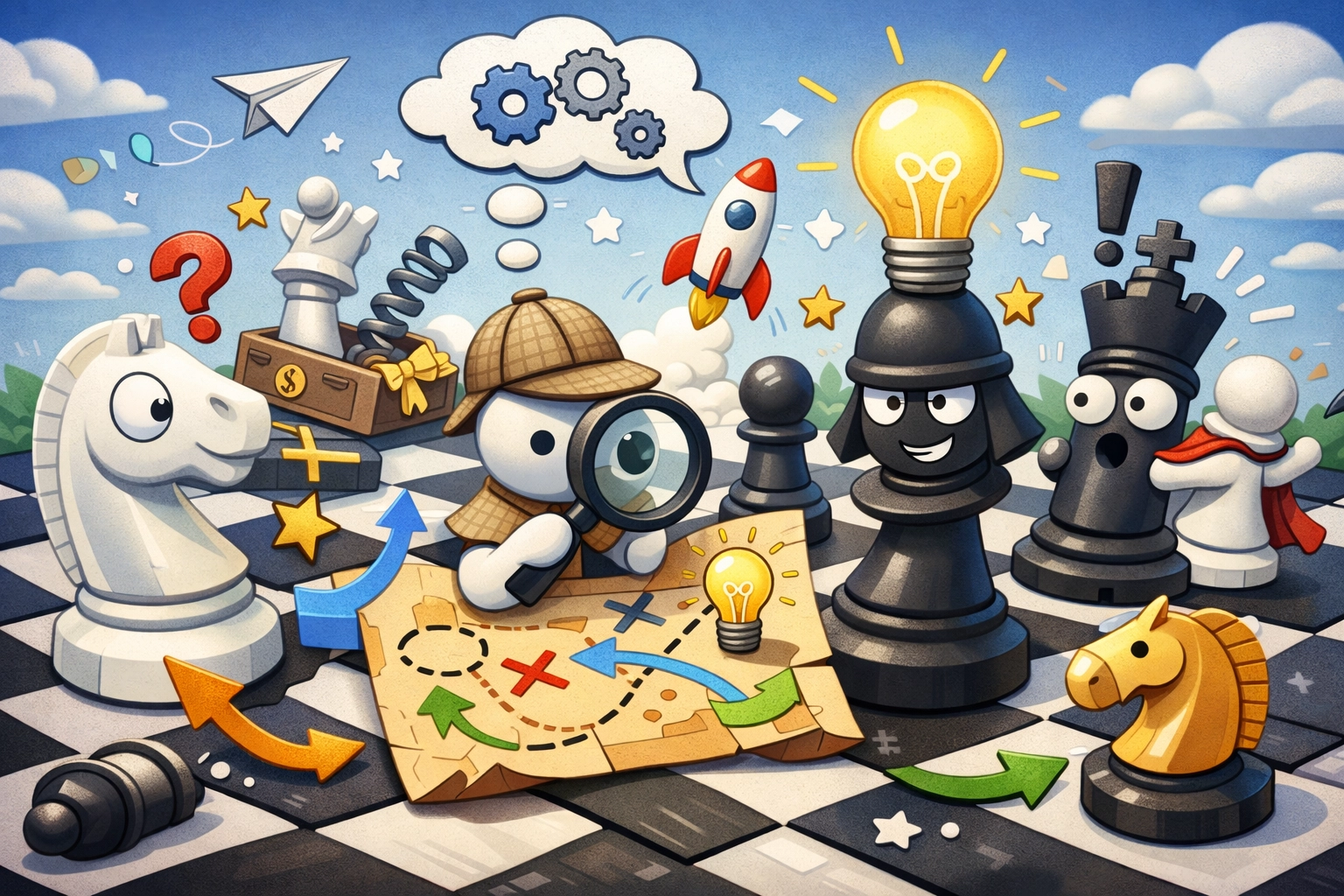
Welcome to Enthuziastic, your global people-to-people live learning network. Today, we are going to talk about a very fascinating topic that every chess player thinks about but very few actually master. We are talking about unexpected moves in chess.
If you have been playing chess for some time, you already know that the game is largely based on logic, rules, and established principles. We are taught to control the centre, develop our pieces, castle early, and look for obvious weaknesses in the opponent's camp. These are excellent guidelines. However, if you strictly follow only the obvious moves, you become a predictable player. Your opponents can easily guess your plans. To truly grow as a player and win tough games, you need to learn creative chess thinking. You must learn how to surprise your opponent by playing moves that look impossible or unsafe at first glance, but are actually very powerful.
In this comprehensive guide, we will explore everything you need to know about unexpected moves in chess. We will look at why we miss them, how to find them, and how they can completely change the result of a game. Let us dive deep into the world of hidden tactics in chess.
- Introduction to unexpected moves in chess
- Why unexpected moves are powerful
- The concept of challenging assumptions
- Common thinking patterns that limit decision making
- Why players ignore moves that seem unsafe at first glance
- Attacking the strongest squares
- Understanding why heavily defended squares can still be targeted
- How this idea creates imbalance and confusion
- Calculation and verification of unexpected ideas
- Why deep calculation is necessary before playing such moves
- How to evaluate whether a surprising move actually works
- Pattern recognition and experience
- How exposure to similar ideas helps players spot unexpected moves
- Learning through master games and tactical examples
- Examples of unexpected moves in practice
- Pawn breaks, sacrifices, and dynamic piece play
- Situations where a single surprising move changes the evaluation completely
- Psychological impact of unexpected moves
- How opponents react when faced with unfamiliar ideas
- Using surprise as a practical weapon in tournaments
- Common mistakes when trying to be creative
- Playing random moves without calculation
- Confusing creativity with unsound play
- Training methods to improve creative thinking
- Solving challenging puzzles
- Analysing games with surprising ideas
- Practising deeper calculation and visualization
- Frequently asked questions (FAQs)
Introduction to unexpected moves in chess
When we sit down at the chessboard, our mind naturally looks for familiar patterns. We look at the board and our brain automatically suggests candidate moves based on what we have seen before. For example, if a piece is attacked, our first instinct is to move it away or defend it. If there is an open file, we think about placing our rook there. This is how normal human thinking works.
But what exactly is an unexpected move? An unexpected move is a move that completely ignores these standard guidelines. It is a move that breaks the natural flow of the game and forces everyone to stop and wonder, "Wait, is that even allowed?" or "Did they just blunder?"
Many players often miss strong moves because of their assumptions. We assume that certain squares are off-limits because they are heavily guarded. We assume that a pinned piece cannot be useful. We assume that sacrificing our queen for positional compensation is only for grandmasters. Because of these strong assumptions, we do not even bother to calculate the unexpected moves.
The main difference between obvious moves and creative moves is the depth of thought behind them. Obvious moves are reactive; they respond to the immediate situation using basic rules. Creative moves are proactive; they dig deeper into the position to find hidden resources. At Enthuziastic, we believe that anyone can develop this kind of creative chess thinking if they are willing to step outside their comfort zone and question their own assumptions.
Why unexpected moves are powerful
You might be wondering why you should spend so much energy trying to find unusual ideas when standard moves work reasonably well. The answer lies in the psychological and practical nature of competitive chess.
When you play an unexpected move, you immediately create immense psychological pressure on your opponent. Chess is not just a battle of pieces on a wooden board; it is a battle of human minds. When your opponent sees a move they did not anticipate, their confidence takes a hit. They start doubting their own evaluation of the position. They wonder if they have missed a hidden trap. This sudden shock often leads to panic, causing them to burn precious time on the clock trying to figure out what is going on.
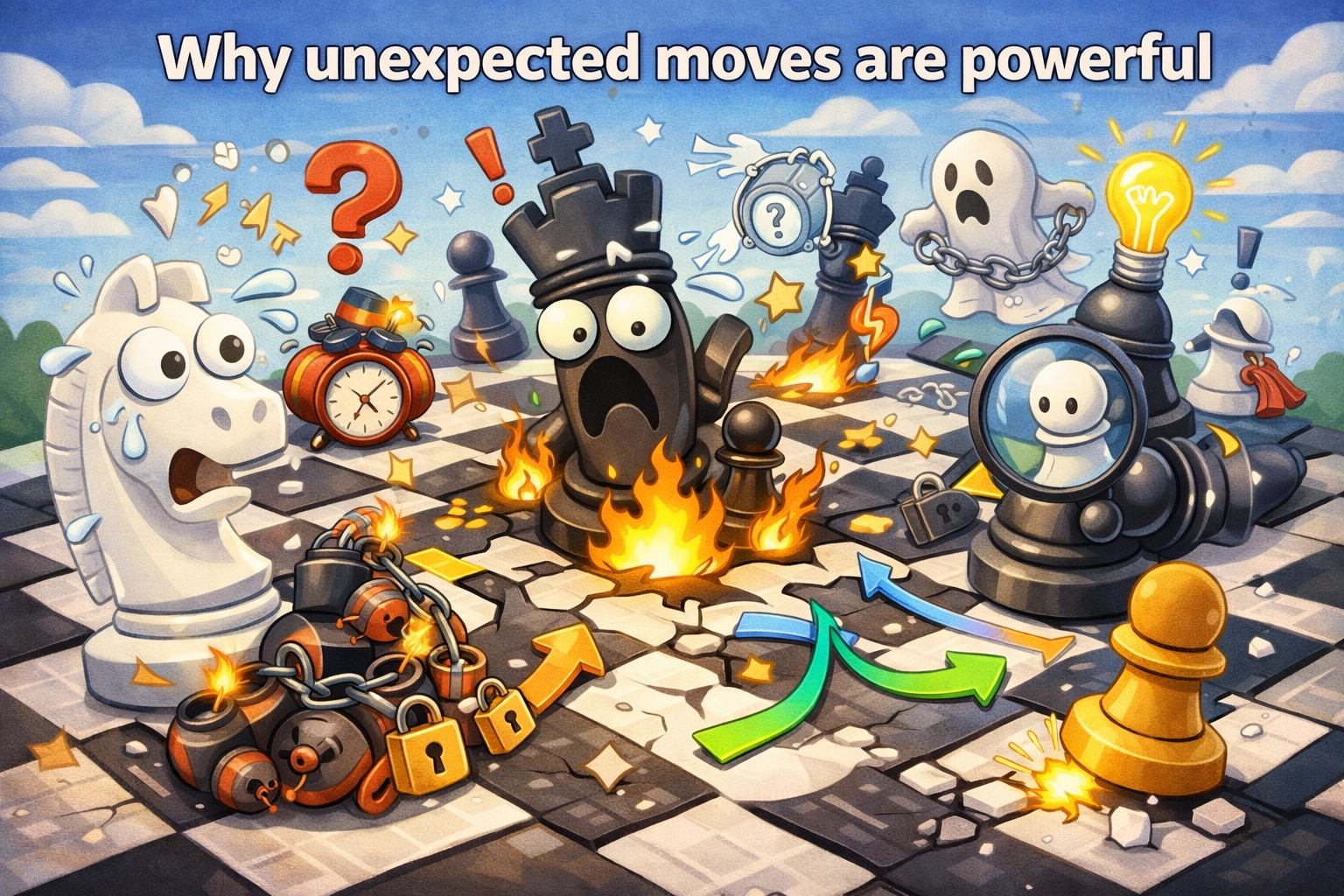
Furthermore, unusual ideas often lead to tactical breakthroughs that standard moves simply cannot achieve. In a very closed and balanced position, playing standard moves will only lead to a draw. Nobody makes a mistake, but nobody makes progress either. To break this balance, you need to inject chaos. An unexpected pawn break or a strange piece maneuver can suddenly open up lines that were previously closed. It forces the opponent out of their prepared plans and takes them into deep, uncharted waters where they have to think for themselves.
The concept of challenging assumptions
To find hidden tactics in chess, you must first understand the mental barriers that stop you from seeing them. Human beings rely on heuristics, which are mental shortcuts, to make decisions quickly. In chess, these shortcuts are our opening theories and middle-game principles. While they are very helpful, they also create blind spots.
Common thinking patterns that limit decision making
One of the most common limiting patterns is the idea of "material over everything". If we see a sequence where we lose a piece, we immediately stop calculating that line. We assume it is a bad line. But what if losing that piece leads to a forced mate five moves later? By cutting our calculation short, we miss a brilliant opportunity.
Another limiting pattern is believing that our own king must always be perfectly shielded behind three pawns. While king safety is important, there are situations where the king itself can become an active attacking piece, especially in the endgame, or where pushing the pawns in front of the king can launch a devastating attack. If you always assume that pushing the h-pawn or g-pawn will weaken your king too much, you will miss out on very aggressive attacking ideas.
Why players ignore moves that seem unsafe at first glance
We ignore unsafe-looking moves because of the fear of losing. When we are playing a serious game, we want to feel in control. A move that looks unsafe brings uncertainty. It makes us feel vulnerable. So, our brain naturally rejects it and looks for a safer, more solid option.
However, chess is a game of concrete variations, not just general feelings. A move is only unsafe if the opponent has a concrete way to punish it. If they do not have a way to punish it, then the move is actually completely sound, no matter how crazy it looks. Learning how to find strong moves requires you to silence that voice of fear in your head and rely purely on your chess calculation skills.
Attacking the strongest squares
One of the most fascinating concepts in creative chess thinking is the idea of attacking the opponent's strongest point. Most chess books teach you to look for weaknesses. They tell you to attack backward pawns, isolated pawns, or squares that cannot be defended. This is very good advice for beginners.
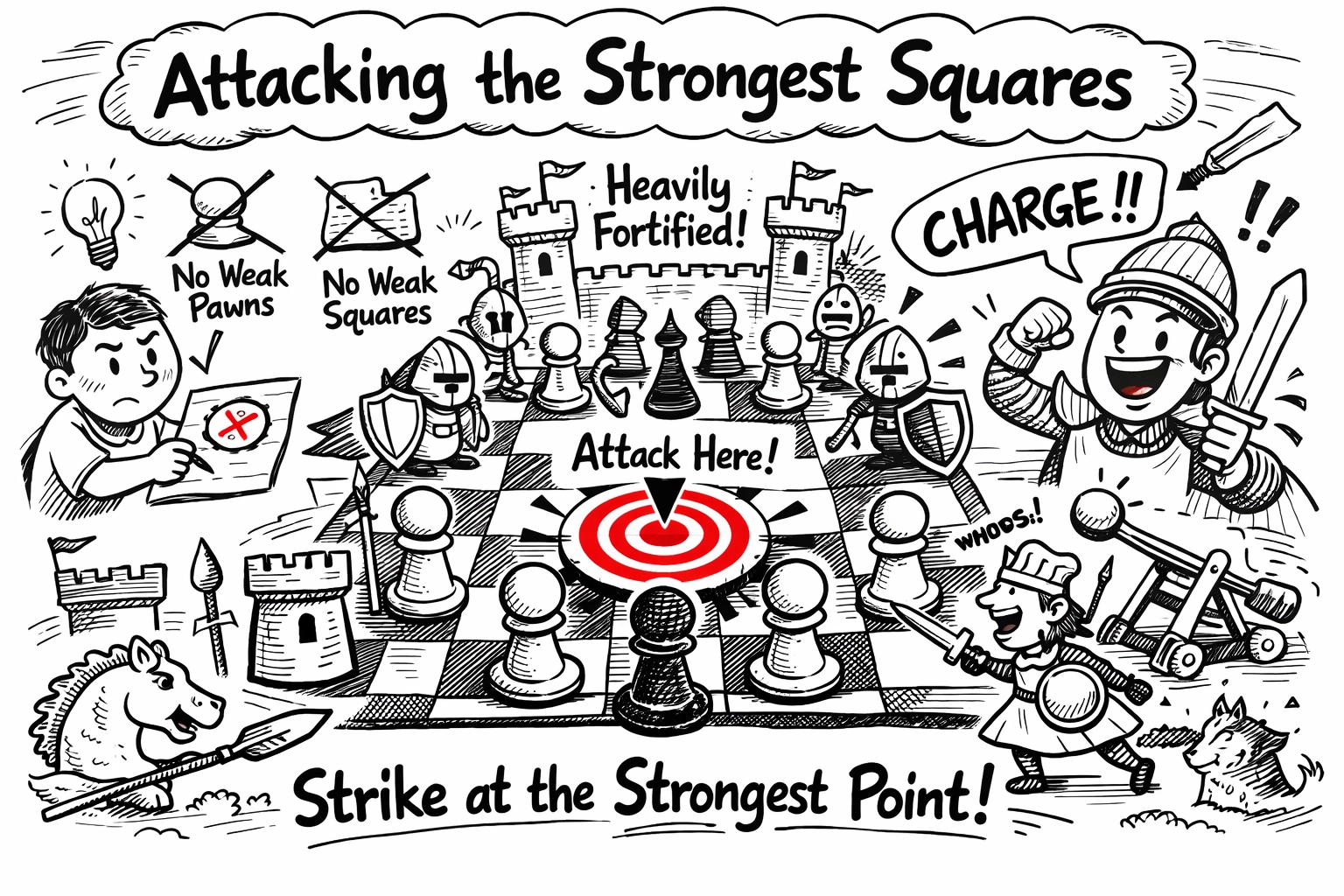
But what if you do the exact opposite? What if you launch an attack directly at the square that your opponent has defended the most?
Understanding why heavily defended squares can still be targeted
This sounds counter-intuitive, right? Why would you attack a fortress? The reason is that when a square is heavily defended, the opponent feels a false sense of security about it. They believe that area of the board is locked down.
When you strike at their strongest point, you are basically saying, "Your defense is an illusion." Sometimes, a heavily defended square is the structural glue holding their entire position together. If you can break that specific point, their whole position might collapse like a house of cards. For example, if they have a central pawn chain heavily guarded by knights and bishops, sacrificing a piece to destroy the base of that pawn chain can suddenly leave all their defending pieces awkwardly placed and lacking coordination.
How this idea creates imbalance and confusion
Targeting the strongest square automatically creates massive imbalance. It usually requires a sacrifice, such as giving up a rook for a minor piece (an exchange sacrifice) or giving up a whole piece for a couple of pawns. This changes the material balance of the game.
Imbalance is the breeding ground for unexpected moves in chess. When the material is unequal but the position is dynamic, standard evaluations no longer work. The opponent cannot just trade pieces to simplify the game. They have to constantly worry about the specific dynamic compensation you have gained. This confusion often leads to blunders, allowing your hidden winning ideas to come to life.
Calculation and verification of unexpected ideas
Creativity in chess is not about playing crazy moves just for fun. It is about playing moves that are objectively good but hard to see. To do this, you need exceptionally strong chess calculation skills.
Why deep calculation is necessary before playing such moves
When you play a standard developing move, you do not always need to calculate ten moves deep. You know it improves your position. But when you play an unexpected move, especially one that breaks rules or sacrifices material, you are burning your bridges. There is no turning back. If your idea is flawed, you will likely lose the game immediately.
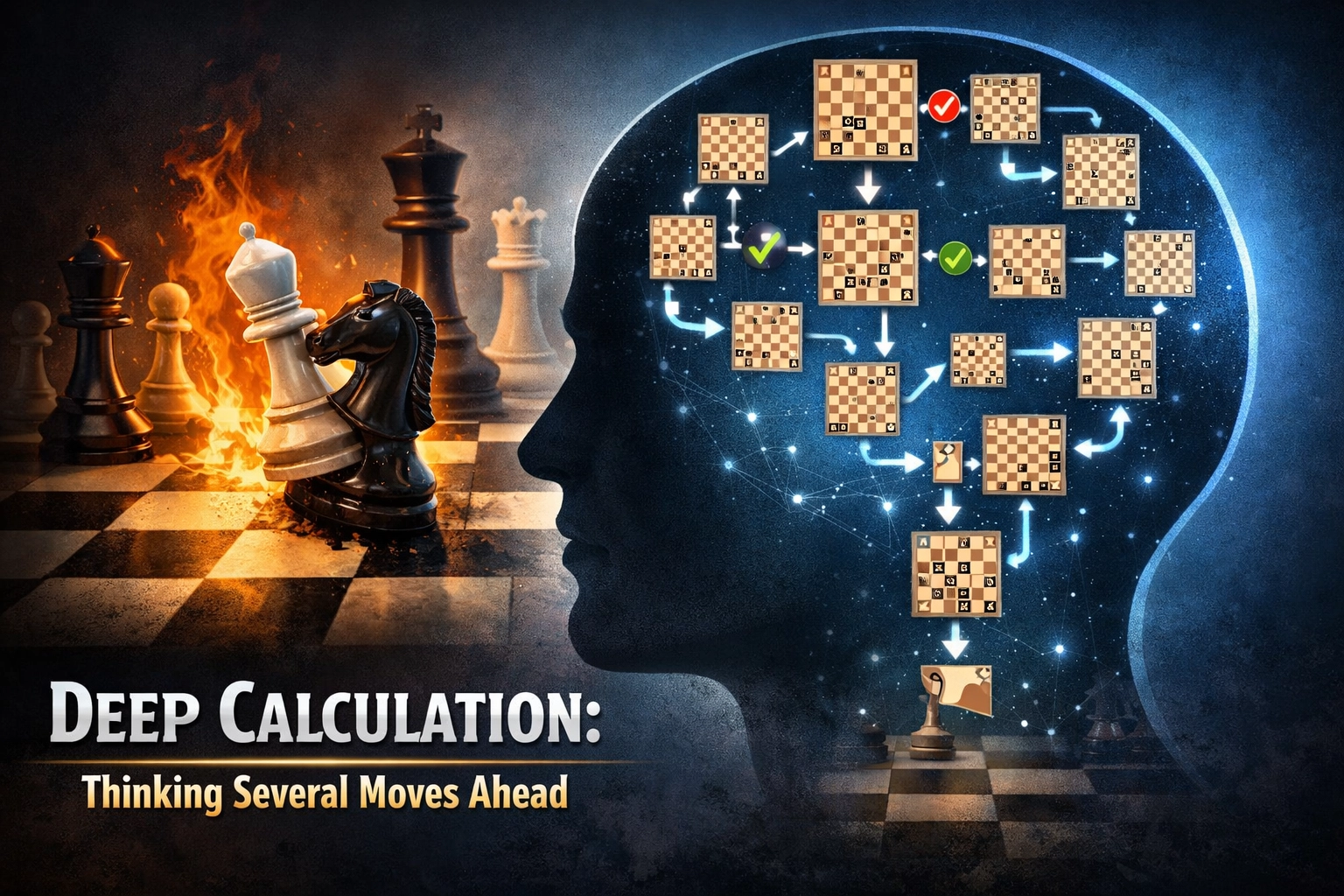
Therefore, deep calculation is absolutely necessary. You have to force yourself to look further down the line than you normally would. You must calculate every single forced reply your opponent has. If you give a check, capture a piece, or make a direct threat, what are their options? You must calculate all of them to the very end until you reach a quiet position that you can evaluate clearly.
How to evaluate whether a surprising move actually works
It is one thing to calculate variations; it is another to evaluate the final position accurately. After calculating a surprising move, ask yourself a few critical questions:
Does this move improve my piece activity significantly?
Does it ruin the opponent's pawn structure permanently?
Does it expose their king to a decisive attack?
Do I have enough compensation for any material I might be giving up?
If the answer to these questions is yes, then your surprising move is likely very strong. You must trust your calculation. At Enthuziastic, we always encourage learners to trust their analytical work. If the variations say the move wins, play it, even if it looks terrifying.
Pattern recognition and experience
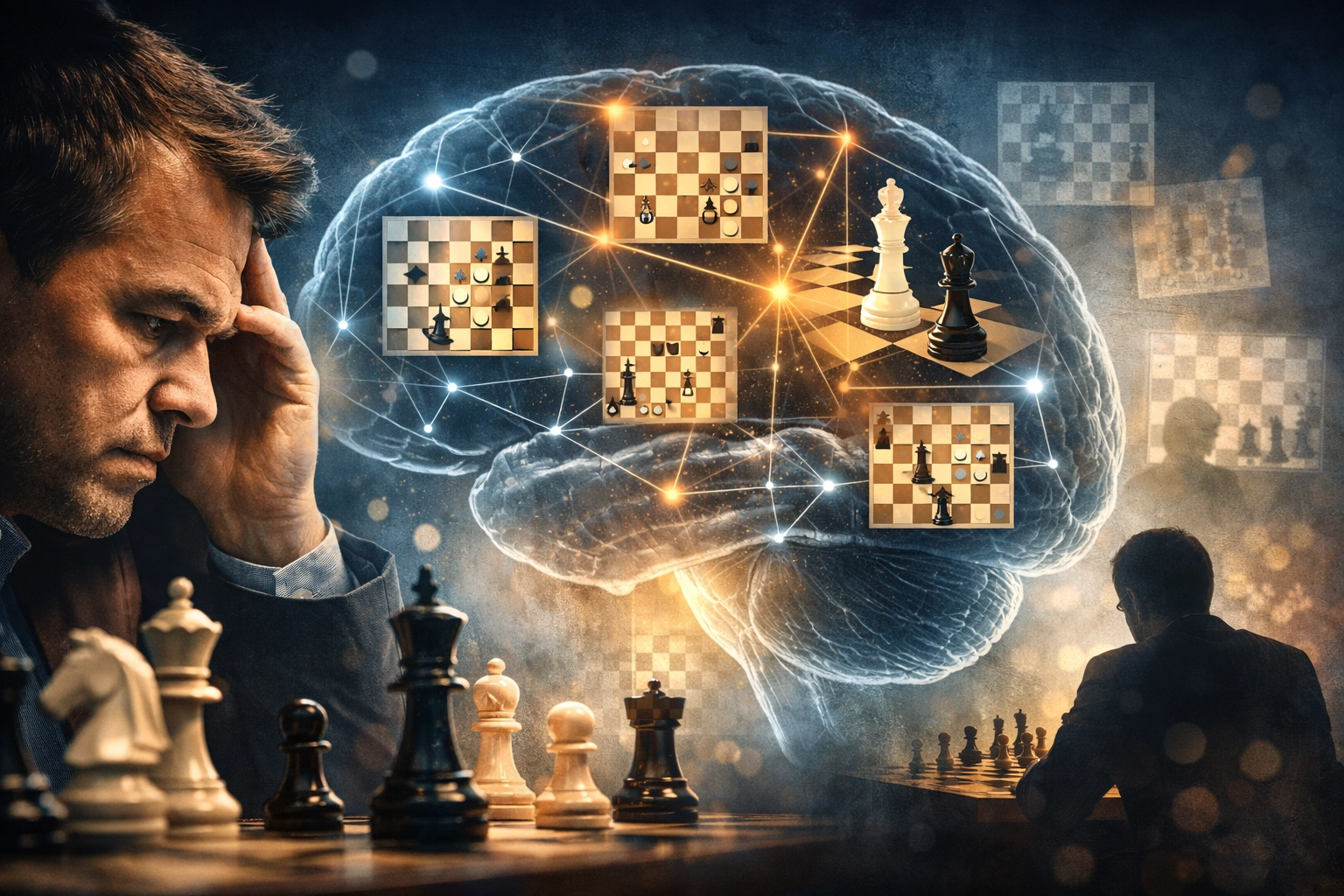
While calculating everything from scratch is important, even the best grandmasters rely heavily on pattern recognition. Our brain is incredibly good at storing images and recalling them when similar situations arise.
How exposure to similar ideas helps players spot unexpected moves
Creative chess thinking is actually a result of massive exposure to different chess ideas. When a master plays an "unexpected" move, it is often unexpected only to the amateur. To the master, it is a pattern they have seen before in a different context.
By studying thousands of tactical puzzles and master games, you build a mental library of hidden tactics in chess. You learn the geometry of the chessboard. You start realizing that a bishop on g2 can surprisingly control the a8 square, or that a knight on f5 can deliver a smother mate if the opponent's pawns are pushed too far. When you sit at the board, your brain automatically matches the current position with the patterns stored in your memory, suddenly highlighting moves that seem totally out of nowhere.
Learning through master games and tactical examples
One of the best ways to build this mental library is by studying the games of highly creative players. Think of legendary players like Mikhail Tal, Garry Kasparov, or modern geniuses like Daniil Dubov and Richard Rapport. These players are famous for their unexpected moves in chess.
When you replay their games, do not just casually click through the moves. Stop at critical moments and try to guess the move. When they play something that surprises you, spend time understanding why they played it. What did they see that you missed? How did they break the assumptions of the position? This active learning is exactly how you improve your ability to find strong moves in your own games.
Examples of unexpected moves in practice
Let us try to visualize some common scenarios where unexpected ideas take centre stage. While we cannot put a physical chessboard here, imagine these situations in your mind's eye.
Pawn breaks, sacrifices, and dynamic piece play
Imagine a completely locked center where the pawns are jammed together. Neither side can move through the middle. The standard approach is to try and play on the flanks (sides) of the board. But a creative player might look at that locked center and suddenly sacrifice a knight for two central pawns. This unexpected move instantly destroys the pawn chain, opens up lines for their bishops, and creates a massive passed pawn. The opponent, who felt completely safe in the center, is suddenly facing a dangerous attack.
Another classic example is the "quiet move" in the middle of a tactical sequence. Normally, when there is a series of captures and checks, we expect the opponent to immediately recapture a piece. But sometimes, the strongest move is to ignore the capture and simply make a quiet positional move that creates an unstoppable threat. These quiet moves are incredibly hard to see because our brain is hyper-focused on the loud captures.
Situations where a single surprising move changes the evaluation completely
Sometimes, an unexpected move does not win the game immediately, but it changes the whole evaluation of the position. Suppose you are defending a very difficult endgame. You are a pawn down and struggling to survive. Suddenly, instead of passively defending, you sacrifice your last rook for a minor piece just to reach a specific drawn endgame fortress. The opponent, expecting a long, grinding victory, is suddenly forced to accept a draw because they cannot break your fortress. One surprising decision completely saved a lost game.
Psychological impact of unexpected moves
We briefly touched upon this earlier, but the psychological aspect of chess cannot be overstated. We are not playing against computers; we are playing against human beings with emotions, nerves, and fatigue.
How opponents react when faced with unfamiliar ideas
When you play a standard opening variation, your opponent is comfortable. They have studied this at home, perhaps with a cup of coffee. They know the plans. But when you unleash an unexpected move, you rip them out of their comfort zone.
The immediate reaction is usually confusion, followed by suspicion. "Why did they do that? Am I falling into a trap?" This internal dialogue consumes their mental energy. They might spend twenty minutes on the clock verifying a move that you already know is sound. Even if they find the correct response, they will be playing the rest of the game with less time and more anxiety.
Using surprise as a practical weapon in tournaments
In practical tournament play, surprise is a massive weapon. If you are playing against someone who is technically superior to you, trying to outplay them in a standard, dry position is very difficult. They will just slowly grind you down.
Instead, you need to muddy the waters. You need to create imbalances and play unexpected moves that force them to think deeply early in the game. By doing this, you drag them into a street fight where calculation and creativity matter more than memorised knowledge. This levels the playing field and gives you a much higher chance of scoring an upset victory.
Common mistakes when trying to be creative
While we highly encourage creative chess thinking, we must also warn you about the dark side of it. Many players misunderstand what it means to be creative and end up ruining their games.
Playing random moves without calculation
The biggest mistake is confusing creativity with randomness. Moving your pieces to weird squares just to "surprise" your opponent is not creative; it is simply bad chess. An unexpected move must always have a concrete, logical foundation. It must be backed by solid chess calculation skills. If you play a shocking move hoping your opponent will get confused, but the move actually loses a piece by force, you are playing "hope chess". Hope is a very bad strategy on the chessboard.
Confusing creativity with unsound play
Similarly, some players love to sacrifice pieces just for the thrill of the attack. They give up a knight and say, "I have attacking compensation," but when you analyze it, the attack leads nowhere. True hidden tactics in chess are objectively strong. They might look crazy, but the engine evaluation usually approves of them. Before you play a creative idea, you must be brutally honest with yourself: does this actually work, or do I just want to look cool?
Training methods to improve creative thinking
So, how do we actually learn how to find strong moves that are hidden beneath the surface? Like any other skill, it requires structured training. Here at Enthuziastic, we recommend a few specific methods to boost your chess creativity.
Solving challenging puzzles
Regular puzzle solving is good, but to improve creativity, you need to solve challenging puzzles. Do not just solve puzzles where the first move is an obvious queen sacrifice that leads to a forced mate. Seek out endgame studies or compositions where the solution requires a very quiet, completely unexpected maneuver. Websites and books dedicated to "hard chess puzzles" will force your brain to look beyond the obvious.
Analysing games with surprising ideas
Make it a habit to study the classic games of attacking players. When you review these games, cover up the moves and try to guess what the master played. Whenever you are wrong, and the master played something unexpected, pause and analyze. Try to reverse-engineer their thought process. Ask yourself, "What assumption did I make that stopped me from seeing this move?"
Practising deeper calculation and visualization
Finally, you must train your calculation muscles. Set up a complex position on a real board. Do not move the pieces. Try to calculate the variations entirely in your head, going as deep as you possibly can. Write down your variations on a piece of paper. Then, check your analysis with a computer engine. This exercise will vastly improve your visualization skills, allowing you to clearly see the outcome of unexpected moves before you play them on the board.
In conclusion, learning how to find hidden winning ideas is a journey of breaking your own mental habits. It requires courage to step away from the standard rules and the diligence to calculate deeply. By practicing pattern recognition, challenging your assumptions, and studying the masters, you can bring a fresh, creative spark to your games. We hope this guide helps you on your path to mastering unexpected moves in chess. Keep learning, keep playing, and keep surprising your opponents!
Frequently asked questions (FAQs)
1. What exactly are unexpected moves in chess? Unexpected moves in chess are decisions made on the board that break typical standard principles, opening theories, or obvious assumptions. They are moves that surprise the opponent, often looking impossible or unsafe at first, but carrying a deep tactical or positional purpose.
2. How can I improve my creative chess thinking? You can improve your creative chess thinking by regularly solving complex tactics, studying endgame compositions, and analysing the games of imaginative players like Mikhail Tal or Richard Rapport. It is also important to consciously question your own assumptions during a game instead of always playing the most obvious move.
3. Are unexpected moves always sacrifices? No, not always. While many surprising moves involve sacrificing material to open lines or create imbalances, an unexpected move can also be a very quiet positional maneuver, a strange king walk, or ignoring an opponent's threat entirely to create a stronger threat of your own.
4. Why is deep calculation so important for hidden tactics in chess? Hidden tactics usually involve high-risk decisions. Because they break normal rules, playing them without calculating properly can lead to immediate disaster. Deep calculation is required to verify that the surprising idea is objectively sound and actually works against the best defense.
5. Is it a good idea to play unexpected moves against stronger opponents? Yes, it can be an excellent practical strategy. Stronger players often rely on standard, predictable positions where they can slowly outplay you. By introducing unexpected moves, you create chaos and force them to solve complex problems over the board, which increases their chances of making a mistake.
6. What is the difference between an unexpected move and a blunder? A blunder is a mistake that objectively worsens your position and loses material or the game without any compensation. An unexpected move, while perhaps looking strange, is backed by concrete calculation and hidden ideas that actually improve your position or give you a decisive advantage.
7. How do I stop playing "hope chess" when trying to be creative? To stop playing hope chess, you must demand proof from yourself before making a move. Do not play a move just hoping the opponent gets confused. You must calculate their absolute best replies, and if your move still works against their best defense, only then should you play it.
8. Can beginners learn how to find strong moves that are unexpected? Absolutely! While beginners should first focus on mastering basic principles, introducing creative thinking early on helps build a flexible chess mind. Beginners can start by solving simple tactical puzzles that involve surprising checkmates or basic deflections, gradually moving on to more complex hidden tactics.

Comments